
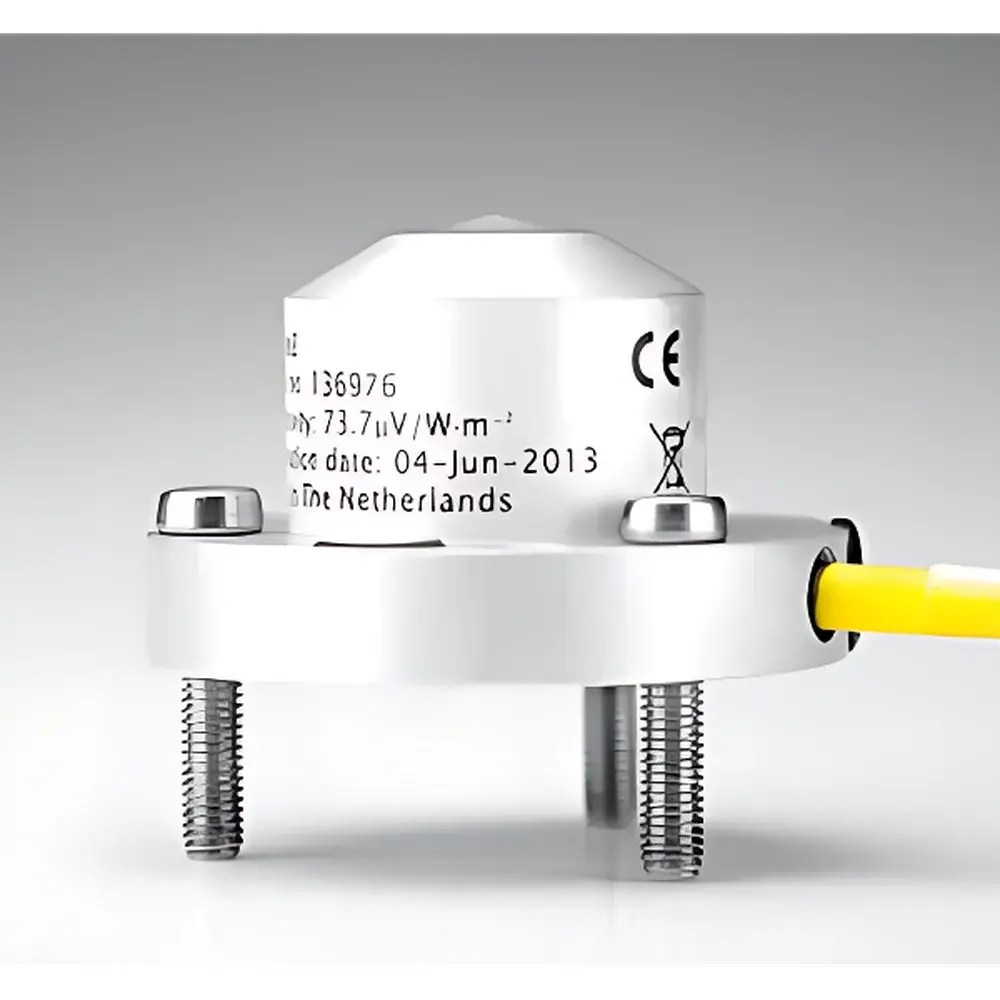
Kipp & Zonen SP Lite2 Pyranometer
| Brand | Kipp & Zonen |
|---|---|
| Origin | Netherlands |
| Model | SP Lite2 |
| Spectral Range | 400–1100 nm |
| Sensitivity | 60–100 µV/W·m⁻² |
| Response Time (95%) | < 500 ns |
| Directional Error (up to 80°, 1000 W/m² beam) | < 10 W/m² |
| Temperature Response | < −0.15 %/°C |
| Operating Temperature Range | −40 °C to +80 °C |
| Maximum Irradiance | 2000 W/m² |
| Field of View | 180° |
| Output | Analog voltage (mV), proportional to irradiance |
| Calibration Certificate | Traceable to WRR (World Radiometric Reference) |
| Cable | Integrated high-quality yellow cable (5 m standard) |
| Mounting | Integrated leveling bubble and adjustment screws |
Overview
The Kipp & Zonen SP Lite2 Pyranometer is a compact, thermally compensated silicon photodiode-based instrument engineered for reliable, cost-effective measurement of global solar irradiance under diverse environmental conditions. It operates on the principle of spectral responsivity matched to the photosynthetically active radiation (PAR) and near-infrared (NIR) portion of the solar spectrum—specifically 400–1100 nm—making it well-suited for applications where spectral fidelity within this band is sufficient and thermal stability is prioritized over absolute thermopile-level accuracy. Unlike thermopile pyranometers, the SP Lite2 leverages a calibrated silicon photodiode with a precision cosine-corrected diffuser to ensure angular response adherence to Lambert’s cosine law, minimizing directional error even at high zenith angles (≤80°). Its sub-microsecond electrical response (<500 ns to 95%) enables detection of rapid irradiance transients—valuable in cloud-edge studies or PV system dynamic performance evaluation. Designed for long-term unattended operation, the SP Lite2 features a robust anodized aluminum housing, hermetically sealed optics, and integrated leveling instrumentation, supporting deployment in remote field stations, agricultural networks, educational laboratories, and distributed solar monitoring arrays.
Key Features
- High-stability silicon photodiode sensor with factory calibration traceable to the World Radiometric Reference (WRR) via Kipp & Zonen’s ISO/IEC 17025-accredited calibration laboratory
- Cosine-corrected optical diffuser ensuring directional response error <10 W/m² up to 80° solar zenith angle at 1000 W/m² irradiance
- Integrated bubble level and fine-adjustment screws for precise horizontal alignment without external tools
- M6 threaded mounting interface compatible with standard meteorological booms, tilt mounts, and dual-pyranometer albedometer configurations
- Low-temperature coefficient (<−0.15 %/°C) and extended operating range (−40 °C to +80 °C) enabling year-round use across continental and arid climates
- 5-meter integrated yellow PVC cable with shielded twisted-pair construction, optimized for low-noise analog signal transmission to data loggers or PLCs
- No external power required—passive voltage output (typically 0–25 mV at 1000 W/m²) linearly proportional to irradiance (W/m²)
Sample Compatibility & Compliance
The SP Lite2 is intended for outdoor measurement of broadband global horizontal irradiance (GHI) on flat, unshaded surfaces. It complies with the functional classification of “Class C” instruments per ISO 9060:2018 (formerly secondary standard), indicating suitability for routine monitoring rather than reference-grade calibration. While not certified to ISO 9060:2018 Class A or B specifications, its performance characteristics—including directional, temperature, and non-linearity errors—are rigorously characterized and documented in the included calibration report. The device meets IEC 61724-1:2021 requirements for PV system monitoring when deployed as part of a validated solar resource assessment chain. Its materials and sealing conform to IP67 ingress protection, ensuring operational integrity during rain, snow, dust exposure, and freeze-thaw cycling. No user recalibration is supported; periodic verification against a reference pyranometer or lamp-based calibrator is recommended every 2 years per GLP-aligned maintenance protocols.
Software & Data Management
The SP Lite2 delivers analog DC voltage output, requiring no embedded firmware or communication protocol. Integration is achieved via standard analog input channels on third-party data acquisition systems—including Campbell Scientific CR series, Onset HOBO, Delta-T Devices DL2e, and industrial SCADA platforms. Voltage-to-irradiance conversion follows the linear equation: E = V / K, where E is irradiance (W/m²), V is measured voltage (mV), and K is the instrument-specific calibration constant (µV/W·m⁻²) provided on the certificate. For automated scaling and metadata tagging, users may configure input scaling tables in logger software (e.g., LoggerNet, BoxCar Pro, or custom Python/Node-RED pipelines). While the SP Lite2 itself does not support digital protocols (RS-485, SDI-12, Modbus), it is routinely deployed alongside Kipp & Zonen’s UVR, CMP, or SMP series sensors in mixed-sensor networks managed through the Kipp & Zonen MeteoLink or third-party IoT edge gateways. Audit trails, calibration history, and uncertainty budgets are maintained externally in accordance with ISO/IEC 17025 and FDA 21 CFR Part 11-compliant data management systems when used in regulated environmental or agronomic research.
Applications
- Photovoltaic (PV) plant performance ratio (PR) monitoring and yield forecasting
- Agricultural evapotranspiration (ET₀) modeling using FAO-56 Penman-Monteith and related energy-balance methods
- Surface albedo derivation via paired upward/downward SP Lite2 units in fixed or rotating mounts
- Atmospheric science education: solar geometry, cloud cover classification, and diurnal irradiance profiling
- Air quality modeling inputs for dispersion simulations (e.g., CALPUFF, AERMOD) requiring ground-level shortwave flux estimates
- Building energy simulation validation and daylight harvesting control system commissioning
FAQ
Is the SP Lite2 suitable for bankable solar resource assessments?
No. For project financing or P50/P90 energy yield modeling, IEC 61724-1:2021 recommends Class A or B thermopile pyranometers (e.g., CMP series). The SP Lite2 serves best in operational monitoring, educational, or secondary-tier validation contexts.
Can the SP Lite2 be used indoors or under artificial lighting?
Only if the light source’s spectral distribution closely matches natural sunlight within 400–1100 nm. Broadband halogen or full-spectrum LED sources may yield acceptable results; fluorescent or narrow-band LEDs will introduce significant spectral mismatch error.
Does the SP Lite2 require desiccant or regular window cleaning?
The sealed optical assembly eliminates desiccant requirements. However, periodic inspection and gentle cleaning of the diffuser surface with lens-grade tissue and isopropyl alcohol are recommended—especially after dust, pollen, or bird droppings accumulate.
What is the typical measurement uncertainty over one year?
Under stable mounting and routine maintenance, expanded uncertainty (k=2) is ±3–5 % for daily totals, dominated by cosine and temperature response drift—not inherent sensor noise.
Can two SP Lite2 units be mounted back-to-back for albedo without additional hardware?
Yes. Using the integrated M6 threads and supplied stainless steel bolts, users can mechanically couple two units with opposing orientations. A rigid mounting pole and leveling base are required to maintain parallelism and minimize shadowing artifacts.
Related Products







