
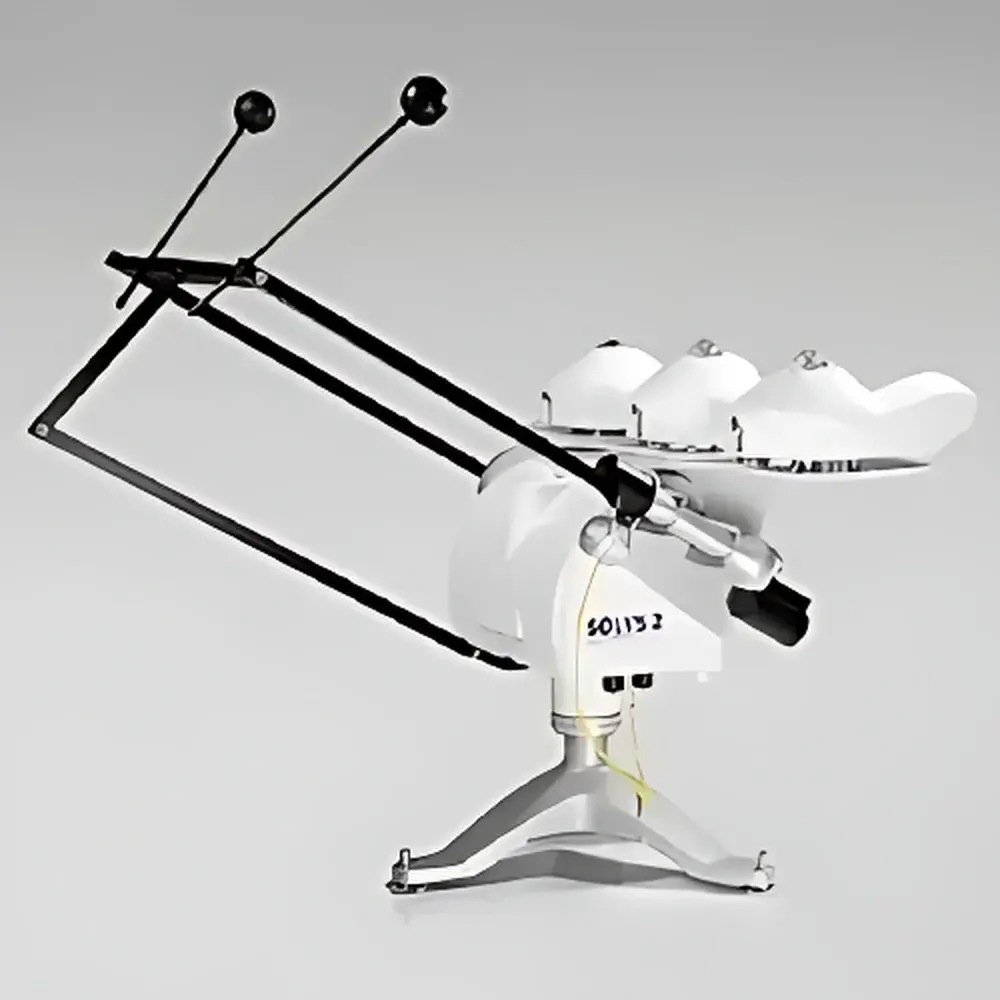
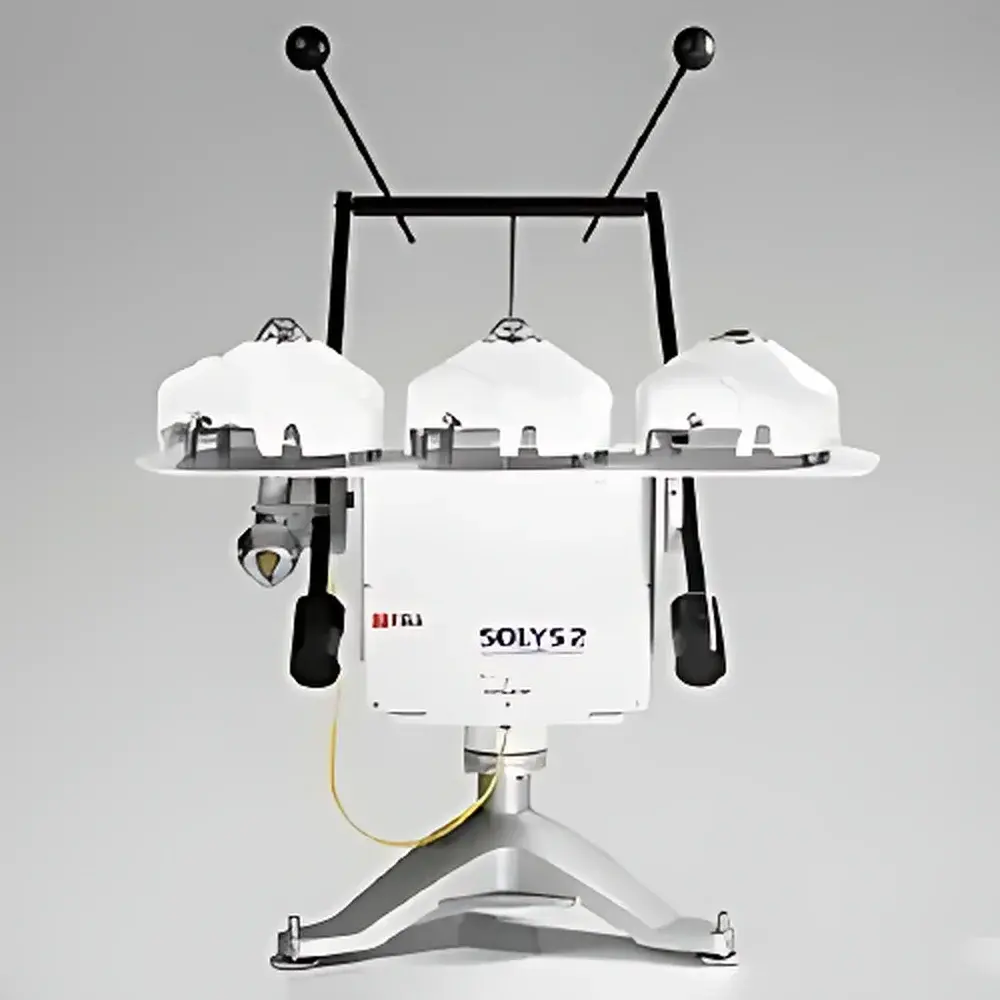
Kipp&Zonen Solys2 Dual-Axis Solar Tracker
| Brand | Kipp&Zonen |
|---|---|
| Origin | Imported |
| Manufacturer Type | Authorized Distributor |
| Model | Solys2 |
| Power Input | 24 VDC or 90–264 VAC |
| Operating Temperature Range | -40 °C to +50 °C (with AC-powered heater) |
| Payload Capacity | ≤20 kg |
| Positioning Accuracy | <0.02° RMS |
| Communication Interfaces | Ethernet, RS-232, RS-485 |
| Integrated GPS | Yes, for autonomous latitude/longitude/time synchronization |
| Sun Sensor Option | Available for closed-loop active tracking |
| Enclosure | Cast aluminum, IP65-rated, tripod-mounted with leveling feet |
| Drive System | Maintenance-free toothed belt transmission |
| Mounting | Top plate supports up to three Kipp&Zonen pyrheliometers or pyranometers |
Overview
The Kipp&Zonen Solys2 Dual-Axis Solar Tracker is a precision-engineered, weather-resistant azimuth-altitude positioning platform designed for continuous, high-accuracy solar vector tracking. It operates on the principle of astronomical ephemeris calculation—leveraging real-time GPS-derived geolocation and UTC time to compute the sun’s position in the sky using the NREL SPA (Solar Position Algorithm). This open-loop tracking architecture ensures sub-arcminute pointing accuracy (<0.02° RMS) without dependency on internal clock drift or manual time-zone configuration. When equipped with the optional integrated sun sensor, the Solys2 transitions to closed-loop mode, enabling active feedback correction against mechanical hysteresis, wind-induced deflection, or thermal deformation—critical for applications demanding long-term radiometric stability under variable environmental loads.
Key Features
- Autonomous GPS initialization: Automatically acquires latitude, longitude, altitude, and UTC time at power-on—eliminating manual setup and reducing commissioning time.
- Robust dual-axis kinematic design: Precision-machined cast aluminum housing with IP65 ingress protection; tripod base with adjustable leveling feet ensures stable deployment on uneven terrain.
- Maintenance-free drive system: High-efficiency synchronous toothed belt transmission delivers smooth, backlash-free motion across full azimuth (0–360°) and elevation (−5° to +90°) ranges.
- Dual power architecture: Accepts 24 VDC (e.g., battery or solar-charged systems) or universal 90–264 VAC input; built-in heater activates automatically under AC supply, extending operational capability to −40 °C.
- Modular sensor integration: Standard top mounting plate accommodates up to three Kipp&Zonen radiometers (e.g., CHP1 pyrheliometer + CMP series pyranometers); dedicated side bracket enables co-located DNI measurement with redundant instrumentation.
- Remote operability & diagnostics: Ethernet interface supports firmware updates, status polling, and sun-position data streaming (azimuth/elevation angles, solar zenith, equation-of-time correction); multi-color LED indicators provide at-a-glance operational state feedback.
Sample Compatibility & Compliance
The Solys2 is optimized for use with ISO 9060:2018 Class A and Class B thermopile-based radiometers—including Kipp&Zonen’s CHP1, CMP21, CMP3, and SMP series. Its mechanical stability, low vibration profile, and repeatable pointing repeatability (<0.01° over 24 h) meet the spatial uniformity and temporal consistency requirements specified in IEC 61724-1:2021 (Photovoltaic system performance monitoring) and ASTM E892 (Standard Test Method for Spectral Match of Solar Simulators). The tracker’s passive thermal management, sealed electronics compartment, and corrosion-resistant finish comply with IEC 60529 (IP65) and MIL-STD-810G environmental test protocols for outdoor instrumentation. No proprietary software runtime is required; all configuration and control adhere to open ASCII command protocols over serial or TCP/IP.
Software & Data Management
The Solys2 communicates via standardized ASCII command sets over RS-232, RS-485, or Ethernet (TCP/UDP), enabling seamless integration into SCADA, PLC, or custom Python/Node.js data acquisition frameworks. Kipp&Zonen provides the free Solys2 Configuration Utility (Windows/macOS) for initial setup, calibration offset adjustment, and diagnostic logging—but operation remains fully functional without persistent PC connection. Firmware updates are delivered as signed binary packages via HTTP POST or local USB stick, supporting secure over-the-air (OTA) maintenance. All position logs, error codes, and GPS health metrics are timestamped using synchronized UTC and stored in non-volatile memory; audit trails comply with GLP-aligned record retention practices. Optional Modbus TCP mapping enables interoperability with industrial automation systems requiring register-level access to solar vector outputs.
Applications
- Solar resource assessment for utility-scale PV plant feasibility studies and bankable energy yield modeling (EYM).
- Calibration reference stations supporting BSRN (Baseline Surface Radiation Network) and GAW (Global Atmosphere Watch) networks.
- Direct Normal Irradiance (DNI) and Global Horizontal Irradiance (GHI) co-measurement for atmospheric transmittance analysis and aerosol optical depth derivation.
- Concentrated Solar Power (CSP) field alignment verification and heliostat aiming point validation.
- Long-term climate monitoring programs requiring >10-year instrument stability under extreme diurnal/seasonal thermal cycling.
- Research-grade spectral irradiance campaigns where radiometer angular response errors must be minimized through precise solar vector control.
FAQ
Does the Solys2 require continuous PC connectivity to operate?
No. Once configured via GPS and saved parameters, it operates autonomously. PC connection is only needed for firmware updates or advanced diagnostics.
Can the Solys2 track the sun accurately at high latitudes (e.g., above 60°N)?
Yes. Its elevation range extends to +90° and its astronomical algorithm accounts for polar day/night conditions, including civil twilight thresholds and solar declination extremes.
Is the optional sun sensor necessary for routine DNI monitoring?
It is recommended for installations subject to strong crosswinds, seismic microtremors, or where traceable uncertainty budgets demand closed-loop correction per ISO/IEC 17025 calibration protocols.
What is the maximum allowable payload moment load?
The system supports ≤20 kg total mass with center-of-gravity within 150 mm of the top mounting plane; detailed mechanical loading diagrams are provided in the Installation Manual (IM-SOLYS2-EN).
How is time synchronization maintained during GPS signal loss?
The internal TCXO maintains timekeeping within ±1 second over 72 hours; full resynchronization occurs automatically upon GPS signal recovery.







