Kissei Nanotag Implantable Telemetry Device for Long-Term In Vivo Activity and Temperature Monitoring in Rodents
| Brand | KISSEI |
|---|---|
| Origin | Japan |
| Model | Nanotag |
| Communication | FeliCa®/NFC (ISO/IEC 18092) |
| Operating Distance | ~10 mm |
| Time Accuracy | ±60 sec/month |
| Battery Life | Up to 60 days (24-hr recording + 2-min daily data transfer) |
| Recording Modes | Cyclic, Memory-Hold-Stop, Time-Scheduled Start/Stop |
| Activity Measurement | Cross-count detection |
| Temperature Range | 30–45.87 °C |
| Temp. Resolution | 0.0625 °C |
| Temp. Accuracy | ±0.5 °C |
| Enclosure Rating | IPX7 (IEC 60529) |
| Housing Materials | ABS plastic + epoxy encapsulation |
| Dimensions | 15 × 14.2 × 7.1 mm |
| Weight | 2.5 g |
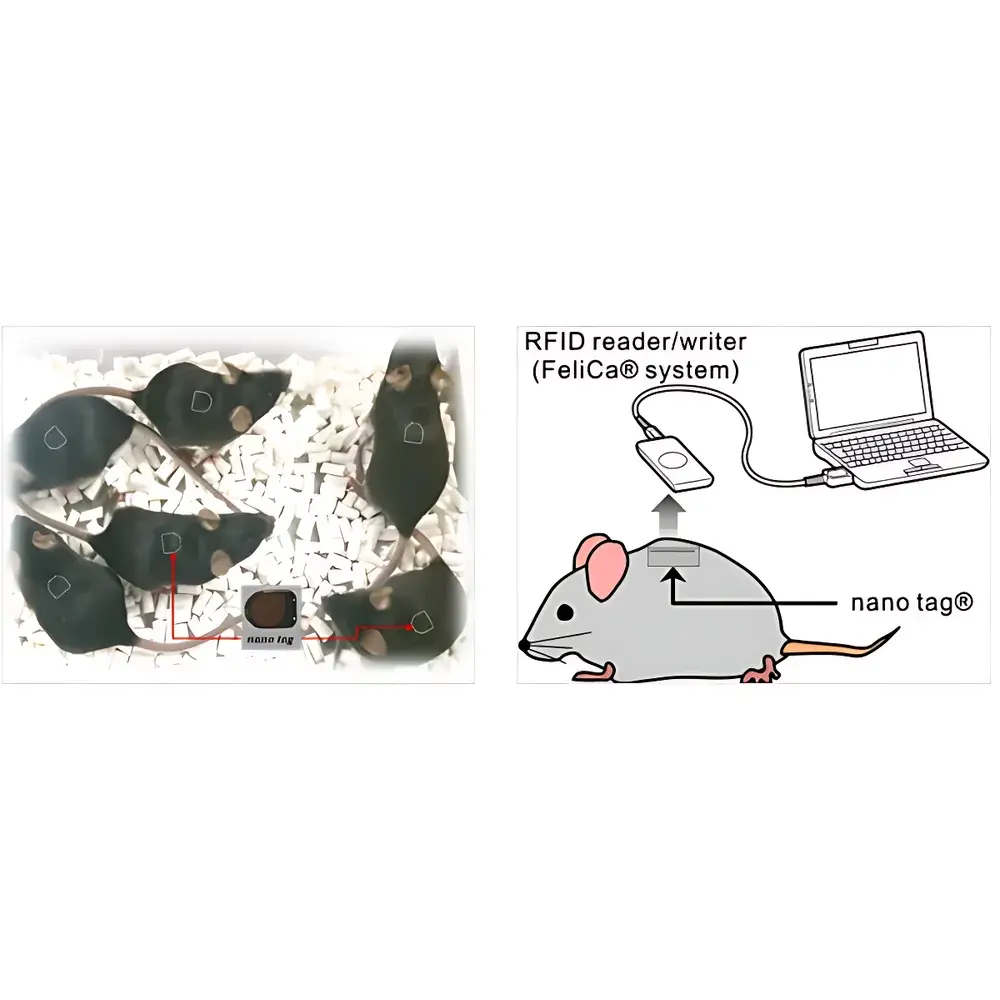
| Data Retrieval | Contactless FeliCa® interrogation via compatible reader |
Overview
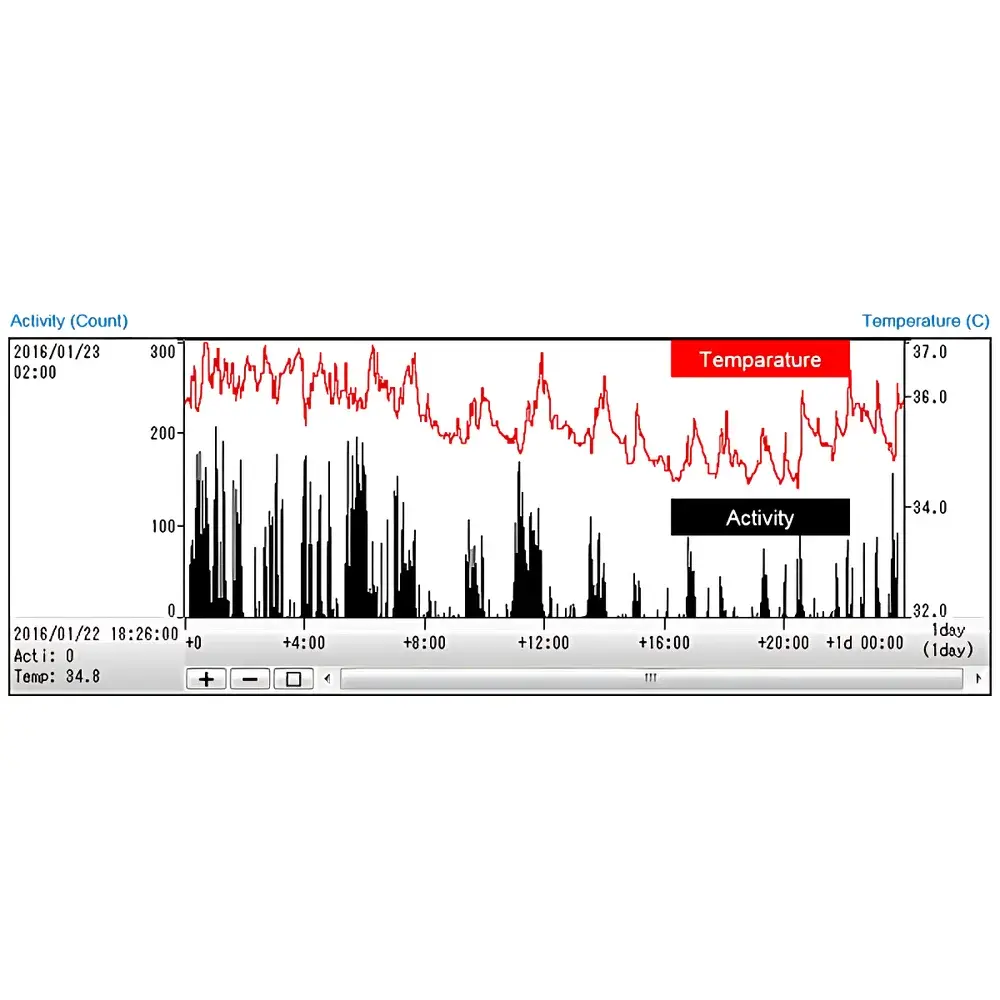
The Kissei Nanotag is a miniaturized, implantable telemetry device engineered for continuous, long-term in vivo monitoring of locomotor activity and core body temperature in small laboratory rodents—primarily mice and rats. Based on capacitive cross-count sensing and high-stability thermistor-based temperature measurement, the Nanotag operates autonomously after surgical implantation into the peritoneal cavity. Its ultra-low-power architecture enables uninterrupted data acquisition for up to 60 days under standard duty cycles (24-hour continuous sensing with 2-minute daily wireless data retrieval). Designed specifically for chronic behavioral and physiological phenotyping studies, the Nanotag eliminates external tethers, harnesses, or cage-integrated sensors that may confound natural behavior—thereby supporting ethologically valid experimental paradigms compliant with ARRIVE 2.0 and NIH animal welfare guidelines.
Key Features
- Implantable form factor (15 × 14.2 × 7.1 mm, 2.5 g) optimized for intraperitoneal placement in adult mice (≥20 g) and rats (≥200 g), with biocompatible ABS housing and medical-grade epoxy encapsulation.
- FeliCa®-enabled contactless communication (ISO/IEC 18092 NFC standard) permits rapid, non-invasive data readout at ~10 mm range—no physical connection or anesthesia required during retrieval.
- Three programmable recording modes: (1) Cyclic mode for continuous overwrite storage; (2) Memory-Hold-Stop mode preserving all data until manual extraction; (3) Time-scheduled Start/Stop mode enabling precise alignment with circadian or pharmacological protocols.
- Temperature sensor calibrated across 30–45.87 °C with 0.0625 °C resolution and ±0.5 °C accuracy (traceable to NIST-traceable reference standards), validated per ISO 80601-2-56 for clinical thermometer equivalence.
- IPX7-rated hermetic sealing ensures full submersion resistance (1 m for 30 min), critical for post-surgical recovery and longitudinal studies involving bedding moisture or cage cleaning cycles.
- Timekeeping stability of ±60 seconds per month supports multi-animal cohort synchronization without external clock drift correction—essential for circadian rhythm analysis and cross-group temporal alignment.
Sample Compatibility & Compliance
The Nanotag is validated for use in C57BL/6, BALB/c, CD-1, and Sprague-Dawley strains. Surgical implantation follows standard aseptic laparotomy procedures with absorbable suture closure. Device materials comply with ISO 10993-5 (cytotoxicity) and ISO 10993-10 (irritation/sensitization) requirements. Data integrity adheres to ALPACO (Animal Laboratory Protocol and Compliance Oversight) best practices. While not FDA-cleared for human use, its design principles align with ISO 14155:2020 for investigational medical device studies in preclinical models. The embedded firmware supports audit-ready timestamping and immutable session logging—facilitating GLP-compliant study documentation.
Software & Data Management
Data export occurs via Kissei’s proprietary Nanotag Manager software (Windows 10/11, 64-bit), which ingests binary telemetry streams and converts them into CSV- and MATLAB-compatible time-series matrices. Each dataset includes synchronized timestamps, activity event counts, and calibrated temperature values. The software enforces role-based access control, auto-generates audit trails (per 21 CFR Part 11 Annex 11 principles), and logs all user-initiated start/stop commands with operator ID and system timestamp. Raw files retain SHA-256 checksums for forensic data integrity verification. Exported datasets are structured to interface directly with EthoVision XT, ActiMetrics ClockLab, and Python-based analysis pipelines (e.g., circadian periodogram, Bout analysis).
Applications
- Chronic circadian rhythm disruption studies (e.g., jet lag, shift-work models, SCN lesion validation)
- Thermoregulatory response profiling during febrile episodes, sepsis, or neuroinflammatory challenges
- Longitudinal assessment of metabolic phenotypes in diet-induced obesity or diabetes models
- Pharmacokinetic/pharmacodynamic correlation of CNS-active compounds (e.g., antipsychotics, hypnotics) via core temperature and activity coupling
- Validation of optogenetic or chemogenetic manipulations in freely behaving cohorts over extended durations
- Preclinical safety pharmacology (ICH S7A) requiring 24/7 autonomic parameter monitoring
FAQ
Is the Nanotag suitable for use in juvenile rodents?
Yes—implantation is feasible in mice ≥16 g and rats ≥150 g, provided surgical protocols are adjusted for anatomical scale and postoperative care is intensified.
Can multiple Nanotags be read simultaneously from one reader?
No—FeliCa® operates in single-tag arbitration mode; sequential interrogation is required for multi-animal cohorts.
Does the device support real-time streaming?
No—it is a store-and-forward telemetry system optimized for energy efficiency and long-term autonomy; no live RF transmission is performed.
What happens when battery depletion occurs?
The device enters irreversible low-power hibernation; no data loss occurs prior to depletion, and final state is preserved until readout.
Is sterilization possible between implants?
No—the device is supplied pre-sterilized (EO gas); re-sterilization compromises epoxy integrity and voids calibration traceability.