
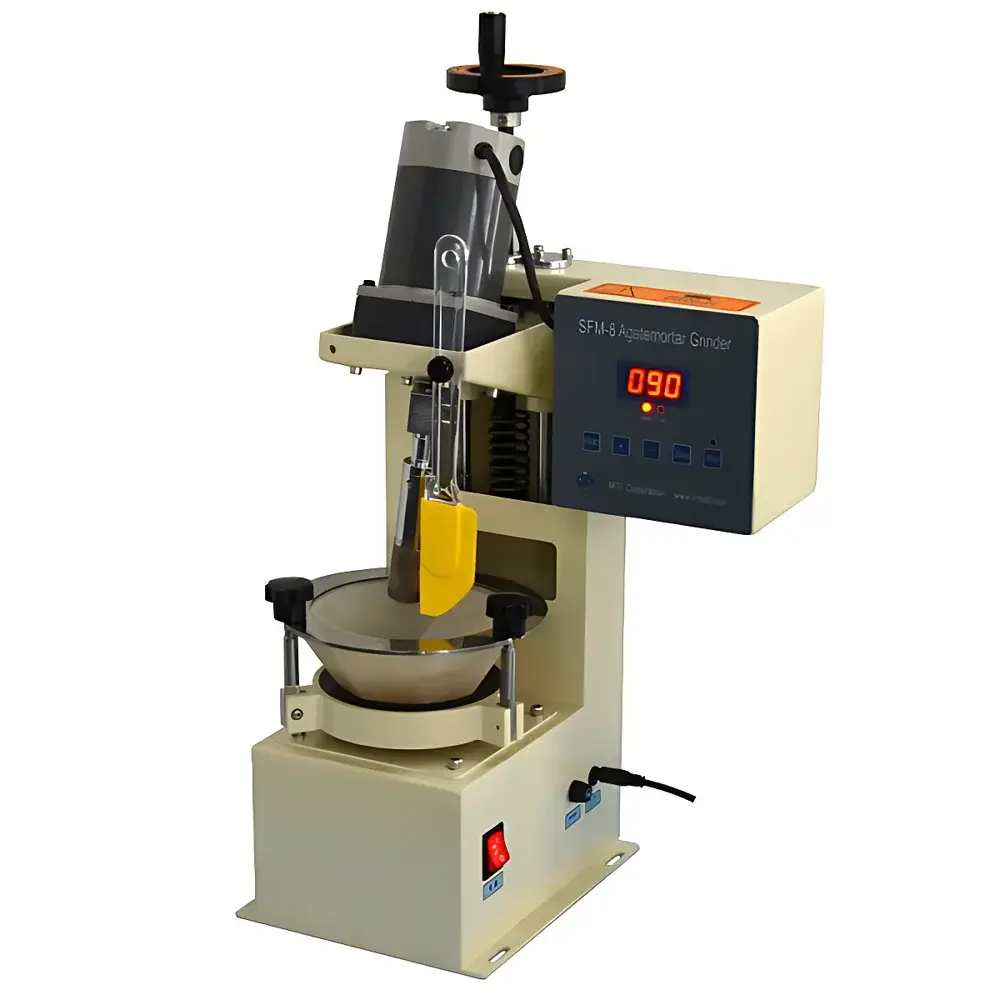
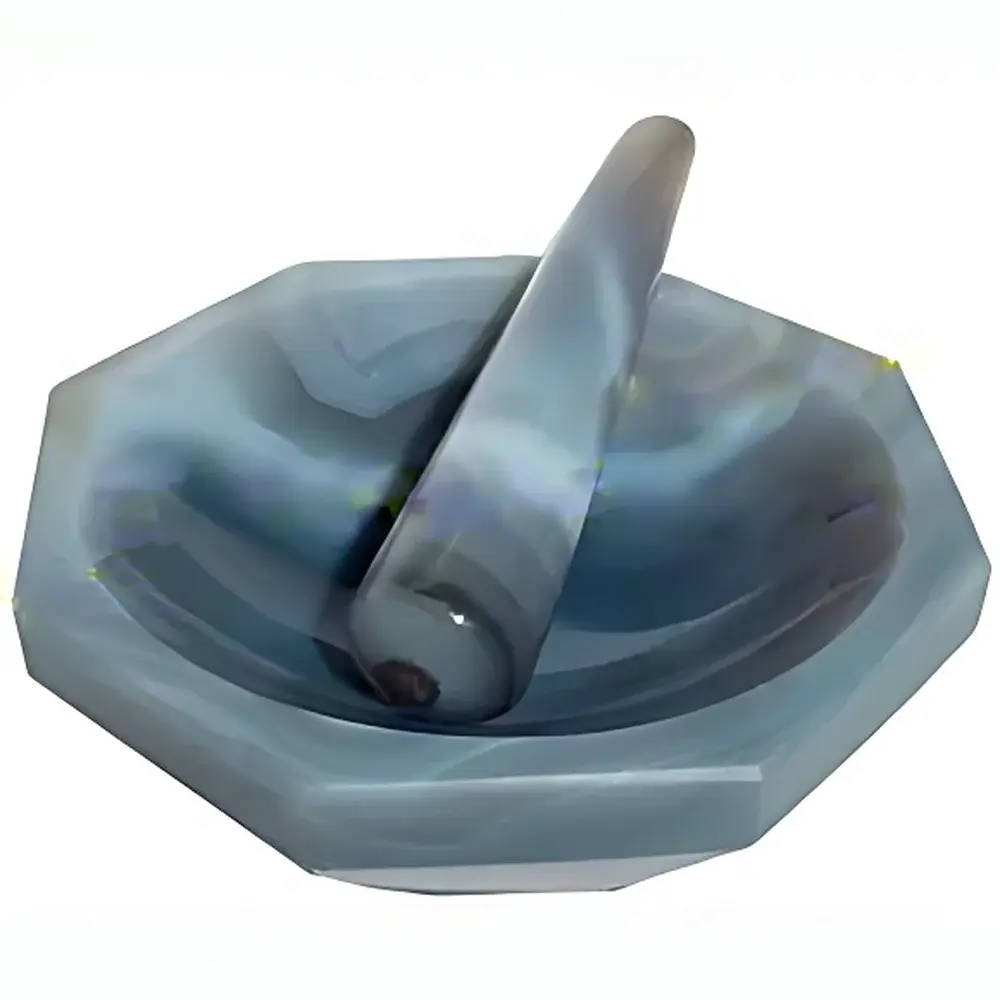
KJ GROUP SFM-8 Agate Mortar Grinder
| Brand | KJ GROUP |
|---|---|
| Origin | Liaoning, China |
| Manufacturer Type | Authorized Distributor |
| Origin Category | Domestic (China) |
| Model | SFM-8 |
| Price Range | USD 700–1,400 (FOB) |
| Sample Suitability | Hard & Brittle Solids |
| Final Particle Size | < 10 µm (typical), down to ~100 nm under optimized conditions |
| Batch Capacity | Ø120 mm × 34 mm mortar volume (~30–50 g typical dry feed) |
| Input Voltage | AC 110/220 V, 50/60 Hz |
| Power Consumption | Mortar drive: 10 W |
| Pestle drive | 25 W |
| Mortar & Pestle Material | Natural Agate (≥99.5% SiO₂, Mohs hardness ≈7) |
| Mortar Rotational Speed | 10 rpm (fixed) |
| Pestle Rotational Speed | 20–90 rpm (adjustable, stepless) |
| Grinding Time | 0–900 min (programmable, ±1 s resolution) |
| Dimensions (W×D×H) | 250 × 320 × 580 mm |
| Net Weight | 12 kg |
Overview
The KJ GROUP SFM-8 Agate Mortar Grinder is a precision-engineered laboratory-scale grinding instrument designed for controlled, low-contamination size reduction of hard, brittle, and chemically inert solid samples. It operates on the principle of planetary shear-assisted mortar-pestle attrition: a high-purity agate mortar rotates at a fixed low speed (10 rpm), while an independently driven agate pestle rotates at variable speeds (20–90 rpm) in the same direction, generating consistent compressive and shearing forces across the entire sample bed. A stationary agate scraper continuously redirects material from the mortar periphery toward the center, ensuring uniform residence time and eliminating preferential channeling or edge accumulation. This kinematic configuration delivers statistically homogeneous particle size distributions (PSD) with minimal thermal load and negligible metallic or organic contamination—critical for applications requiring trace-level purity, such as reference material preparation, XRD sample conditioning, or pre-analysis milling for ICP-MS or SEM-EDS.
Key Features
- High-purity natural agate construction (≥99.5% SiO₂) for ultra-low contamination—ideal for trace-element-sensitive analyses and non-metallic applications.
- Independent dual-speed motor control: fixed 10 rpm mortar rotation ensures stable torque delivery; adjustable 20–90 rpm pestle rotation enables precise energy input tuning for varying sample hardness and desired fineness.
- Programmable digital timer (0–900 min, ±1 s accuracy) with automatic shutdown and audible alert—supports reproducible method development and unattended operation.
- Compact footprint (250 × 320 × 580 mm) and low power draw (total ≤35 W) enable integration into fume hoods, gloveboxes, or shared lab benches without cooling or dedicated circuits.
- Ergonomic design with quick-release pestle clamp, removable mortar assembly, and tool-free scraper alignment—facilitates rapid cleaning and cross-sample changeover.
Sample Compatibility & Compliance
The SFM-8 is validated for grinding hard, non-fibrous, non-sticky solids including silicon carbide, fused quartz, alumina ceramics, borosilicate glass, pharmaceutical actives (e.g., ibuprofen, paracetamol), food-grade spices, epoxy resins, and battery cathode precursors (e.g., LiCoO₂). It is not suitable for soft, elastic, fibrous, or hygroscopic materials. All wetted components comply with ISO 8502-3 (cleanliness of surfaces) and meet general lab equipment requirements under ISO/IEC 17025:2017 for sample preparation integrity. While not certified to GLP or GMP out-of-box, its programmable parameters, time-stamped operation log (via optional RS232 output), and mechanical repeatability support audit-ready documentation when integrated into validated workflows per USP , ASTM E11-22 (specifications for test sieves), or ISO 13320:2020 (laser diffraction particle sizing sample prep).
Software & Data Management
The SFM-8 operates via a front-panel membrane keypad with LED display—no proprietary software required. All operational parameters (pestle speed, duration, start time) are stored in non-volatile memory and recalled after power cycling. Optional RS232 serial interface (available upon request) enables external logging of start/stop timestamps and parameter settings into LIMS or ELN systems. No embedded data storage or user accounts are provided; this aligns with ISO/IEC 17025 Clause 7.5.2 (control of documented information) by maintaining separation between instrument control and data governance responsibilities.
Applications
- Preparation of X-ray diffraction (XRD) specimens requiring sub-10 µm homogeneity to minimize preferred orientation artifacts.
- Milling of calibration standards for laser diffraction (ISO 13320) or dynamic light scattering (ISO 22412) particle size analyzers.
- Homogenization of ceramic green bodies prior to sintering studies or rheological slurry formulation.
- Size reduction of electronic-grade powders (e.g., BaTiO₃, ZnO) where iron or chromium leaching must be avoided.
- Pharmaceutical R&D: micronization of APIs for dissolution testing (USP ) or solid-state form screening.
- Food safety labs: grinding of spice matrices for heavy metal analysis (AOAC 2013.06) without stainless-steel wear debris.
FAQ
What is the maximum recommended batch size for optimal particle size distribution?
For consistent <10 µm output, we recommend 20–40 g of dry, pre-sieved (<500 µm) material. Overloading reduces interparticle shear efficiency and increases median particle size variability.
Can the SFM-8 achieve true nanoscale grinding (e.g., <100 nm)?
Yes—under extended cycles (≥600 min), cryogenic assistance (optional liquid nitrogen jacket), and multi-stage sequential grinding with intermediate sieving, median sizes approaching 80–120 nm have been verified by TEM and DLS in silica and alumina benchmarks.
Is agate wear debris a concern during prolonged operation?
Agate abrasion is negligible below 90 rpm pestle speed and <900 min runtime; SEM-EDS analysis of milled quartz shows <0.002 wt% SiO₂ contribution from mortar/pestle wear—well below detection limits for most ICP-MS applications.
Does the instrument support regulatory compliance for GMP environments?
While the SFM-8 itself is not 21 CFR Part 11-compliant (no electronic signatures or audit trails), its deterministic mechanical behavior, calibrated timers, and agate-only contact surface allow it to be included in GMP-compliant processes when paired with procedural controls, calibration logs, and operator training records.
How often does the agate pestle require replacement?
Under normal use (≤5 hrs/day, hard-ceramic samples), agate pestles show no measurable dimensional change after 2,000+ operating hours. Visual inspection for chipping or surface pitting every 500 hours is recommended.
Related Products



