
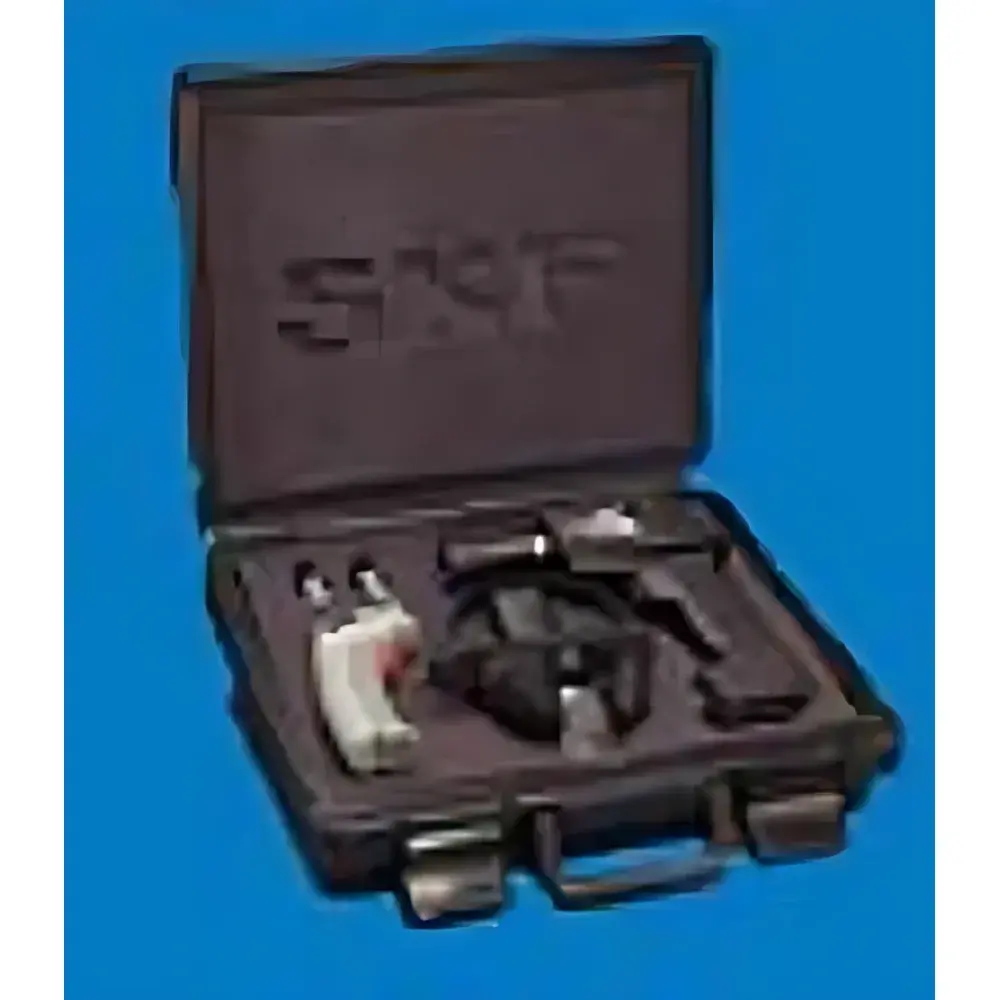
SKF CMPK 200 Condition Monitoring Toolkit
| Origin | Imported |
|---|---|
| Manufacturer Type | Authorized Distributor |
| Model | CMPK 200 |
| Pricing | Available Upon Request |
| CMVP 50 Vibration Pen | Velocity RMS 0.1–55 mm/s (10 Hz–1 kHz), Acceleration Envelope gE 0.01–45 gE (10 kHz–30 kHz) |
| CMIN 400 Ultrasonic Leak Detector | Frequency Response 20–100 kHz (Center Frequency 38–42 kHz) |
| CMSS 2020 Infrared Thermometer | Temperature Range −18 °C to +260 °C |
Overview
The SKF CMPK 200 Condition Monitoring Toolkit is an integrated, field-deployable solution engineered for predictive maintenance professionals conducting routine mechanical integrity assessments across rotating and static assets. Designed as a purpose-built tri-instrument ensemble—comprising the CMVP 50 vibration pen, CMIN 400 ultrasonic leak detector, and CMSS 2020 infrared thermometer—the CMPK 200 enables simultaneous evaluation of three fundamental failure precursors: mechanical vibration signatures, high-frequency acoustic emissions from leaks or friction, and surface thermal anomalies. Its architecture reflects the ISO 18436-2 competency framework for condition monitoring personnel, supporting Level I and Level II practitioners in performing standardized walkdown inspections per ISO 13373-1 (vibration), ISO 18436-8 (ultrasonics), and ISO 18436-7 (infrared thermography). The toolkit does not perform real-time data logging or spectral analysis; rather, it delivers immediate, operator-interpreted pass/fail indicators aligned with OEM-recommended thresholds and industry-established severity bands.
Key Features
- Modular tri-sensor configuration: Each instrument is independently calibrated, battery-powered, and housed in a ruggedized carrying case with dedicated compartments and quick-reference guides.
- CMVP 50 vibration pen: Measures broadband velocity RMS (10 Hz–1 kHz) for overall machine health screening and acceleration envelope (gE) at high frequencies (10–30 kHz) to detect early-stage bearing defects, gear mesh anomalies, and lubrication-related impacts.
- CMIN 400 ultrasonic detector: Operates within a tunable 20–100 kHz band with center frequency optimized near 40 kHz for maximum sensitivity to turbulent gas flow (leak detection), rolling element spalling, and partial discharge activity in energized electrical components.
- CMSS 2020 infrared thermometer: Features fixed emissivity (0.95), 12:1 optical resolution, and dual-range accuracy specification compliant with ASTM E1933-19 for non-contact surface temperature measurement during operational equipment surveys.
- No software dependency: All instruments function autonomously without PC connectivity, minimizing setup time and eliminating cybersecurity concerns associated with networked diagnostic tools.
- IEC 60529 IP54-rated enclosures ensure resistance to dust ingress and water splashing—suitable for industrial plant floor environments including refineries, power generation facilities, and manufacturing lines.
Sample Compatibility & Compliance
The CMPK 200 is applicable to ferrous and non-ferrous metallic surfaces, insulated piping, valve bodies, pump casings, motor housings, and electrical enclosures. It is not intended for use on highly reflective surfaces without emissivity correction (e.g., bare aluminum or polished stainless steel), nor for sub-zero cryogenic systems below −18 °C. Instrument calibration adheres to traceable standards: vibration sensor response validated per ISO 5347-11, ultrasonic transducer sensitivity verified using ANSI/ASNT CP-189 reference blocks, and IR thermometer certified per NIST-traceable blackbody sources. The toolkit supports compliance with preventive maintenance programs governed by ISO 55001, API RP 574, and EN 1330-9 (NDT terminology), and its usage documentation meets GLP audit requirements for inspection record retention.
Software & Data Management
The CMPK 200 operates as a standalone hardware toolkit with no embedded firmware updates or cloud synchronization capabilities. Measurement results are recorded manually by operators into paper-based or enterprise CMMS-compatible digital logs (e.g., SAP PM, IBM Maximo). While no proprietary software is bundled, raw readings—velocity RMS values, gE amplitudes, ultrasonic decibel levels, and spot temperatures—are structured to align with ISO 13372 Annex B metadata fields for condition monitoring data exchange. Users may import timestamped observations into third-party analytics platforms supporting CSV or Excel ingestion for trend analysis, provided manual entry protocols follow 21 CFR Part 11-compliant electronic record practices where applicable.
Applications
- Routine route-based inspections of centrifugal pumps, compressors, fans, and gearmotors for imbalance, misalignment, looseness, and bearing degradation.
- Steam system integrity verification—including trap functionality, valve seat leakage, and flange joint integrity—using ultrasonic amplitude mapping.
- Electrical asset screening for corona discharge, arcing, and poor connections in switchgear, bus ducts, and transformer cooling fins.
- Thermal verification of heat exchanger tube bundles, furnace refractory linings, and motor winding hotspots during normal operation.
- Baseline data collection prior to major overhauls or after component replacement to establish post-maintenance reference states.
- Training platform for new reliability engineers learning foundational PdM techniques under supervised field conditions.
FAQ
Is the CMPK 200 suitable for continuous online monitoring?
No. It is designed exclusively for periodic handheld inspections and does not support permanent mounting, analog output signals, or integration with SCADA or DCS systems.
Can the CMSS 2020 measure through glass or plastic covers?
No. Infrared measurements require direct line-of-sight to the target surface; transparent barriers attenuate thermal radiation and invalidate readings.
Does the CMIN 400 require coupling gel or contact with the surface?
No. It is a non-contact airborne ultrasonic detector; measurements are performed at distances up to 1.5 meters depending on leak size and ambient noise level.
Are individual instruments available separately?
Yes. CMVP 50, CMIN 400, and CMSS 2020 are sold as standalone units with full manufacturer warranty and calibration certificates.
What is the recommended recalibration interval?
Annual calibration is advised per ISO/IEC 17025-accredited laboratories; however, field verification using certified reference sources (e.g., vibration shaker, ultrasonic calibrator, blackbody source) should be performed before each shift.
Related Products



