
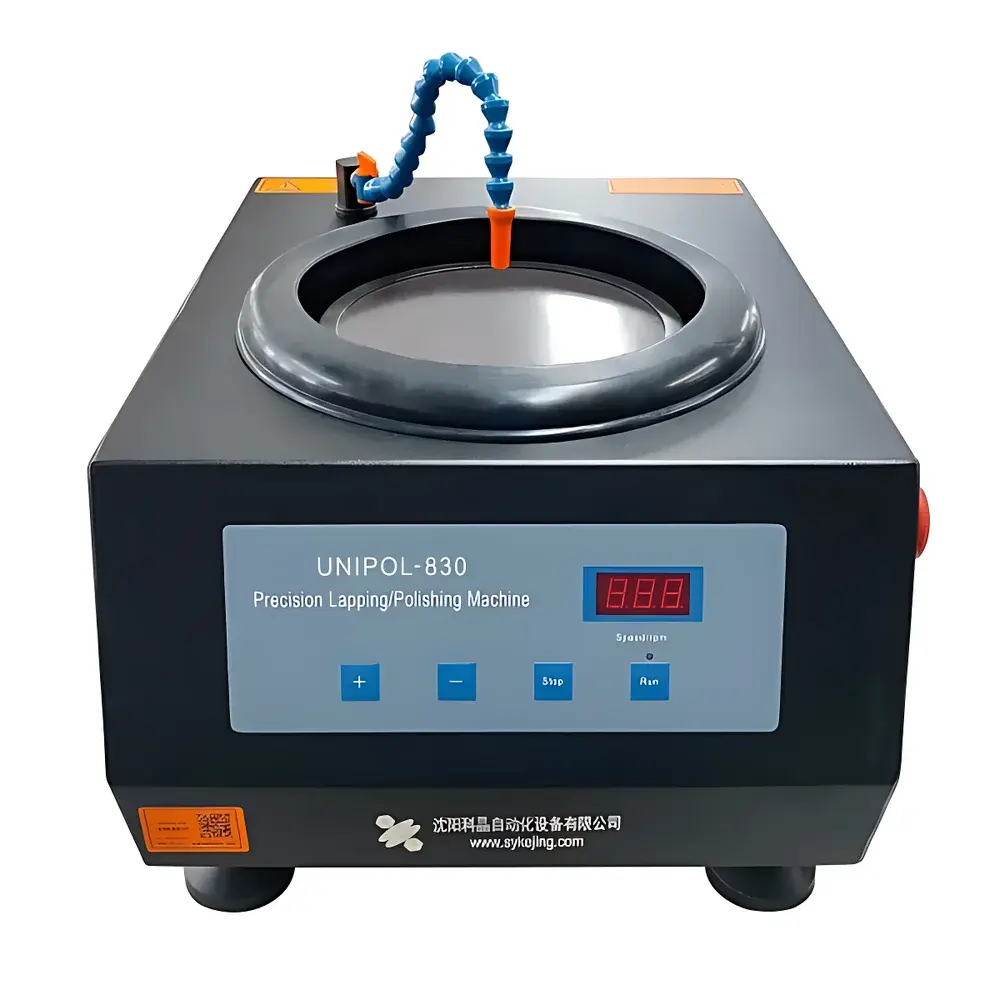
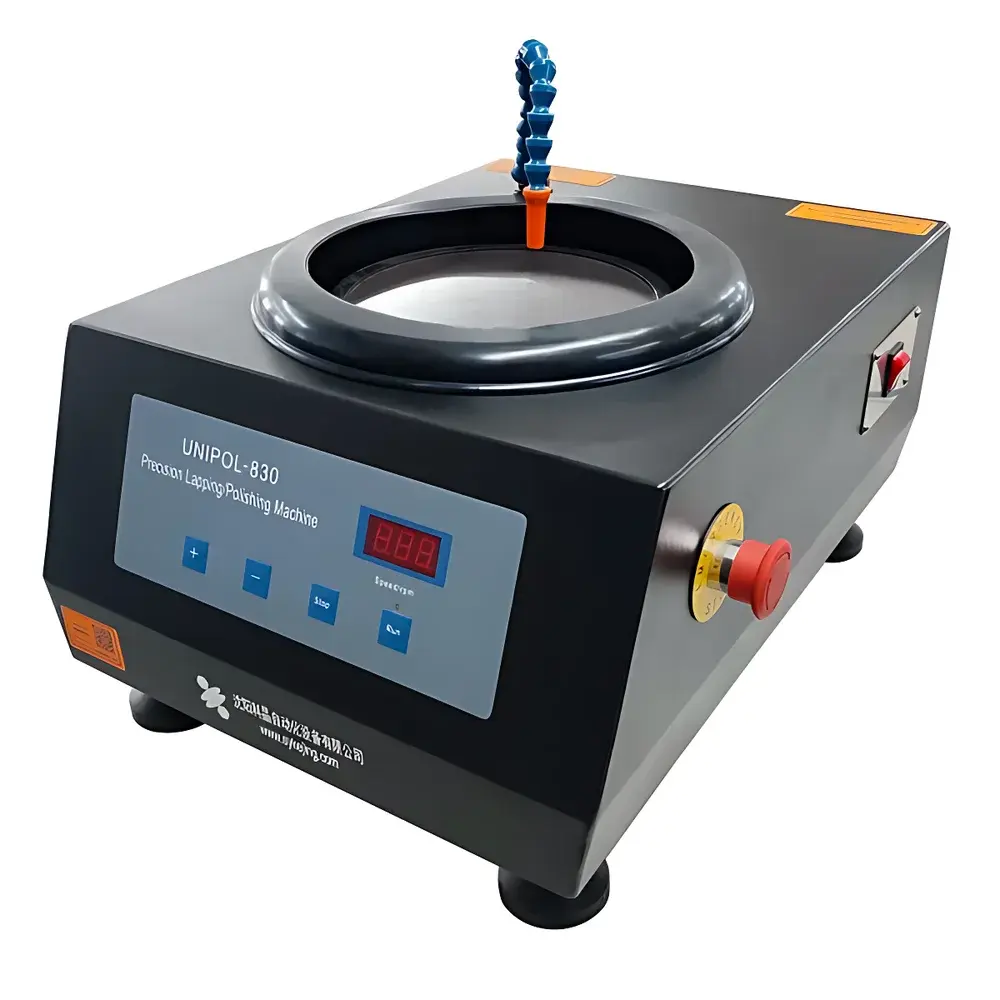
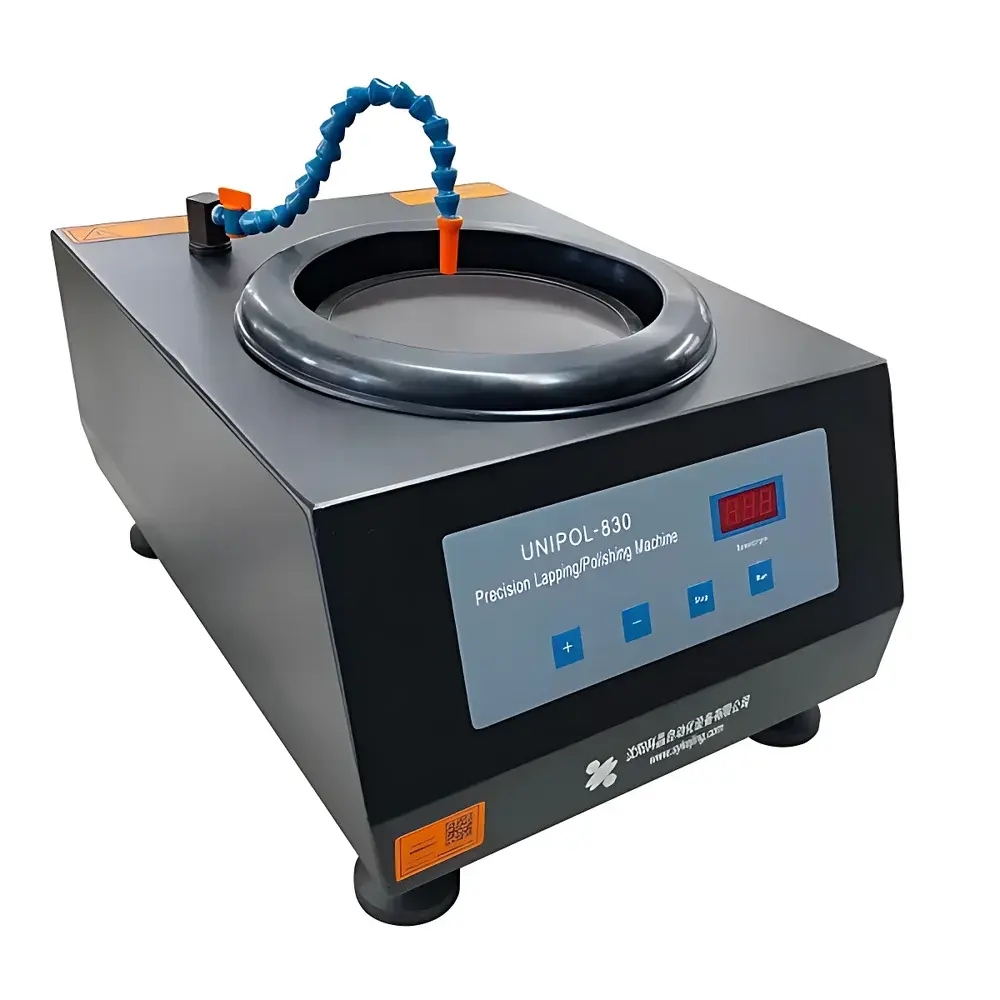
KJ GROUP UNIPOL-830 Manual Metallographic Grinding and Polishing Machine
| Brand | KJ GROUP |
|---|---|
| Origin | Liaoning, China |
| Manufacturer Type | Authorized Distributor |
| Country of Origin | China |
| Model | UNIPOL-830 |
| Dimensions (L×W×D) | 580 mm × 420 mm × 350 mm |
| Number of Platen Stations | 1 |
| Platen Diameter | Ø203 mm |
| Speed Range | 50–600 rpm |
Overview
The KJ GROUP UNIPOL-830 Manual Metallographic Grinding and Polishing Machine is an engineered solution for precision sample preparation in metallurgical, materials science, and geological laboratories. Designed around the fundamental principles of controlled mechanical abrasion and planar surface finishing, the UNIPOL-830 employs a single rotating platen to perform sequential grinding, lapping, and polishing operations on solid specimens—enabling reproducible cross-sectional analysis under optical or electron microscopy. Its core architecture integrates a DC motor-driven Ø203 mm platen with continuously variable speed control (50–600 rpm), allowing users to match rotational kinetics to material hardness, abrasive grit size, and desired removal rate. Unlike fully automated systems, the UNIPOL-830 maintains manual pressure control—a critical requirement for optimizing edge retention, minimizing relief effects, and preventing subsurface deformation in brittle or heterogeneous samples. The unit supports both water-cooled operation (via integrated inlet/outlet ports) and ambient-air cooling, meeting standard safety and thermal management protocols for extended duty cycles in academic and industrial QA/QC environments.
Key Features
- Single-station Ø203 mm magnetic or mechanical platen system with dual mounting options: magnetically retained polishing cloths (using ferromagnetic backing plates) and pressure-ring clamping for conventional abrasive papers—eliminating cloth wrinkling and ensuring uniform contact pressure.
- Stepless DC motor speed regulation (50–600 rpm) via microcontroller-based keypad interface, enabling precise kinetic matching across SiC paper grades (P80–P4000), diamond suspensions (W40–W0.25), and colloidal silica slurries.
- Integrated water supply and drainage ports compliant with ISO 14971 risk management guidelines for laboratory fluid handling; compatible with standard 8 mm OD tubing and gravity-fed or low-pressure municipal water sources.
- Robust aluminum alloy frame with vibration-damped base plate, rated for stable operation at ≤0.05 mm/s RMS acceleration under 45 °C ambient conditions per IEC 61000-6-2 immunity requirements.
- Modular accessory ecosystem—including TEM wedge fixtures (UNIPOL-01), automated slurry dispensers (SKZD-2/3/4/5), and specialized magnetic resin-bonded diamond discs—supports method transfer across ASTM E3, ISO 14488, and GB/T 13298 standards.
Sample Compatibility & Compliance
The UNIPOL-830 accommodates specimens up to 40 mm in diameter and 30 mm in height, covering a broad spectrum of conductive and non-conductive materials: ferrous/non-ferrous metals, sintered carbides, ceramic matrix composites, semiconductor wafers (Si, Ge, ZnSe, ZnS), optical crystals, PCB laminates, geological thin sections, and polymer-matrix composites. All operational parameters comply with GLP documentation requirements: speed settings are digitally logged with timestamping (via optional RS232/USB data export), and mechanical stability meets ISO 14644-1 Class 8 cleanroom vibration thresholds when mounted on ≥100 kg load-rated benches. The absence of pneumatic or high-voltage subsystems ensures compatibility with standard laboratory electrical infrastructure (AC 110/220 V, 50/60 Hz, 10 A grounded outlet) and eliminates need for dedicated exhaust or compressed air lines.
Software & Data Management
As a manually operated instrument, the UNIPOL-830 does not incorporate embedded software or touchscreen interfaces. However, its microcontroller firmware supports audit-trail-capable parameter logging through optional serial communication modules (RS232 or USB-CDC), enabling integration into LIMS or ELN platforms that accept ASCII-formatted speed/time records. All configuration changes—including speed setpoints and runtime duration—are stored in non-volatile memory and persist through power cycling. For regulated environments requiring FDA 21 CFR Part 11 compliance, external validation packages (e.g., IQ/OQ protocols) are available from KJ GROUP’s technical support team upon request. Calibration certificates for rotational speed accuracy (±2 rpm tolerance at all setpoints) and platen runout (<0.02 mm TIR) can be supplied with traceability to NIST-traceable torque and angular velocity standards.
Applications
- Preparation of metallographic mounts for ASTM E3-compliant grain size analysis and phase identification.
- Planarization of brittle ceramics and infrared optical substrates prior to AFM or profilometry.
- Edge-preserving thinning of geological thin sections for transmitted light petrography.
- Final polishing of TEM pre-thinned foils using wedge-type fixtures (UNIPOL-01).
- Routine QC polishing of sintered tungsten carbide inserts and aerospace-grade superalloys per AMS 2750E heat-treat verification protocols.
- Surface conditioning of polymer composites prior to SEM-EDS elemental mapping or nanoindentation testing.
FAQ
Is the UNIPOL-830 suitable for preparing samples for scanning electron microscopy (SEM)?
Yes—when used with progressively finer diamond suspensions (down to W0.25) and final colloidal silica polishing, it produces scratch-free, relief-minimized surfaces required for high-resolution SEM imaging and EBSD analysis.
Can the platen accommodate custom-sized abrasive discs beyond Ø203 mm?
Standard operation is limited to Ø203 mm. Custom platens (e.g., Ø150 mm or Ø250 mm) are available as OEM-engineered modifications subject to minimum order quantity and lead time confirmation.
Does the unit include built-in slurry dispensing capability?
No—the UNIPOL-830 is a base platform. Slurry delivery must be performed manually or via optional accessories such as the SKZD-4 automatic dispenser, which mounts externally and interfaces via solenoid valve control.
What is the maximum recommended continuous operating time per session?
Under nominal load (200 rpm, moderate pressure), continuous operation up to 4 hours is validated per IEC 60068-2-2 thermal endurance testing; extended use requires periodic 15-minute cooldown intervals.
Are replacement magnetic platen assemblies available separately?
Yes—magnetic backing plates (including ferrous steel and rare-earth enhanced variants), adhesive-backed polishing cloths, and replaceable stainless-steel pressure rings are stocked as consumables with full part-number traceability.



