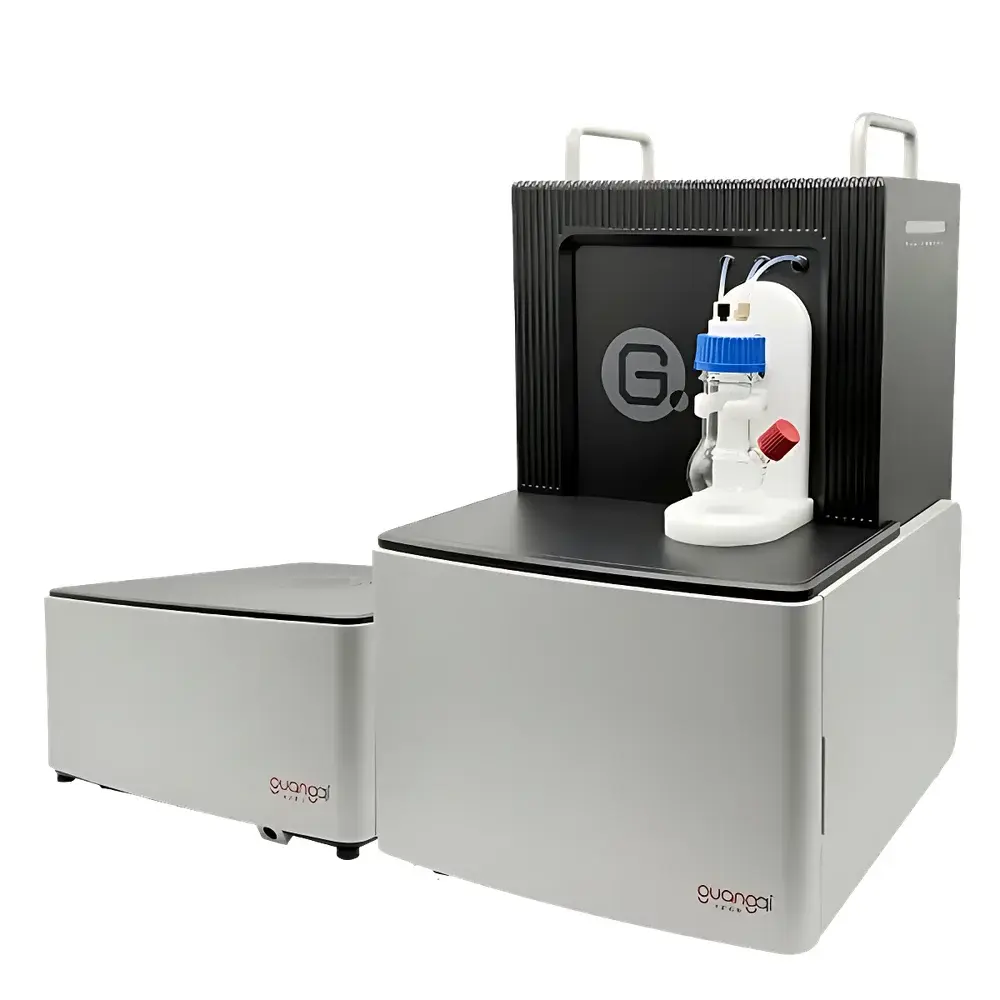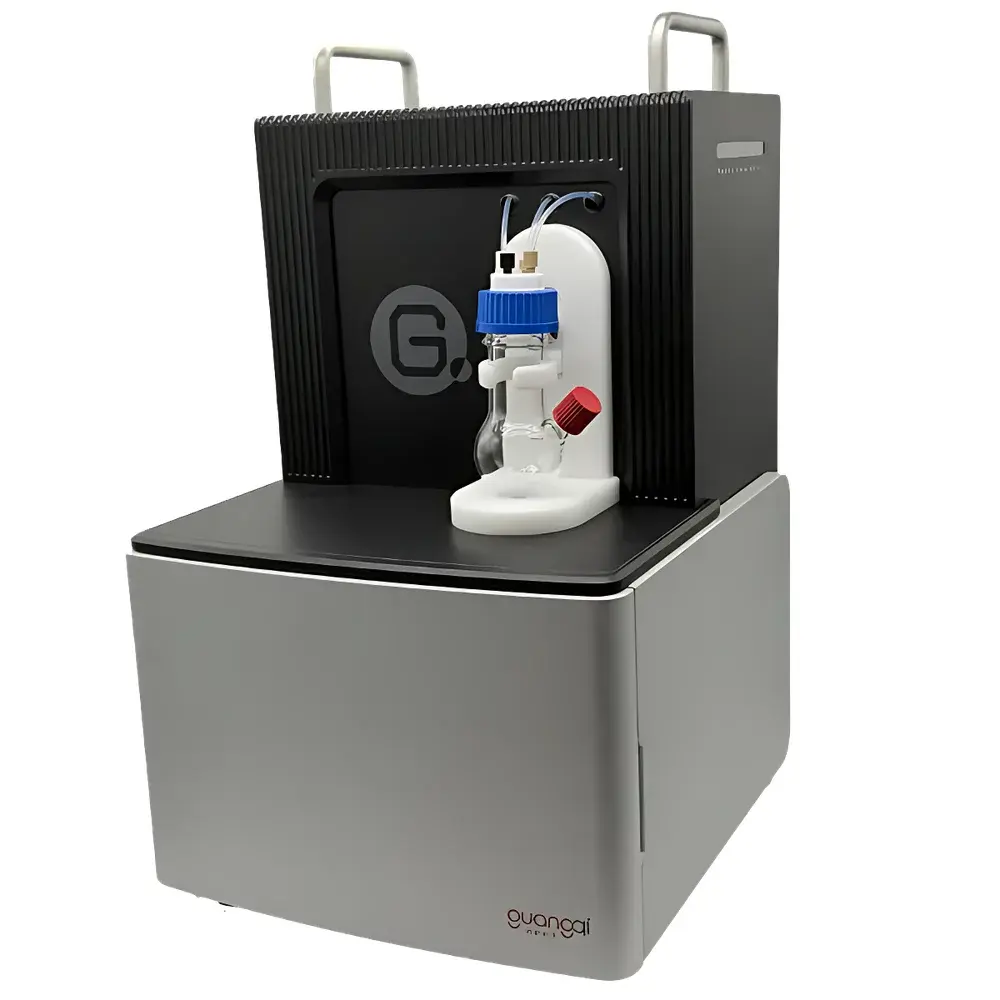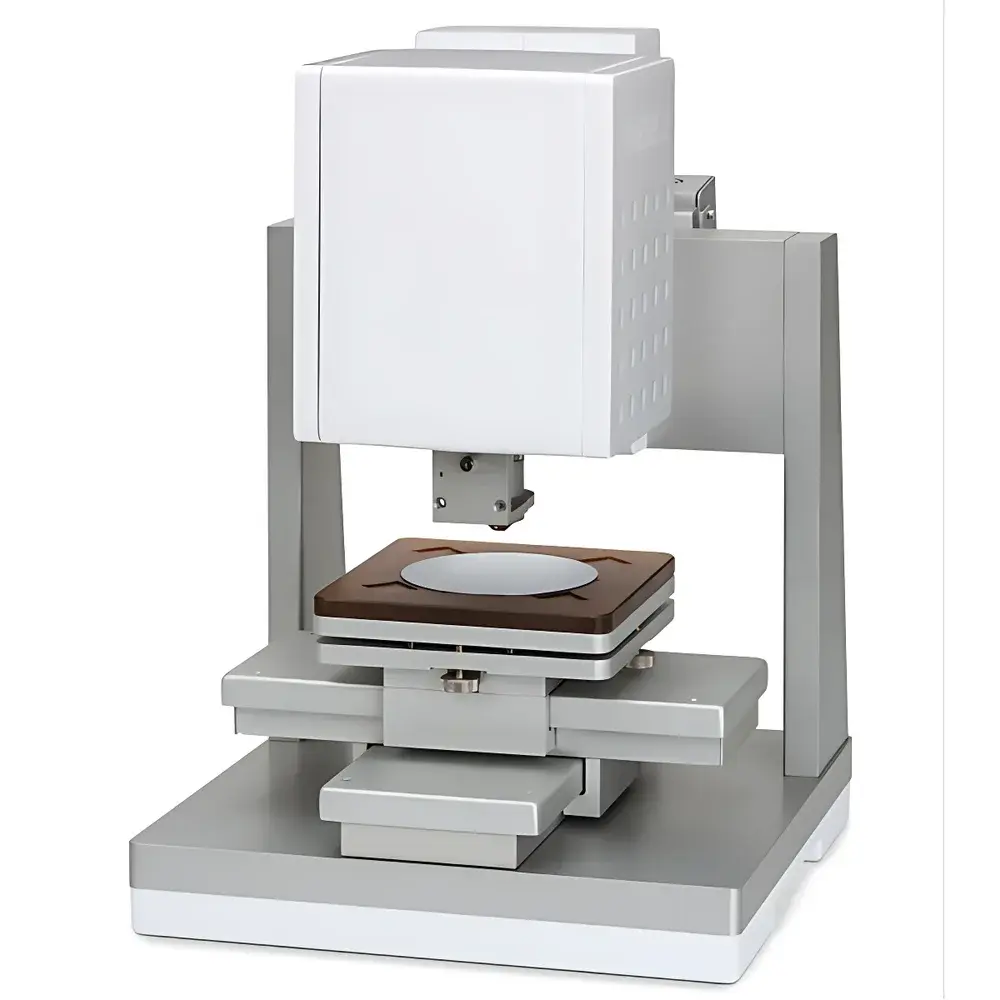
KLA Filmetrics R50 Four-Point Probe & Eddy Current Sheet Resistance Mapping System
| Brand | KLA |
|---|---|
| Origin | Fujian, China |
| Manufacturer Type | Authorized Distributor |
| Country of Origin | China |
| Model | R50 |
| Price Range | USD $42,000 – $140,000 (FOB) |
| Automation Level | Fully Automated |
| Sheet Resistance Range | 5 mΩ/□ to 5 MΩ/□ |
| Measurement Accuracy | ±1% |
| Repeatability | <0.2% |
| XY Stage Options | 100 mm × 100 mm or 200 mm × 200 mm |
| Maximum Sample Diameter | 200 mm |
| Measurement Modes | Contact Four-Point Probe (4PP) and Non-Contact Eddy Current (EC) |
| Mapping Configurations | Linear, Rectangular, Polar, and User-Defined Grids |
| Compliance | ASTM F84, ISO 10474, SEMI MF67, USP <1031>, GLP/GMP-ready audit trail support |
Overview
The KLA Filmetrics R50 is a dual-mode, fully automated sheet resistance mapping system engineered for high-precision process control in semiconductor fabrication, flat panel display (FPD) manufacturing, photovoltaics, and advanced packaging. It integrates two complementary measurement principles—contact four-point probe (4PP) and non-contact eddy current (EC)—within a single platform, enabling traceable, NIST-aligned resistivity characterization across ten decades of sheet resistance (5 mΩ/□ to 5 MΩ/□). The 4PP mode applies standardized Kelvin sensing to eliminate lead resistance error and is calibrated per ASTM F84 for thin-film metrology on conductive layers. The EC mode employs high-frequency electromagnetic induction to measure conductive films without physical contact—critical for fragile, patterned, or coated substrates such as flexible PET, ITO-coated glass, or passivated wafers. Both modalities are implemented with motorized XY stages (100 mm × 100 mm or 200 mm × 200 mm travel), supporting full-wafer mapping of 100 mm and 200 mm diameter substrates. The system’s architecture adheres to SEMI MF67 guidelines for semiconductor metrology tools and supports configurable recipe-driven workflows compliant with GLP and GMP environments.
Key Features
- Fully automated dual-sensor platform supporting both contact 4PP and non-contact EC measurement modes
- High-repeatability stage positioning (<±0.5 µm) with closed-loop stepper motors and optical encoders
- Calibration traceability to NIST standards via KLA’s proprietary thin-film reference standards
- Configurable XY mapping: linear scans, rectangular grids, polar coordinate patterns, and custom-defined point sets
- Unlimited measurement points per recipe; batch execution with pass/fail thresholds and statistical reporting
- Integrated environmental compensation for temperature and humidity drift (optional)
- Modular design supporting field-upgradable firmware, sensor heads, and stage configurations
Sample Compatibility & Compliance
The R50 accommodates diverse substrate geometries and material systems including silicon wafers (bare and patterned), quartz, sapphire, fused silica, soda-lime and borosilicate glass, polymer films (PET, PI, PC), metal foils, PCB traces, and thin-film solar cells. It supports measurements on transparent conductive oxides (TCOs), metal stacks (Al, Cu, TiN), doped polysilicon, graphene, and printed electronics. All measurement protocols conform to ASTM F84 (Standard Test Method for Sheet Resistance of Semiconductor Wafers Using the Van der Pauw Technique), ISO 10474 (Metallic products — Inspection documents), and SEMI MF67 (Specification for Sheet Resistance Measurements). Data integrity meets FDA 21 CFR Part 11 requirements when paired with optional audit trail and electronic signature modules.
Software & Data Management
The R50 operates under Filmetrics’ MetroSuite™ software—a Windows-based application built for metrology-grade data acquisition and analysis. It features real-time contour mapping, cross-sectional line profiles, statistical process control (SPC) charts (X-bar/R, Cpk), and export to CSV, XML, or industry-standard SEMI E142 (SEMI Data Format for Equipment Communication). Raw measurement logs include timestamp, operator ID, sensor mode, calibration status, environmental readings, and full metadata per point. Software supports role-based access control (RBAC), version-controlled recipes, and integration with MES/SCADA via OPC UA or SECS/GEM protocols. Audit trails record all user actions—including parameter changes, calibration events, and report generation—for regulatory review.
Applications
- Process monitoring of sputtered, evaporated, or ALD-deposited conductive films in front-end semiconductor lines
- Uniformity assessment of TCO layers (e.g., ITO, AZO) in OLED and LCD manufacturing
- Thickness estimation of metallic films (e.g., Al, Cu) using resistivity-to-thickness conversion models
- Post-implant activation verification via sheet resistance correlation with dopant concentration
- Quality assurance of flexible printed electronics and touch sensor arrays
- Failure analysis of open/short defects in fine-pitch PCBs and redistribution layers (RDLs)
- Research-grade characterization of 2D materials (graphene, MoS₂) and nanocomposite coatings
FAQ
What is the difference between 4PP and EC measurement modes?
The 4PP method uses physical contact with four collinear probes to inject current and sense voltage, delivering absolute sheet resistance values traceable to SI units. EC relies on electromagnetic coupling and is ideal for non-destructive, high-speed mapping of coated or delicate surfaces where probe contact is undesirable.
Can the R50 measure patterned wafers or structured substrates?
Yes—the EC mode is routinely used for patterned wafers, while the 4PP mode supports localized measurements on unpatterned die areas or macro-scale uniformity mapping when probe alignment tolerances permit.
Is calibration required before each use?
No—daily verification using certified reference wafers is recommended, but full recalibration is performed annually or after hardware maintenance per ISO/IEC 17025 guidelines.
Does the system support integration with factory automation systems?
Yes—via SECS/GEM, OPC UA, or custom API interfaces; MetroSuite™ includes native support for equipment communication standards used in 300 mm fabs.
What documentation is provided for regulatory compliance?
A complete validation package is available—including IQ/OQ/PQ protocols, traceable calibration certificates, software verification reports, and 21 CFR Part 11 configuration files—upon request.