
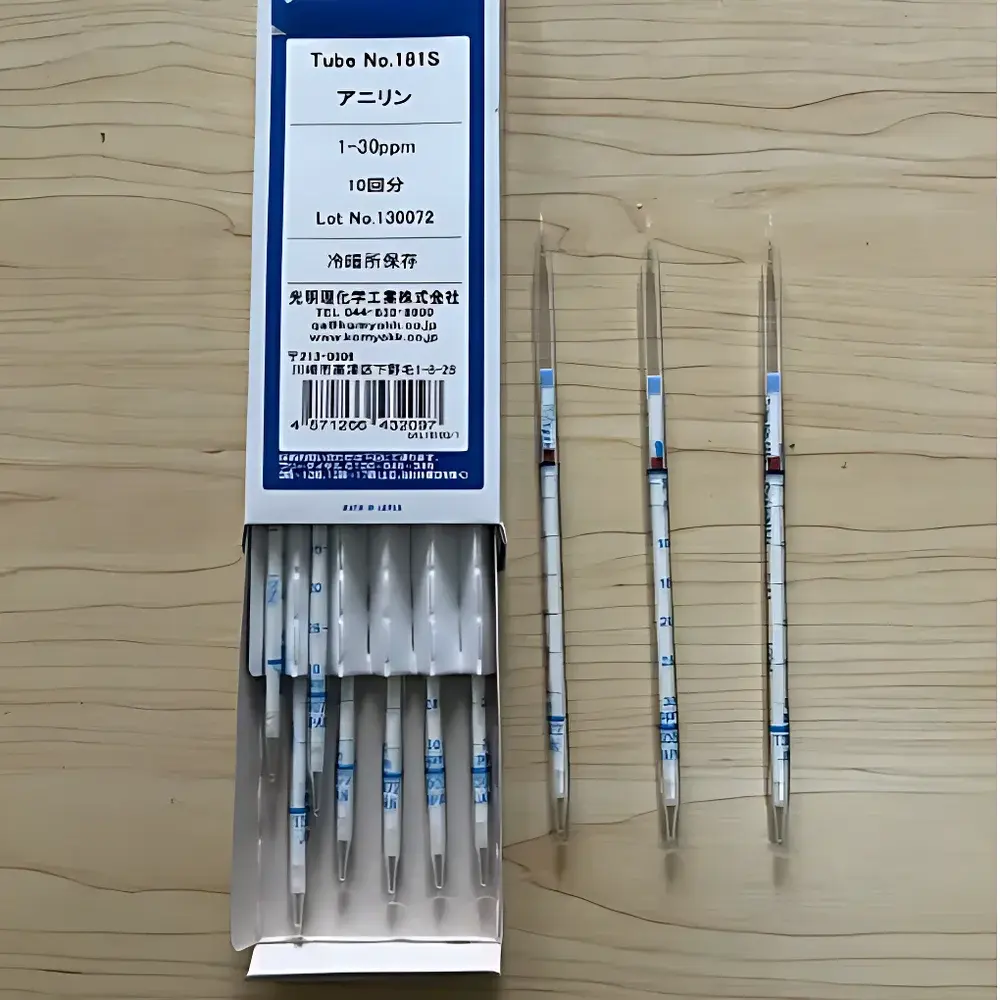
Komyo Rikagaku Aniline Gas Detection Tube
| Brand | Komyo Rikagaku |
|---|---|
| Origin | Japan |
| Model | 181S |
| Detection Principle | Colorimetric Reaction with Pre-calibrated Scale |
| Compatible Pump | AP-20 Hand Pump |
| Measurement Range | As specified per tube lot (see individual lot certificate) |
| Response Time | <1 minute |
| Shelf Life | 24 months from manufacture date (stored at 5–30°C, dry, dark) |
| Compliance | JIS K 0321 (Gas Detection Tubes), ISO 8573-6 (for sampling integrity in compressed air systems, where applicable) |
Overview
The Komyo Rikagaku Aniline Gas Detection Tube (Model 181S) is a single-use, colorimetric direct-reading device engineered for rapid, on-site quantification of aniline vapor concentrations in ambient or workplace air. It operates on the principle of diffusion-controlled chemical reaction: when a precisely metered volume of sampled air is drawn through the tube using the AP-20 hand pump, aniline molecules react stoichiometrically with immobilized reagent layers (typically sulfanilic acid and sodium nitrite-based diazotization system) sealed within the glass microbore tube. This reaction generates a distinct, localized color front whose length—measured against the pre-etched linear scale—is directly proportional to the aniline concentration (ppm·min or ppm, depending on pumping volume and calibration). No power source, catalytic surface, or laboratory infrastructure is required. The method conforms to the fundamental metrological framework defined in JIS K 0321 (“Gas detection tubes — General rules for use and performance requirements”) and supports field compliance with occupational exposure limit (OEL) monitoring under ISO 8573-6–aligned sampling protocols.
Key Features
- Pre-calibrated linear scale etched directly onto borosilicate glass tubing for direct visual readout without interpolation error
- Stable, humidity-compensated reagent formulation validated for reproducible response across 20–80% RH (tested per JIS K 0321 Annex B)
- Integrated desiccant barrier prevents moisture-induced baseline drift during storage and transport
- Lot-specific calibration certificates provided with each package, traceable to NMIJ (National Metrology Institute of Japan) reference standards
- Compatible exclusively with AP-20 dual-stroke hand pump (100 mL/stroke, ±2.5% volumetric accuracy per ISO 9001-certified manufacturing)
- Zero-power, flame-proof operation suitable for Zone 1/2 hazardous locations per IEC 60079-0
Sample Compatibility & Compliance
The 181S tube is validated for use in undiluted ambient air, industrial exhaust streams, and confined-space breathing zones where aniline is present as vapor (not aerosol or particulate-bound). Interference testing per JIS K 0321 confirms minimal cross-sensitivity to common co-contaminants including benzene, toluene, xylene, ammonia, and nitrogen dioxide (<5% signal deviation at 10× OEL). Each production lot undergoes batch certification for shelf-life stability (24 months at ≤30°C), thermal shock resistance (−10°C to +50°C), and mechanical integrity (IEC 60068-2-27 shock test). Devices meet Japanese Industrial Standard JIS K 0321 Class A performance criteria for precision (±15% CV at mid-range), linearity (R² ≥ 0.995), and repeatability (n = 5, same operator, same lot).
Software & Data Management
As a passive, analog measurement device, the 181S detection tube does not interface with digital software or data acquisition systems. However, its output is fully compatible with GLP-compliant manual recordkeeping: users log tube lot number, pump stroke count, ambient temperature/humidity, observer name, and raw scale reading in bound field notebooks or validated electronic lab notebooks (ELN). For audit readiness, all calibration certificates include QR-coded traceability to NMIJ reference gas mixtures and are archived per ISO/IEC 17025 clause 7.7. Digital image capture of the color front (with scale reference) is recommended for long-term verification and internal QA review.
Applications
- Real-time monitoring of aniline vapor during dye synthesis, rubber accelerator production, and pharmaceutical intermediate manufacturing
- Routine area monitoring near storage tanks, transfer hatches, and reactor vent lines per OSHA 1910.1200 (HCS) and EU REACH Annex XVII requirements
- Emergency response screening following suspected leaks or spills in chemical handling facilities
- Verification of local exhaust ventilation (LEV) effectiveness prior to worker re-entry (per HSG258 guidance)
- Complementary tool for Tier 1 exposure assessment in accordance with AIHA RP-1 and ISO 16000-22
FAQ
What is the minimum detectable concentration for aniline using Model 181S?
The lower detection limit is lot-dependent and stated on the individual calibration certificate; typical values range from 0.5 to 2 ppm for standard 100 mL sampling volume.
Can the tube be reused after initial sampling?
No. The 181S is a single-use, irreversible chemical sensor. Reuse compromises calibration integrity and violates JIS K 0321 Clause 5.2.
Is temperature correction required during field use?
Yes. Readings must be adjusted using the temperature compensation factor printed on the tube label if ambient temperature falls outside 20–25°C.
How should expired tubes be disposed?
Dispose as hazardous chemical waste per local regulations (UN 3270, Hazard Class 6.1); do not incinerate or landfill untreated.
Does this tube comply with OSHA permissible exposure limits (PELs)?
The tube enables measurement against PELs (e.g., OSHA PEL-TWA = 2 ppm), but compliance determination requires documented sampling strategy, chain-of-custody records, and comparison to certified reference methods per OSHA ID-201 guidelines.
Related Products







