
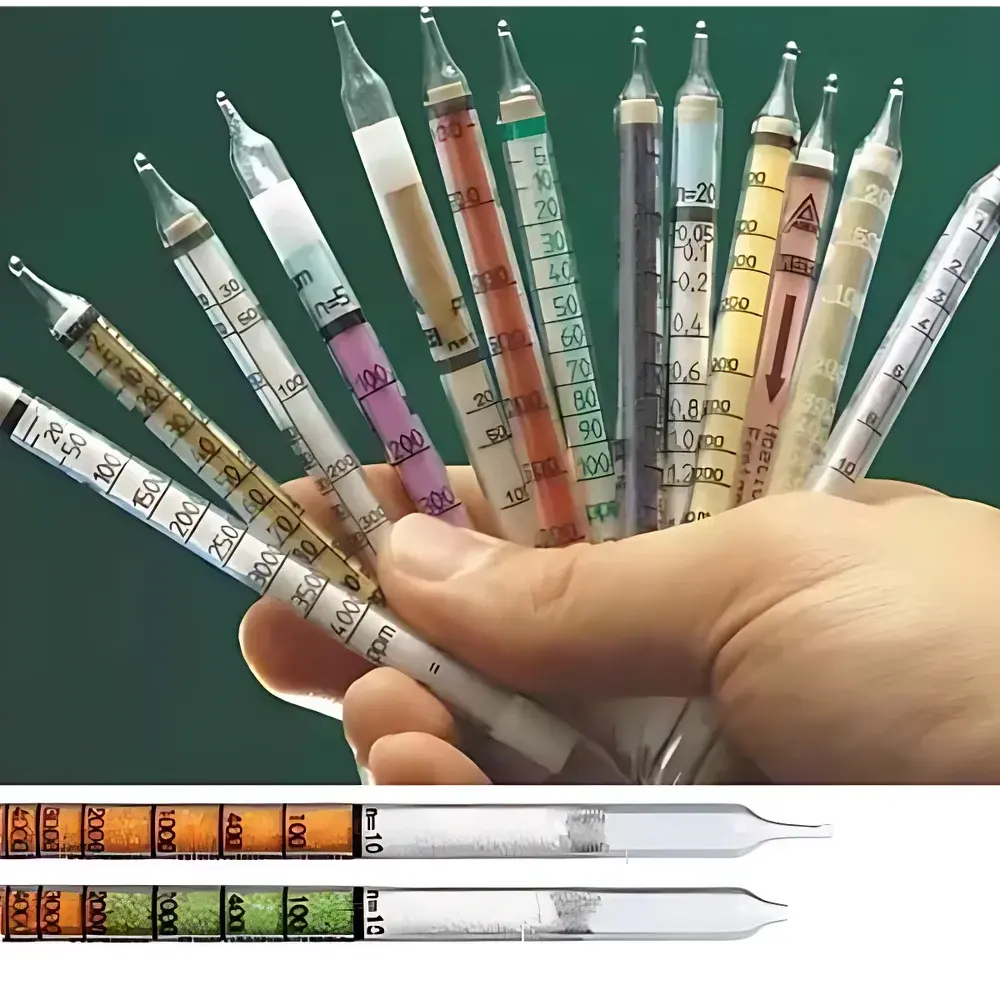
Komyo Rikagaku North川-Style Methanethiol Gas Detection Tube 164SA / 164SB
| Brand | Komyo Rikagaku |
|---|---|
| Origin | Japan |
| Model | 164SA (5–140 ppm) / 164SB (50–1000 ppm) |
| Pack | 10 tubes per box |
| Detection Principle | Colorimetric reaction with pre-impregnated reagent |
| Calibration | Linear color-length scale |
| Compatible Pump | AP-20 handheld bellows pump (sold separately) |
| Compliance | JIS K 0805, ISO 8573-5 (gas purity verification reference method) |
Overview
The Komyo Rikagaku North川-Style Methanethiol Gas Detection Tube 164SA and 164SB are precision-engineered, single-use colorimetric indicator tubes designed for rapid, on-site quantification of methanethiol (methyl mercaptan, CH₃SH) in ambient air. Developed under the legacy North川 (Kitagawa) methodology—pioneered by Dr. Masao Kitagawa in postwar Japan—the tubes employ a fixed-bed, chemically impregnated glass microcolumn that reacts stoichiometrically with methanethiol to produce a sharp, localized color front. The distance traveled by the color front along the calibrated scale is directly proportional to the integrated concentration-time exposure (ppm·min), enabling direct reading of gas concentration when used with the standardized AP-20 dual-stroke hand pump (100 mL per stroke, ±3% volumetric accuracy). This principle conforms to the fundamental analytical framework defined in JIS K 0805 (Japanese Industrial Standard for Gas Detection Tubes) and serves as a field-validated reference method compatible with ISO 8573-5 for trace sulfur compound verification in environmental and occupational hygiene monitoring.
Key Features
- Two calibrated ranges optimized for distinct exposure scenarios: 164SA covers 5–140 ppm (ideal for low-level leak detection and odor threshold assessment near treatment facilities); 164SB spans 50–1000 ppm (suited for emergency response in confined-space entries or industrial process upsets).
- Pre-calibrated linear color-length scale etched directly onto borosilicate glass tubing; no external reader or software required—results obtainable within 90 seconds post-sampling.
- Stable reagent formulation (oxidizing metal salt system) with shelf life of ≥24 months when stored at 10–30°C in original sealed packaging; lot-specific calibration certificates provided per batch.
- Interchangeable compatibility with the universal AP-20 bellows pump—eliminating need for dedicated instrumentation across 300+ Komyo Rikagaku gas detection tube types.
- Robust architecture: 4.5 mm inner diameter × 130 mm length; resistant to mechanical shock and humidity-induced baseline drift below 80% RH.
Sample Compatibility & Compliance
These tubes are validated for use in clean, dry ambient air samples. Performance remains stable across temperatures from 5°C to 40°C and relative humidity up to 80%. Cross-sensitivity to hydrogen sulfide (H₂S) is minimal (<5% interference at equimolar concentrations); no significant response observed for common interferents including CO, CO₂, SO₂, NH₃, or volatile organic compounds (VOCs) at typical environmental levels. Each production lot undergoes rigorous factory calibration against NIST-traceable methanethiol permeation tubes and complies with Japanese Ministry of Health, Labour and Welfare (MHLW) guidelines for workplace atmospheric monitoring. Data generated meets GLP documentation requirements when paired with AP-20 pump usage logs and tube lot traceability records.
Software & Data Management
As a manual, analog field measurement tool, the 164SA/164SB requires no firmware, drivers, or proprietary software. However, quantitative results integrate seamlessly into digital workflows: users may log readings manually into LIMS or EHS platforms using standardized fields (tube ID, lot number, pump strokes, ambient T/RH, observer ID, timestamp). For audit readiness, Komyo Rikagaku provides downloadable PDF calibration reports and material safety data sheets (MSDS) compliant with GHS Rev. 8. While not electronically connected, the system supports full 21 CFR Part 11-aligned recordkeeping when combined with controlled paper-based SOPs and signed analyst worksheets.
Applications
- Emergency response screening for methanethiol releases at wastewater treatment plants, pulp and paper mills, and biogas upgrading facilities.
- Occupational hygiene surveys in chemical synthesis labs handling thiol intermediates or sulfur-containing catalysts.
- Odor complaint investigations near landfills, composting sites, and anaerobic digesters where methanethiol is a primary malodorant.
- Pre-startup safety checks in sulfur recovery units (SRUs) and amine regeneration systems prior to commissioning.
- Educational demonstrations of colorimetric gas analysis principles in university environmental engineering laboratories.
FAQ
What is the recommended sampling volume for accurate results?
100 mL per stroke using the AP-20 pump; 164SA requires 1 stroke (100 mL), while 164SB requires 2 strokes (200 mL) — specified in the tube’s instruction leaflet.
Can these tubes be reused after initial sampling?
No — each tube is a single-use, disposable device; re-use invalidates calibration and introduces carryover risk.
How should expired tubes be disposed of?
Tubes must be treated as hazardous chemical waste per local regulations due to reactive metal salts; consult SDS Section 13 for disposal classification.
Is temperature correction required during field use?
Yes — a temperature correction factor table is provided in the product manual for measurements conducted outside 20±2°C; uncorrected error exceeds ±8% at 5°C or 40°C.
Are there certified reference materials available for field verification?
Komyo Rikagaku offers traceable methanethiol challenge gases (certified to ISO/IEC 17025) for periodic performance verification of the AP-20 + tube system.







