
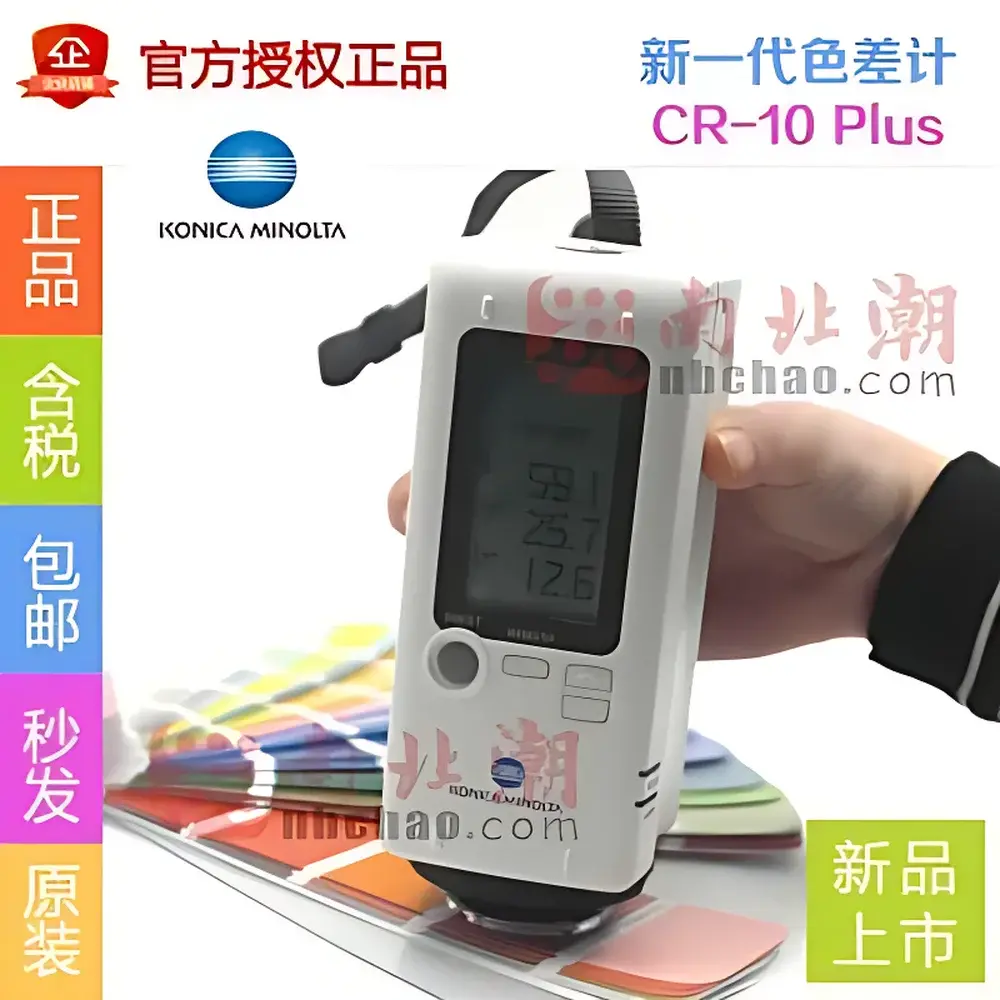
Konica Minolta CR-10 Plus Portable Color Difference Meter
| Brand | Konica Minolta |
|---|---|
| Origin | Japan |
| Model | CR-10 Plus |
| Instrument Type | Portable |
| Optical Geometry | d/8° integrating sphere (including specular component, SCI) |
| Light Source | Pulsed Xenon Lamp |
| Spectral Range | L*: 1–100 |
| Repeatability | Standard deviation of ΔE*ab ≤ 0.1 |
| Measurement Aperture | Ø8 mm |
| Measurement Time | ~1 second |
| Observer Angle | 10° |
| Illuminant | D65 |
| Color Spaces | CIE L*a*b*, L*C*H*, CIE 1976 ΔE*ab |
| Compliance | DIN 5033-7, JIS Z 8722 (Condition d), ISO 7724-1, CIE No. 15, ASTM E1164 |
| Data Storage | Up to 1,000 measurements (reference + sample) |
| Interface | USB 2.0 |
| Power | 4 × AA alkaline or Ni-MH batteries |
| Dimensions | 66 × 158 × 85 mm |
| Weight | 420 g (without batteries) |
| Operating Environment | 0–40°C, ≤85% RH (non-condensing at 35°C) |
| Storage Environment | −20–40°C, ≤85% RH (non-condensing at 35°C) |
Overview
The Konica Minolta CR-10 Plus is a compact, handheld color difference meter engineered for rapid, repeatable color evaluation in production environments, quality control laboratories, and field applications. It operates on the principle of diffuse illumination and directional viewing (d/8° geometry with specular component included—SCI), conforming to international standards including ISO 7724-1, CIE Publication No. 15, ASTM E1164, and JIS Z 8722 (Condition d). The instrument employs a pulsed xenon lamp as its stable, flash-type light source—ensuring consistent spectral output across repeated measurements without thermal drift. Its 10° standard observer angle and D65 illuminant alignment support accurate assessment of color appearance under typical daylight viewing conditions. Designed as the direct successor to the discontinued CR-10, the CR-10 Plus integrates enhanced ergonomics, an enlarged LCD display, and on-device data storage—enabling autonomous operation independent of external software during routine inspections.
Key Features
- Integrated memory supporting up to 1,000 measurement records—including reference standards and sample readings—accessible directly on the device without PC connection.
- Real-time pass/fail judgment using user-defined thresholds for ΔE*ab, Δ(L*a*b*), and Δ(L*C*H*); visual feedback via LED indicators and audible cues (distinct tones for pass/fail outcomes).
- USB 2.0 interface for bidirectional data transfer; compatible with Konica Minolta’s dedicated PC application for advanced reporting, statistical analysis, and export to CSV or PDF formats.
- High repeatability performance: standard deviation of ΔE*ab ≤ 0.1 under controlled conditions (30 consecutive measurements on white calibration tile at 10-second intervals).
- Robust mechanical design optimized for industrial use: lightweight (420 g), compact footprint (66 × 158 × 85 mm), and battery-powered operation (4 × AA cells, enabling ~2,000 measurements per set under typical usage).
- Multi-language UI supporting English, Japanese, and Chinese—facilitating global deployment across multinational manufacturing sites and supplier networks.
Sample Compatibility & Compliance
The CR-10 Plus accommodates flat, opaque, and uniformly textured surfaces with a standard 8 mm measurement aperture. Its d/8° SCI optical configuration ensures reliable color assessment of both matte and glossy materials—including painted panels, plastic housings, coated metals, textiles, and printed packaging—by capturing total reflectance inclusive of specular reflection. Compliance with DIN 5033-7, ISO 7724-1, and ASTM E1164 validates its suitability for regulated industries such as automotive OEM supply chains, pharmaceutical packaging QA, and consumer electronics finish verification. While not designed for liquid or translucent samples, its fixed geometry eliminates operator-dependent variability common in non-integrating instruments. Calibration is performed using a supplied white calibration tile traceable to NIST standards; no external recalibration service is required during normal operation.
Software & Data Management
The CR-10 Plus communicates with Konica Minolta’s proprietary Windows-based software via USB 2.0. This application supports full audit trail functionality—including timestamped measurement logs, operator ID assignment, and version-controlled calibration history—aligning with GLP and GMP documentation requirements. Data exports comply with 21 CFR Part 11 readiness when deployed with appropriate IT controls (e.g., electronic signatures, access logging). Users may generate comparative reports across batches, define custom tolerance zones, and visualize color deviations in CIELAB space. All stored measurements—including statistical summaries (mean, min/max, SD)—remain accessible offline on the device, ensuring continuity during network outages or remote audits.
Applications
- Supplier quality assurance: Rapid verification of incoming material color consistency against master standards across Tier-1 and Tier-2 suppliers.
- In-line process monitoring: Spot-checking of painted, anodized, or molded components during assembly without disrupting workflow.
- Color formulation support: Providing objective ΔE*ab feedback during pigment blending trials to reduce trial-and-error iterations.
- Regulatory compliance documentation: Generating auditable color test records for FDA-regulated packaging, ISO 9001-certified production lines, or IATF 16949 automotive audits.
- Educational labs: Teaching fundamental colorimetry concepts—including CIE color spaces, metamerism, and illuminant dependency—in undergraduate physics and materials science curricula.
FAQ
What standards does the CR-10 Plus comply with?
It conforms to ISO 7724-1, CIE No. 15, ASTM E1164, JIS Z 8722 (Condition d), and DIN 5033-7 for colorimetric measurement methodology and geometric specifications.
Can the CR-10 Plus measure transparent or translucent samples?
No—it is optimized for opaque, solid surfaces. Translucent films, liquids, or powders require specialized instrumentation such as transmission spectrophotometers or integrating sphere accessories.
Is the device suitable for use in cleanroom environments?
Yes, provided ambient temperature and humidity remain within operational limits (0–40°C, ≤85% RH non-condensing); its sealed optical path prevents particulate ingress.
How often must the instrument be calibrated?
Daily verification using the included white calibration tile is recommended before critical measurements; full recalibration by an authorized service center is advised annually or after physical impact.
Does the CR-10 Plus support custom color tolerances beyond ΔE*ab?
Yes—users may configure pass/fail criteria for Δ(L*a*b*) and Δ(L*C*H*) independently, with separate threshold values assignable per parameter.




