
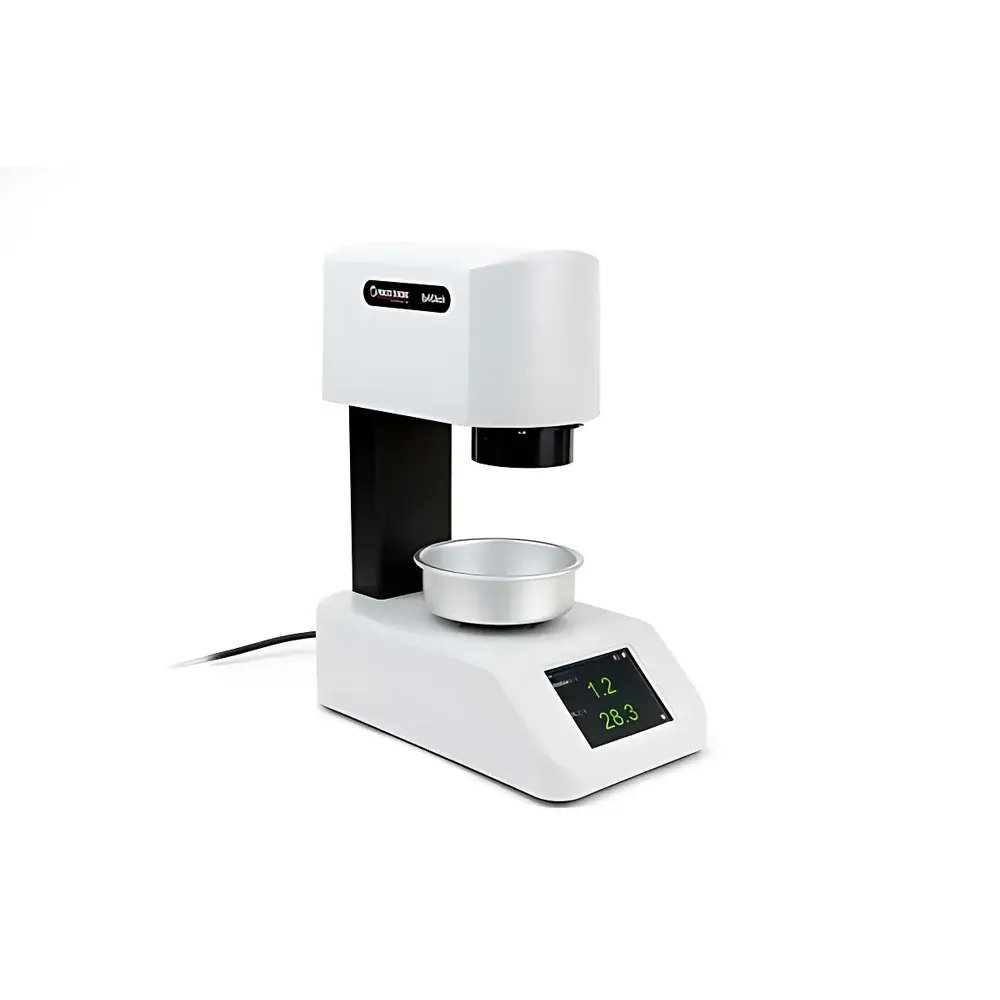
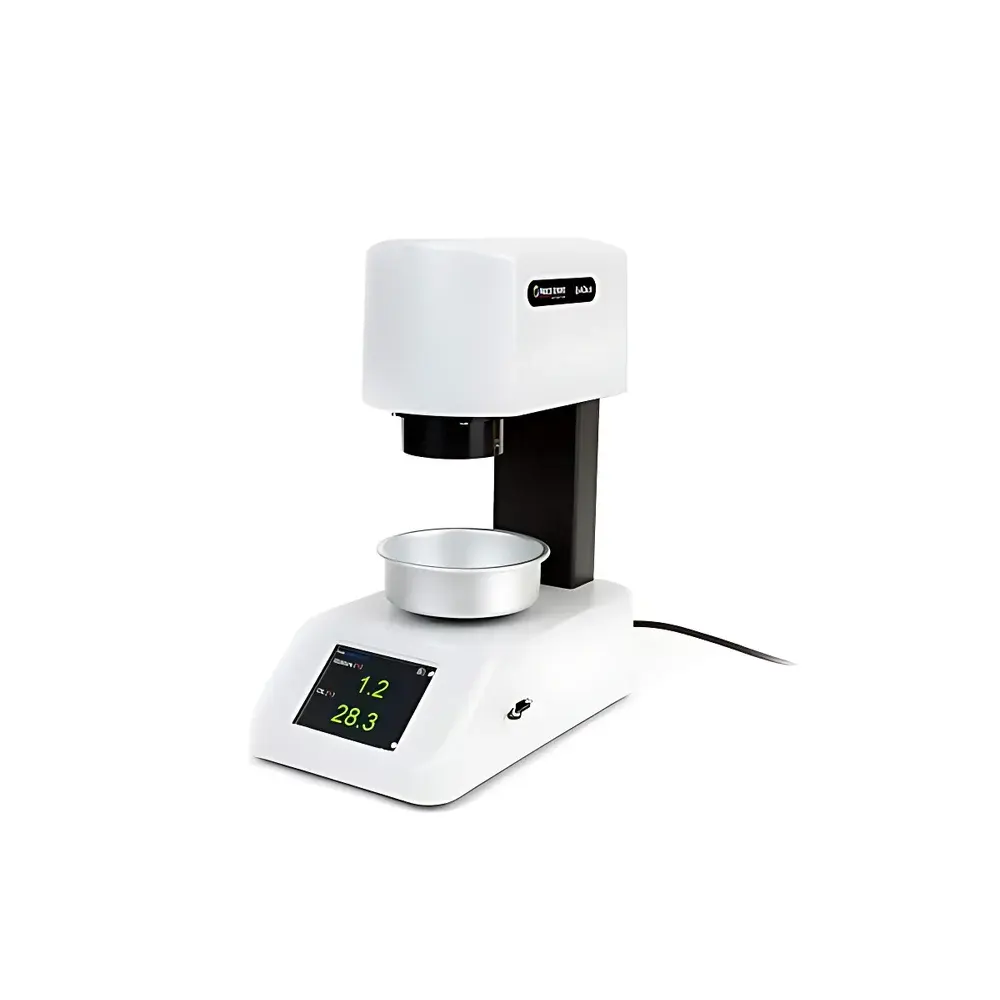
KPM PSC QuikCheck Near-Infrared Moisture and Fat Analyzer
| Brand | KPM PSC |
|---|---|
| Origin | USA |
| Manufacturer Type | Authorized Distributor |
| Product Category | Imported Instrument |
| Model | QuikCheck |
| Application | Laboratory & At-Line Analysis |
| Instrument Principle | Filter-Based NIR |
| Wavelength Channels | 1400 nm, 1820 nm, 1940 nm, 2200 nm |
| Scan Speed | Real-Time |
| Data Sampling Interval | User-Configurable |
| Sample Presentation | Diffuse Reflectance |
| Chemometrics Software | Onboard Embedded Suite |
Overview
The KPM PSC QuikCheck Near-Infrared Moisture and Fat Analyzer is a robust, benchtop filter-based near-infrared (NIR) spectrometer engineered for rapid, non-destructive quantification of moisture, fat/oil, protein, coating weight, and thin-film thickness in solid and semi-solid materials. Operating on fixed-wavelength optical filtering—optimized at 1400 nm (O–H first overtone), 1820 nm (C–H + O–H combination), 1940 nm (O–H second overtone), and 2200 nm (C–H stretch overtones)—the QuikCheck delivers high reproducibility without moving parts or spectral scanning mechanisms. Its measurement architecture relies on diffuse reflectance spectroscopy, enabling direct analysis of heterogeneous samples without grinding, solvent extraction, or chemical reagents. Designed for both laboratory validation and at-line process support, the instrument provides quantitative results in under 10 seconds per measurement—enabling real-time feedback to production supervisors and QC personnel. The system’s thermal-stabilized detector ensures signal integrity across ambient temperatures up to 45 °C, eliminating drift due to thermal gradients common in industrial environments.
Key Features
- Filter-based NIR optics with four discrete, temperature-compensated wavelength channels for targeted molecular absorption detection
- Real-time spectral acquisition with user-defined sampling intervals—from single-shot to continuous monitoring modes
- Dual sample interface options: top-view configuration (for samples behind quartz windows, Petri dishes, vials, or sealed bags) and overhead reflectance mode (for bulk powders, granules, and pastes)
- Rotating sample stage option for improved spatial averaging across non-homogeneous matrices (e.g., tobacco lamina, DDGS pellets, ceramic green bodies)
- Proprietary thermally regulated InGaAs detector assembly, maintaining photometric stability under ambient fluctuations
- Modular mechanical design—optical filters, light source, detector, and sample holder are field-replaceable without calibration recalibration
- Onboard diagnostics engine with self-test routines, LED status indicators, and error-code logging for rapid troubleshooting
- Poly carbonate enclosure rated IP54 for dust resistance and incidental liquid exposure; chemically inert surface compatible with food-grade cleaning agents
Sample Compatibility & Compliance
The QuikCheck accommodates diverse physical forms—including free-flowing powders (e.g., flour, dairy powder), coarse granules (DDGS, wood chips), viscous pastes (peanut butter, hummus), and coated substrates (PVB films, hot-melt adhesive layers). It complies with ISO 12099:2017 (Animal feeding stuffs — Guidelines for the application of near infrared spectroscopy), ASTM E1655 (Standard Practices for Infrared Multivariate Quantitative Analysis), and supports GLP/GMP documentation requirements via audit-trail-capable data export. While not FDA 21 CFR Part 11–certified out-of-the-box, its USB-exported CSV files (with timestamp, operator ID, sample ID, and raw intensity values) are fully compatible with validated LIMS and ELN systems. No hazardous solvents, consumables, or radioactive sources are required—making it suitable for Class 10,000 cleanrooms and USDA-inspected facilities.
Software & Data Management
The analyzer ships with embedded chemometric firmware supporting multivariate regression (PLS-1/PLS-2), outlier detection, and residual analysis. Pre-loaded calibration models cover >35 commodity matrices—including tobacco leaf, corn chips, roasted coffee, meat-and-bone meal, and ceramic slip—requiring only minor parameter tuning upon installation. For proprietary formulations, users can develop custom calibrations using as few as five representative samples via the optional Viewer Suite PC software. This Windows-based application enables full method management: defining product codes, adjusting spectral preprocessing (SNV, derivatives, smoothing), validating model performance (RMSEC, RMSEP, R²), and exporting spectra in JCAMP-DX format. All measurement metadata—including environmental sensor readings (optional external RH/T probe integration), instrument diagnostics, and user annotations—are embedded in each CSV record.
Applications
The QuikCheck serves as a primary or confirmatory tool across regulated and high-throughput sectors. In tobacco processing, it monitors lamina moisture during casing and re-drying to prevent mold growth and ensure consistent burn rate. For wood composites and biofuel feedstocks (e.g., DDGS, wood pellets), it verifies moisture content prior to pelletization to avoid die wear and binder inefficiency. In ceramics manufacturing, it controls green-body water content before bisque firing—reducing cracking and shrinkage variability. Food applications span snack quality control (chip moisture < 2.5% w/w), dairy powder fat homogeneity, and pet food coating uniformity. Coating and adhesive producers use it for PVB film thickness verification and hot-melt glue spread weight consistency—directly correlating to lamination bond strength and shelf-life stability.
FAQ
Does the QuikCheck require daily calibration verification?
No—its fixed-filter design and thermal stabilization eliminate daily standardization. A single NIST-traceable ceramic reference tile is used for quarterly performance verification.
Can it analyze samples in sealed packaging?
Yes—when configured with the top-window module, it measures through low-OH quartz, polyethylene bags, or glass vials without opening the container.
Is method transfer possible between QuikCheck units?
Yes—calibration models and spectral libraries are exportable and interoperable across all QuikCheck instruments of the same generation.
What maintenance is required beyond routine cleaning?
None—no lamps to replace, no gratings to align, and no optical alignment screws. Annual verification by an authorized service technician is recommended.
How does it handle temperature-sensitive samples like chocolate or cheese?
The short measurement time (<10 s) and absence of sample heating elements prevent thermal degradation; optional chilled sample holders are available for extended at-line deployment.





