
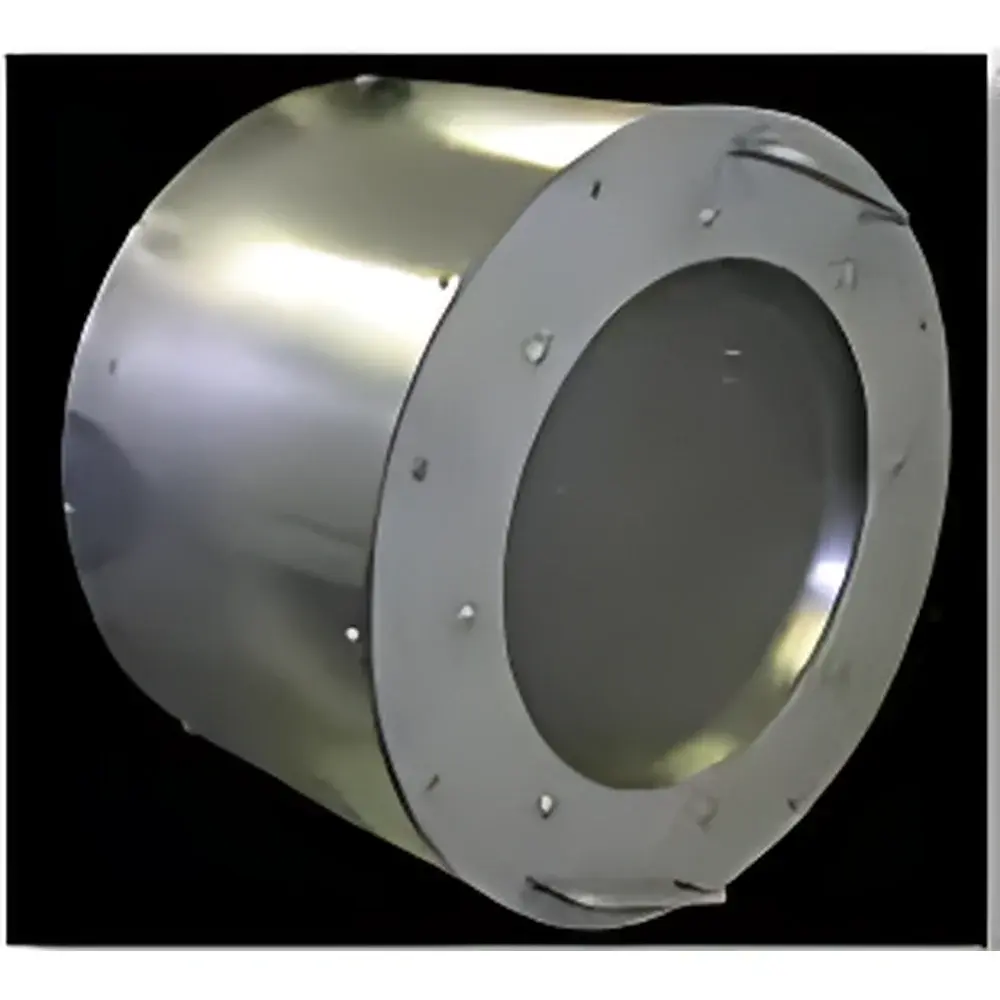
KRI RFICP 220 Radiofrequency Ion Source
| Brand | KRI (Kaufman & Robinson, Inc.) |
|---|---|
| Origin | USA |
| Model | RFICP 220 |
| Anode RF Power | 2 kW @ 2 MHz |
| Max. Beam Current | >1000 mA |
| Beam Energy Range | 100–1200 eV |
| Operating Gases | Ar, O₂, N₂, and other process gases |
| Gas Flow Rate | 5–50 sccm |
| Chamber Pressure | <0.5 mTorr |
| Grid Diameter | 22 cm |
| Grid Material | Molybdenum |
| Beam Optics | OptiBeam™ self-aligning ion optics |
| Neutralizer | LFN 2000 or MHC 1000 |
| Dimensions (H × D) | 30 cm × 41 cm |
| Flange | 10" ConFlat (CF) |
Overview
The KRI RFICP 220 is a high-performance radiofrequency inductively coupled plasma (RF-ICP) ion source engineered for precision ion beam processing in vacuum environments. Unlike thermionic or DC discharge ion sources, the RFICP 220 employs a 2 MHz, 2 kW RF-driven anode coil to generate a dense, stable plasma without internal electrodes—eliminating cathode erosion and enabling extended operational lifetime and superior beam stability. The source operates on the Kaufman-type broad-beam principle, where ions extracted through a three-grid electrostatic system are accelerated to energies between 100 eV and 1200 eV, with total beam currents exceeding 1000 mA under optimized conditions. Its design supports both continuous and pulsed operation modes, making it suitable for applications demanding high reproducibility across extended duty cycles—including semiconductor-grade surface preparation, optical thin-film synthesis, and nanoscale etch profiling.
Key Features
- RF-driven inductively coupled plasma generation ensures electrode-free plasma confinement, minimizing contamination and maximizing source longevity.
- OptiBeam™ self-aligning ion optics provide dynamic control over beam divergence, collimation, and focal characteristics—enabling parallel, focused, or scattered beam configurations without manual realignment.
- 22 cm diameter molybdenum extraction grid assembly offers thermal stability and resistance to sputter erosion during prolonged high-current operation.
- Integrated RF auto-matching network maintains impedance stability across varying gas compositions (Ar, O₂, N₂, and reactive mixtures) and pressure regimes (<0.5 mTorr).
- Modular neutralizer compatibility with LFN 2000 (low-frequency filament neutralizer) or MHC 1000 (magnetohydrodynamic cathode) ensures space-charge compensation across wide current and energy ranges.
- 10-inch ConFlat (CF) flange interface enables straightforward integration into UHV and HV systems, including cluster tools and multi-chamber deposition platforms.
Sample Compatibility & Compliance
The RFICP 220 is compatible with substrates ranging from 100 mm (4″) to 200 mm (8″) wafers, as well as planar optics, metallic foils, and ceramic components. Its low-pressure operation (<0.5 mTorr) and chemically inert plasma generation support processing of oxygen-sensitive materials (e.g., III-V semiconductors, high-k dielectrics) and reactive films (e.g., TiO₂, SiNₓ). The system conforms to standard vacuum interface protocols per ISO-KF and ANSI/ASTM F2781 for ion source integration. While not intrinsically certified, the RFICP 220 is routinely deployed in GLP- and GMP-aligned R&D and pilot-line facilities; its digital control architecture supports audit-ready logging when interfaced with host systems compliant with FDA 21 CFR Part 11 requirements.
Software & Data Management
The RFICP 220 operates via analog and RS-232/RS-485 interfaces, allowing integration with programmable logic controllers (PLCs) and supervisory control systems (SCADA). KRI provides OEM-compatible command sets for remote parameter adjustment—including RF forward/reflected power, extraction voltage, acceleration voltage, and neutralizer bias. Real-time monitoring of beam current, grid temperature, and match network status is supported through optional analog output modules. For traceability-critical environments, third-party data acquisition software (e.g., LabVIEW, EPICS) can log timestamps, setpoints, and measured values with configurable sampling intervals—facilitating post-process correlation with film stoichiometry, roughness, or etch rate uniformity.
Applications
- Ion Beam Assisted Deposition (IBAD): Enhances adhesion, density, and crystallinity of evaporated or sputtered films (e.g., Al₂O₃, YBCO, DLC) by concurrent ion bombardment during growth.
- Ion Beam Sputter Deposition (IBSD): Enables stoichiometric transfer of complex targets (e.g., multilayer mirrors, superconducting oxides) with minimal thermal load and no arcing risk.
- Ion Beam Etching (IBE): Delivers anisotropic, maskless patterning of Si, SiO₂, GaAs, and hard metals at sub-10 nm depth resolution—validated for 200 mm wafer-scale processes.
- Precision Surface Pre-Cleaning: Removes hydrocarbon monolayers and native oxides prior to epitaxial growth or bonding—critical for compound semiconductor heterostructures.
- Ion Beam Figuring (IBF): Used in ultra-precision optics manufacturing for deterministic sub-nanometer surface error correction.
FAQ
What vacuum level is required for stable RFICP 220 operation?
The source requires base pressure ≤5×10⁻⁷ Torr and operating pressure <0.5 mTorr during gas flow to sustain stable plasma ignition and minimize charge-exchange losses.
Can the RFICP 220 operate with reactive gases such as O₂ or Cl₂?
Yes—the RF-driven plasma chamber and molybdenum grids are chemically resistant to O₂, N₂, CF₄, and other reactive feedstocks; however, long-term Cl₂ exposure may require periodic grid inspection.
Is beam energy tunable in real time during deposition?
Yes—acceleration voltage is independently adjustable while maintaining constant beam current, enabling dynamic energy modulation synchronized with substrate rotation or shutter sequencing.
Does KRI provide integration support for custom vacuum platforms?
Yes—KRI engineering offers mechanical interface drawings, electrical pinouts, and protocol documentation for seamless integration into OEM tools and academic UHV systems.
What maintenance intervals are recommended for the RFICP 220?
Under typical 8-hour/day operation, grid inspection is advised every 500 hours; RF matching network capacitors and neutralizer filaments should be verified quarterly per preventive maintenance guidelines.





