
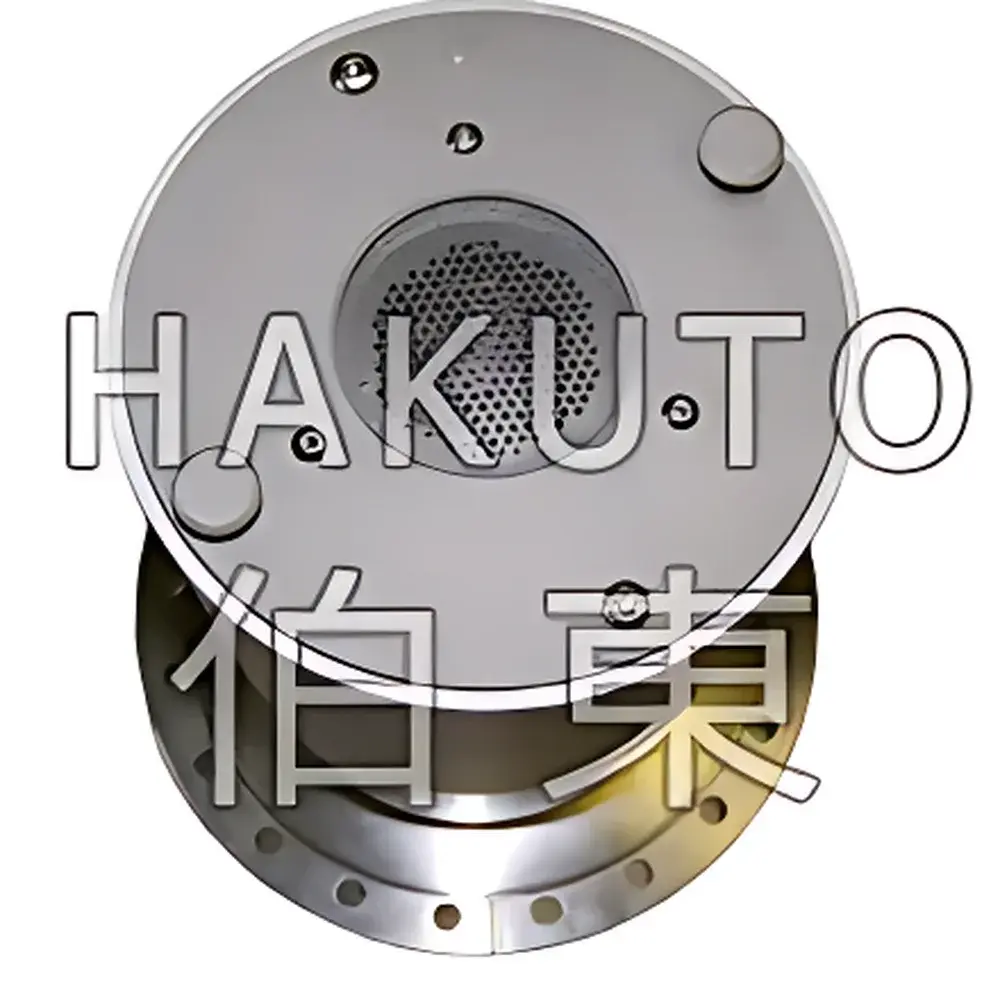
KRI RFICP 325 RF Ion Source for LED-DBR Ion-Assisted Deposition
| Brand | Kaufman & Robinson, Inc. (KRI) |
|---|---|
| Origin | USA |
| Model | RFICP 325 |
| Type | RF Inductively Coupled Plasma Ion Source |
| Grid Configuration | E22 Gridded |
| Beam Coverage | Up to 1650 mm substrate holder diameter |
| Application | Ion Beam Assisted Deposition (IBAD) and Pre-deposition Substrate Cleaning |
Overview
The KRI RFICP 325 is a high-performance radiofrequency inductively coupled plasma (RF-ICP) ion source engineered for precision ion-assisted deposition (IBAD) in advanced optical thin-film manufacturing—particularly for distributed Bragg reflector (DBR) stacks used in high-brightness LED fabrication. Unlike conventional Hall-effect or DC Kaufman-type ion sources, the RFICP 325 operates without internal cathodes or thermionic filaments, eliminating contamination risks from electrode sputtering and enabling ultra-stable, long-lifetime plasma generation under high-vacuum conditions (typically 1×10⁻⁵ to 5×10⁻⁴ Torr). Its core principle relies on inductive coupling of RF power (13.56 MHz) into argon or oxygen process gas, generating a dense, low-energy-spread plasma that is extracted and accelerated through a dual-grid (E22) electrostatic optics system. This architecture delivers a highly collimated, uniform ion beam with independently controllable ion energy (up to 1.2 keV) and ion current density (≥1.5 mA/cm² at 10 cm), critical for optimizing film density, stoichiometry, and interfacial adhesion in multilayer DBR structures composed of alternating SiO₂/TiO₂ or Al₂O₃/Ta₂O₅ layers.
Key Features
- RF-driven plasma generation: No consumable cathodes or filaments—ensures stable operation over >10,000 hours with minimal maintenance downtime.
- E22 dual-grid extraction system: Optimized for wide-beam uniformity across substrates up to 1650 mm in diameter; enables full coverage of large-area e-beam evaporation chambers without mechanical scanning.
- Independent control of ion energy and beam current: Facilitates precise tuning for both pre-deposition substrate cleaning (50–300 eV) and concurrent IBAD (300–1200 eV), minimizing thermal load while maximizing densification.
- Modular mechanical design: Quick-disconnect flanges and tool-less grid alignment simplify field servicing and grid replacement—reducing mean time to repair (MTTR) by >40% versus legacy DC ion sources.
- Integrated RF matching network: Auto-tuning capability maintains impedance stability across varying chamber pressures and gas compositions (Ar, O₂, N₂, or mixtures).
- Full RS-485/Modbus RTU and analog I/O interface: Enables seamless integration into OEM vacuum cluster tools and PLC-based process automation systems.
Sample Compatibility & Compliance
The RFICP 325 is compatible with standard 1650 mm-diameter planetary substrate holders used in industrial-scale e-beam evaporation platforms for LED-DBR production. It supports reactive co-sputtering and oxide-based IBAD processes compliant with ISO 9001-certified thin-film manufacturing workflows. The ion source meets electromagnetic compatibility (EMC) requirements per CISPR 11 Group 2 Class A and is designed for use in cleanroom environments conforming to ISO Class 5 (Class 100) standards. When deployed in GMP-aligned LED packaging lines, its operational parameters—including beam current, extraction voltage, and RF forward/reflected power—are fully audit-trail capable via external SCADA logging, supporting FDA 21 CFR Part 11 data integrity requirements when integrated with validated MES systems.
Software & Data Management
KRI provides the IonSource Control Suite (ISC v3.2), a Windows-based configuration and monitoring application supporting real-time telemetry of ion current, grid voltages, RF forward/reflected power, and chamber pressure correlation. All setpoints and operational logs are timestamped and exportable in CSV or XML format for traceability. For OEM integrators, a comprehensive API (DLL + TCP/IP socket interface) allows embedding ion source control within proprietary deposition recipe managers. Process recipes—including ramp profiles for energy sweeps during pre-clean cycles—can be stored, version-controlled, and recalled with user-level access permissions. Audit trails include operator ID, timestamp, parameter changes, and system fault events—fully aligned with GLP/GMP documentation practices.
Applications
- Ion-assisted deposition of high-refractive-index DBR mirror stacks for GaN-based micro-LEDs and flip-chip LEDs.
- In-situ substrate pre-cleaning prior to oxide layer deposition—removing hydrocarbon monolayers and native oxides without substrate heating or surface damage.
- Densification of porous e-beam evaporated SiO₂ layers, increasing refractive index from ~1.46 to ≥1.48 and reducing moisture uptake in humid operating environments.
- Enhancing interfacial adhesion between TiO₂ and sapphire substrates, directly improving device reliability in thermal cycling and wire-bond pull tests.
- Enabling high-yield production of >30-layer DBR structures with <±0.3% thickness non-uniformity across 150-mm wafers and larger substrates.
FAQ
What vacuum level is required for stable RFICP 325 operation?
Optimal performance is achieved at base pressures ≤2×10⁻⁶ Torr, with process pressure maintained between 1×10⁻⁵ and 3×10⁻⁴ Torr during Ar or O₂ plasma generation.
Can the RFICP 325 be used with reactive gases such as oxygen or nitrogen?
Yes—the RF plasma generation mechanism is chemically inert and fully compatible with O₂, N₂, CF₄, and gas mixtures; no grid corrosion or performance degradation observed after >2000 hours of continuous O₂ operation.
How does the E22 grid design improve uniformity on 1650 mm substrates compared to single-grid sources?
The E22’s optimized aperture geometry and electrostatic lensing profile produce a ±5% ion current density variation across a 1650 mm diameter—verified by Faraday cup mapping—versus ±15–25% typical of uncorrected single-grid configurations.
Is remote diagnostics and predictive maintenance supported?
Yes—integrated sensor telemetry feeds into KRI’s cloud-enabled Predictive Service Platform (PSP), which monitors RF impedance drift, grid emission asymmetry, and cooling water flow anomalies to forecast component replacement needs 72+ hours in advance.
Does the RFICP 325 meet semiconductor equipment safety standards?
It complies with SEMI S2-0215 (safety guidelines) and SEMI F47-0215 (voltage sag immunity), and carries CE marking for EMC and LVD directives.





