
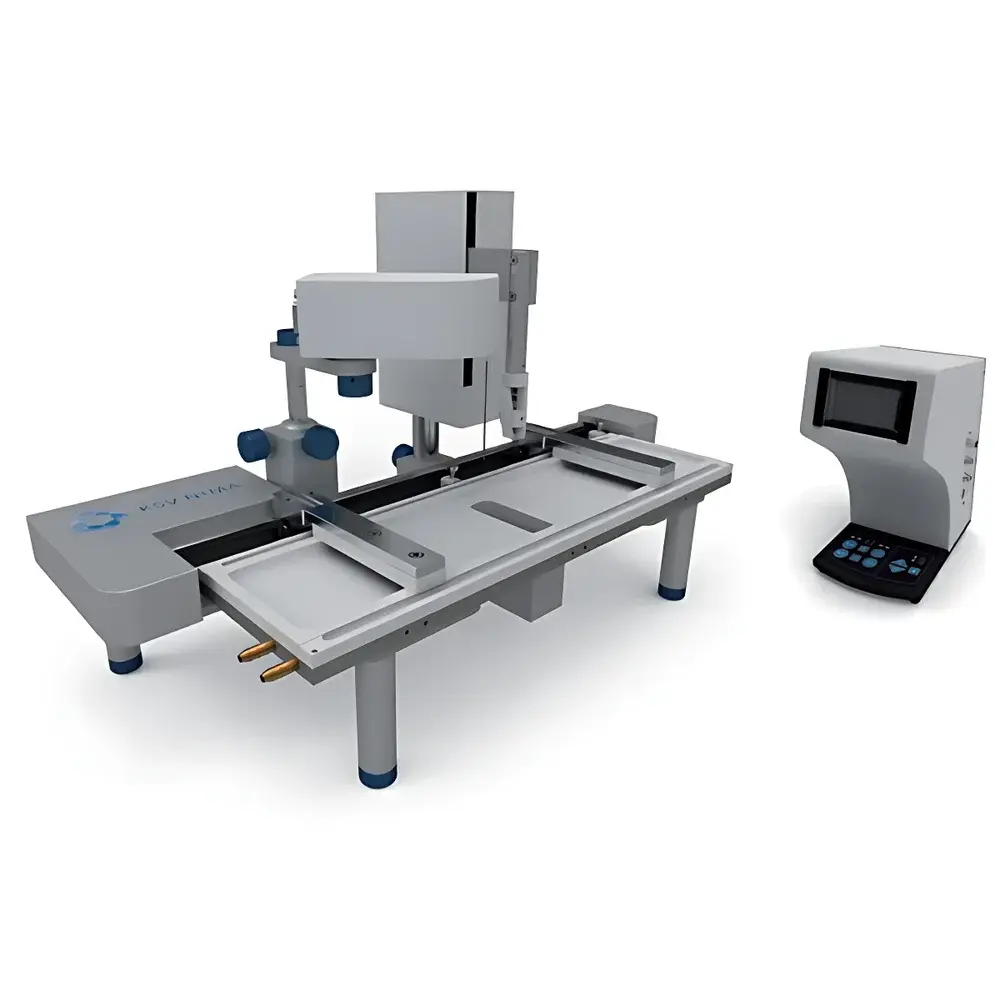
KSV NIMA KN2004 Large-Scale Alternating Langmuir-Blodgett Trough
| Brand | KSV NIMA |
|---|---|
| Origin | Finland |
| Manufacturer Type | Original Equipment Manufacturer (OEM) |
| Category | Imported Instrument |
| Model | KN2004 Large-Scale Alternating |
| Measurement Range | 0–300 mN/m (Pt plate), 0–1000 mN/m (Pt rod) |
| Surface Area per Trough | 930 cm² × 2 |
| Subphase Volume | 6000 mL |
| Temperature Control Range | −10 °C to +60 °C |
| Barrier Speed | 0.1–200 mm/min |
| Barrier Speed Accuracy | ±0.1 mm/min |
| Deposition Speed | 0.1–85 mm/min |
| Balance Max Load | 1 g |
| Force Sensitivity | 0.1 μN/m |
| Trough Dimensions (L×W×H) | 775 × 120 × 10 mm × 2 |
| Dipping Well Radius | 133 mm, Depth: 128 mm |
| Max Substrate Size | 3 × 129 × 114 mm or 4-inch wafer |
| Frame Height Adjustment | 33 mm |
| XYZ Positioning Range for Balance | 360° rotation, 110 mm (X), 45 mm (Y/Z) |
| Power Supply | 100–240 VAC, 50–60 Hz |
Overview
The KSV NIMA KN2004 Large-Scale Alternating Langmuir-Blodgett Trough is a precision-engineered platform for the formation, compression, and sequential vertical deposition of monolayers at air–water or oil–water interfaces. Based on the classical Langmuir–Blodgett (LB) technique, it enables controlled assembly of amphiphilic molecules, nanoparticles, nanowires, graphene derivatives, and biomimetic lipids into highly ordered, thickness-defined thin films. Unlike vapor-phase or spin-coating methods, LB deposition preserves molecular orientation, packing density, and lateral homogeneity across macroscopic areas—critical for functional device fabrication and fundamental interfacial science. The KN2004 implements a dual-trough alternating deposition architecture: two independent, temperature-regulated Langmuir troughs operate in parallel with synchronized barrier control and a shared dipping mechanism, allowing precise layer-by-layer stacking of chemically distinct monolayers (e.g., donor–acceptor bilayers, peptide–polymer heterostructures, or lipid–nanoparticle composites). Its modular frame supports in situ coupling with complementary surface-sensitive techniques including PM-IRRAS, BAM, ISR, and electrochemical probes—enabling real-time correlation between surface pressure, molecular conformation, domain morphology, and interfacial rheology.
Key Features
- Modular dual-trough design with independently controllable barriers, Wilhelmy pressure sensors, and subphase reservoirs—enabling true alternating deposition without cross-contamination.
- High-precision Wilhelmy plate sensor (Pt, 19.62 × 10 mm) compliant with EN 14370:2004; optional Pt rod (0–1000 mN/m range) and liquid/liquid interface plates available.
- PTFE monoblock trough construction: non-porous, autoclavable, chemically inert, and leak-proof—eliminating adhesive-based sealing and minimizing background contamination.
- Hydrophilic Delrin® barriers ensure stable monolayer compression; optional hydrophobic PTFE barriers available for low-surface-energy systems.
- Full XYZ + rotational positioning of microbalance (360° azimuth, 110 mm X, 45 mm Y/Z), enabling optimal alignment with optical access ports and external instrumentation.
- Integrated water-jacketed aluminum baseplate with external chiller/heater interface (−10 °C to +60 °C); level calibration via adjustable stainless-steel feet.
- Dual 930 cm² compression areas (775 × 120 × 10 mm each), 6000 mL total subphase capacity, and semi-circular dipping well (r = 133 mm, d = 128 mm) optimized for uniform vertical transfer of substrates up to 4-inch wafers.
- Deposition speed control from 0.1 to 85 mm/min with closed-loop stepper motor feedback; programmable multi-cycle immersion sequences across three stations (Trough A, Trough B, blank well).
Sample Compatibility & Compliance
The KN2004 accommodates a broad spectrum of amphiphilic and interfacially active materials—including phospholipids, block copolymers, conjugated polymers, quantum dots, carbon nanotubes, exfoliated 2D materials, and peptide amphiphiles—without requiring covalent anchoring or substrate pre-treatment. Its open-frame architecture permits direct integration with ISO/IEC 17025-compliant environmental enclosures and GLP-aligned laboratory workflows. All mechanical and sensing components meet CE marking requirements for electromagnetic compatibility (EN 61326-1) and electrical safety (EN 61010-1). Surface pressure calibration traceability follows ISO 1409 and ASTM D971 protocols; Wilhelmy plate geometry conforms to EN 14370:2004 for interfacial tension measurement reproducibility. For regulated environments, audit trails, user access logs, and electronic signature support are enabled via optional KSV NIMA TroughControl™ software modules compliant with FDA 21 CFR Part 11.
Software & Data Management
Operation is managed through KSV NIMA’s TroughControl™ v5.x software suite—a Windows-based application supporting real-time acquisition, multi-channel synchronization (pressure, barrier position, temperature, pH, conductivity), and automated isotherm generation. Isotherms are exportable in ASCII, CSV, and MATLAB-compatible formats; raw force data includes timestamped metadata (sensor ID, calibration date, ambient conditions). Advanced scripting allows custom deposition routines (e.g., “dip–pause–dry–repeat” cycles with variable dwell times), conditional triggers (e.g., deposit only when π ≥ 25 mN/m), and batch processing across multiple experiments. Integrated data validation tools flag outliers based on standard deviation thresholds and hysteresis analysis. For regulatory compliance, optional 21 CFR Part 11 modules provide role-based user authentication, electronic signatures, and immutable audit logs with SHA-256 hashing of all parameter changes and measurement events.
Applications
- Biomimetic membrane studies: Reconstitution of lipid rafts, protein–lipid interactions, antimicrobial peptide insertion kinetics, and drug–membrane partitioning under physiologically relevant ionic strength and pH.
- Functional hybrid films: Alternating deposition of electron-donor (e.g., phthalocyanines) and electron-acceptor (e.g., fullerenes) monolayers for organic photovoltaics and photodetectors.
- Nanomaterial assembly: Controlled stacking of graphene oxide–polyelectrolyte, MoS₂–peptide, or AuNP–DNA layers for biosensing, catalysis, and ion-gated transistors.
- Interfacial reaction monitoring: In situ tracking of interfacial polymerization, enzyme-mediated hydrolysis, antigen–antibody binding, and photo-crosslinking using synchronized pressure–fluorescence or pressure–IR readouts.
- Colloidal and surfactant science: Quantitative assessment of micellization thresholds, mixed monolayer phase behavior, and emulsion stabilization mechanisms via compression–expansion cycling and dilatational rheology.
- Thin-film rheology: Coupling with KSV NIMA ISR for simultaneous surface pressure and interfacial shear modulus measurements during compression or oscillatory deformation.
FAQ
What distinguishes the KN2004 from single-trough LB systems?
The KN2004 integrates two fully independent Langmuir troughs with synchronized barrier motion and a shared dipping arm—enabling true alternating deposition without manual trough swapping or risk of monolayer collapse. This architecture eliminates downtime between layers and ensures consistent transfer conditions across >100-layer stacks.
Can the system be used for liquid–liquid (oil–water) monolayers?
Yes. Optional Wilhelmy plates designed for liquid–liquid interfaces (e.g., W19.62 × H7 mm Pt plate) and subphase immiscibility kits are available. Temperature-controlled dual-phase reservoirs support stable interfacial film formation at oil–water boundaries.
Is in situ infrared or fluorescence imaging supported?
Absolutely. The open-top, low-profile frame provides unobstructed optical access for PM-IRRAS, BAM, epifluorescence microscopy, and confocal setups. Dedicated mounting brackets and kinematic stages facilitate repeatable alignment with external optics.
How is temperature uniformity maintained across large trough areas?
The aluminum baseplate features integrated coolant channels connected to an external recirculating chiller. Thermal mapping confirms ≤ ±0.3 °C variation across the full 930 cm² surface at steady state, verified by calibrated Pt100 sensors embedded in both troughs.
What maintenance is required for long-term stability?
Annual recalibration of the microbalance and pressure sensor is recommended. PTFE troughs require only deionized water rinsing between experiments; Delrin® barriers are cleaned with ethanol and inspected for wear. No lubricants or consumable gaskets are used in the core mechanism.
Related Products



