
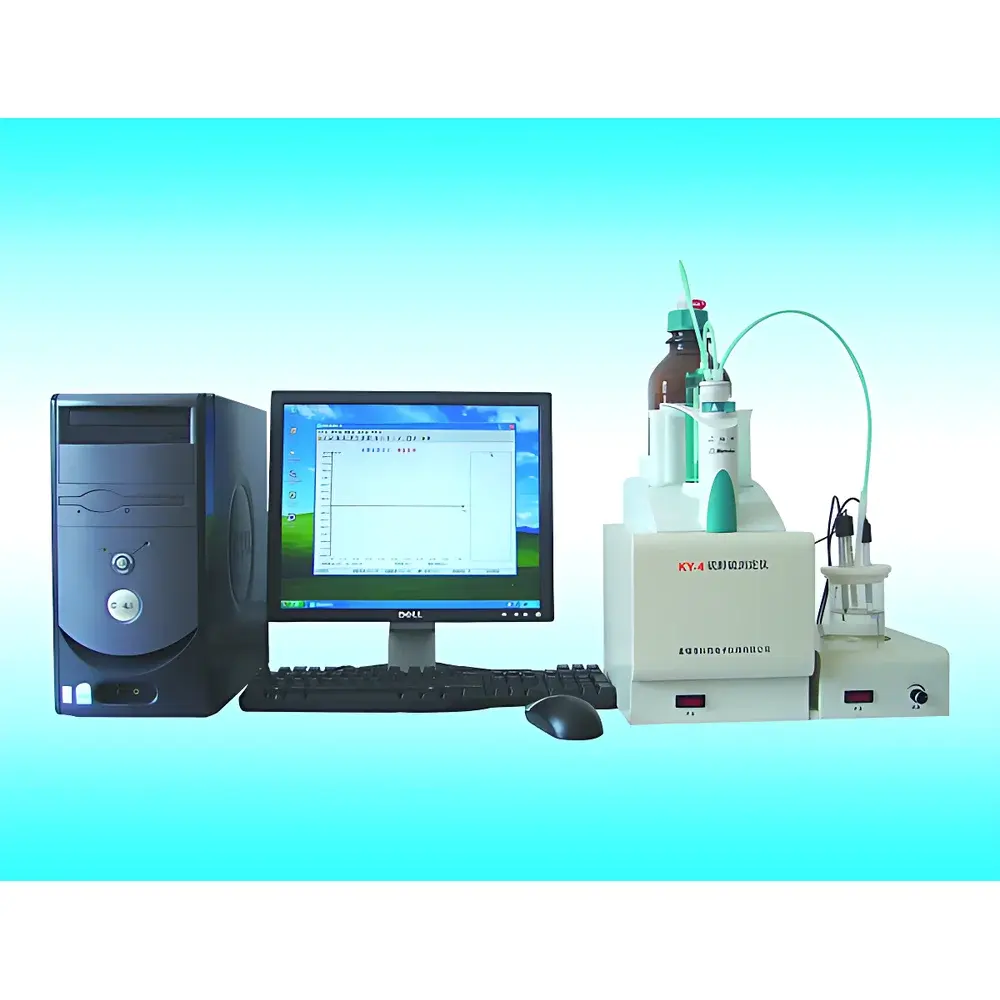
KY-4S Thiolsulfur Analyzer by Keyuan Instruments
| Brand | Keyuan Instruments |
|---|---|
| Origin | Jiangsu, China |
| Manufacturer Type | Direct Manufacturer |
| Origin Category | Domestic (China) |
| Model | KY-4S |
| Pricing | Upon Request |
| Sample Type | Liquid |
| Analytical Method | Potentiometric Titration |
| Detection Limit | ≥3 µg/g |
| Minimum Titrant Dispense Volume | 0.01 mL |
| Potentiometric Range | 0 to ±1999.5 mV |
| Burette Accuracy | ±0.1% F.S. |
| Electronic Unit Basic Error | ±0.1% of full scale + 0.5 mV |
| Relative Standard Deviation | ≤5% |
| Compliance Standard | GB/T 1792–1988 “Determination of Mercaptan Sulfur in Distillate Fuels” |
Overview
The KY-4S Thiolsulfur Analyzer is a fully automated potentiometric titration system engineered for precise quantification of mercaptan sulfur (R–SH) in liquid hydrocarbon samples—primarily distillate fuels such as gasoline, kerosene, diesel, and jet fuel. Based on the principle of selective electrochemical titration with silver nitrate (AgNO₃), the instrument detects the stoichiometric endpoint via real-time monitoring of potential shift across a dual high-impedance silver/silver sulfide indicator electrode pair. This method conforms rigorously to the Chinese national standard GB/T 1792–1988, which aligns closely with ASTM D3229 (Standard Test Method for Mercaptans in Gasoline and Aviation Fuels by Potentiometric Titration) in analytical scope and procedural logic. The KY-4S integrates a calibrated burette drive, low-drift potentiometric measurement circuitry, and closed-loop endpoint recognition algorithms to deliver reproducible results under routine laboratory conditions—without manual intervention or subjective visual interpretation.
Key Features
- Imported precision titration module with ceramic piston burette, delivering consistent 0.01 mL minimum dispensing resolution and ±0.1% full-scale volumetric accuracy.
- Dual high-impedance input circuitry (≥10¹² Ω) ensures stable electrode potential acquisition and minimizes noise-induced endpoint drift during slow titrant addition near equivalence point.
- Real-time digital smoothing of titration curves using adaptive Savitzky–Golay filtering; automatic inflection-point detection with second-derivative-based endpoint refinement.
- Integrated fluid handling subsystem supports automatic reagent replenishment, fixed-volume sample aspiration, and waste evacuation—all synchronized with titration sequence logic.
- Embedded microcontroller architecture with isolated analog signal conditioning provides immunity to electromagnetic interference typical in refinery-adjacent lab environments.
- Compliance-ready operation log: timestamps all critical events—including electrode calibration, blank titration, sample injection, endpoint confirmation, and result calculation—for GLP traceability.
Sample Compatibility & Compliance
The KY-4S accepts transparent, non-viscous liquid hydrocarbon samples within the boiling range of C₅–C₁₆, including but not limited to motor gasoline (ASTM D439), aviation turbine fuel (ASTM D1655), and middle distillates (ASTM D975). Samples must be free of suspended solids and elemental sulfur, which may interfere with Ag⁺–thiolate complex formation. The analyzer operates strictly within the performance envelope defined by GB/T 1792–1988, ensuring metrological consistency with interlaboratory validation data reported in CNAS-accredited proficiency testing schemes. While not certified to ISO/IEC 17025 out-of-the-box, its hardware architecture and data integrity controls support full audit readiness for GMP-aligned QA/QC workflows—including 21 CFR Part 11-compliant electronic records when paired with validated third-party LIMS interfaces.
Software & Data Management
The KY-4S runs embedded firmware supporting USB-host connectivity for direct export of raw titration curves (.CSV), processed results (.XLSX), and audit trails (.LOG) to external storage. Optional Windows-based PC software (v3.2+) provides advanced visualization tools—including overlay comparison of multiple titration profiles, statistical summary reports per batch, and customizable certificate-of-analysis templates. All measurement data include embedded metadata: operator ID, sample ID, date/time stamp, electrode serial number, calibration verification status, and calculated uncertainty budget per ISO/IEC Guide 98-3 (GUM). Audit trail entries are write-once, non-erasable, and time-stamped with NTP-synchronized hardware clock.
Applications
- Quality control of finished gasoline blends prior to dispatch, verifying compliance with ultra-low sulfur fuel specifications (e.g., ≤10 ppm total sulfur, where thiols contribute significantly to odor and corrosion).
- Refinery process monitoring: tracking mercaptan conversion efficiency in Merox® or caustic wash units.
- R&D evaluation of antioxidant additives that suppress thiol oxidation pathways during fuel aging studies.
- Forensic analysis of fuel adulteration—elevated mercaptan levels may indicate improper desulfurization or blending with untreated straight-run naphtha.
- Supporting ASTM D664 acid number correlation studies, as thiols can influence baseline stability in potentiometric acid-base titrations.
FAQ
What electrode configuration does the KY-4S require?
A matched pair of silver/silver sulfide (Ag/Ag₂S) indicator electrodes with reference junctions filled with saturated KNO₃ electrolyte. Electrode cleaning and storage protocols follow GB/T 1792–1988 Annex B.
Can the KY-4S analyze viscous or multi-phase samples?
No. Only homogeneous, low-viscosity (5% FAME, or heavy gas oils require prior solvent dilution and phase separation.
Is method validation documentation included?
Yes—the instrument delivery package includes a Factory Performance Verification Report covering repeatability (n=6, RSD ≤3.2%), spike recovery (92–103%), and linearity (r² ≥0.999 over 3–100 µg/g range), conducted per ISO 8466-1.
Does the system support remote diagnostics?
Local Ethernet port enables ping-based connectivity checks and firmware version interrogation; however, no cloud telemetry or remote control functionality is implemented for cybersecurity compliance.
How often must the titrant solution be standardized?
Daily standardization against certified potassium iodate (KIO₃) reference material is recommended, especially when ambient temperature fluctuates >±2 °C between calibrations.






