
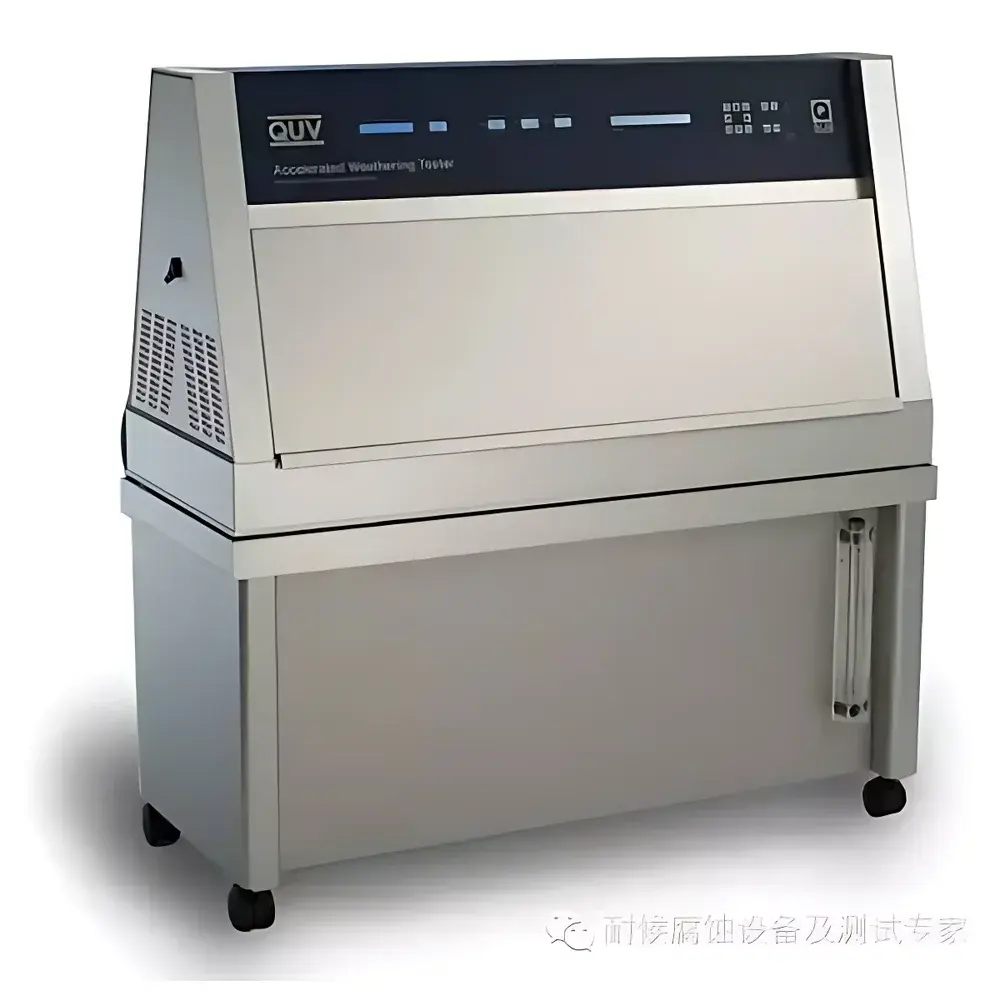
Q-LAB QUV/basic UV Aging Test Chamber
| Brand | Q-LAB |
|---|---|
| Origin | USA |
| Model | QUV/basic |
| UV Wavelength Range | 280–400 nm |
| Compliance | ASTM G154, ISO 11507, JIS D0205, SAE J2020, ASTM D4587, ISO 4892-3, DIN 53384, GM 9125P, NACE TM-01-84 |
| Sample Capacity | Two 75 mm × 150 mm specimens per rack |
| Light Source | Fluorescent UV lamps (UVA-340 standard) |
| Condensation Mechanism | Water-cooled condensate cycle |
| Irradiance Control | None (manual lamp replacement & positioning required) |
| Chamber Construction | Stainless steel interior, insulated enclosure |
Overview
The Q-LAB QUV/basic UV Aging Test Chamber is a rigorously engineered environmental test system designed to accelerate material degradation under controlled ultraviolet (UV) radiation and condensation cycles. It operates on the principle of fluorescent UV irradiation combined with thermal-hygrometric condensation—mimicking key outdoor weathering stressors including solar UV exposure, dew formation, and thermal cycling. Unlike full-featured models with closed-loop irradiance control, the QUV/basic relies on standardized UVA-340 fluorescent lamps calibrated to replicate the critical short-wave UV spectrum (295–365 nm) of terrestrial sunlight. This configuration delivers reproducible spectral output for comparative durability assessment across polymer, coating, automotive, and architectural material testing programs. The chamber’s architecture prioritizes operational simplicity and cost-efficiency while maintaining strict adherence to internationally recognized weathering test protocols.
Key Features
- UVA-340 fluorescent lamp array optimized for solar-spectrum simulation in the 295–365 nm range, with documented spectral stability across lamp life
- Condensation cycle generated via temperature-controlled water-cooled specimen backplate, replicating nocturnal dew formation without external humidification systems
- Fixed-intensity UV exposure—no SOLAR EYE irradiance feedback control; lamp output decays predictably over service life (typical 1,600–2,000 hours)
- Manual lamp alignment and periodic replacement protocol ensures consistent irradiance geometry; lamp position verification recommended every 500 hours
- Stainless steel test chamber interior with corrosion-resistant insulation and integrated drain for condensate management
- Standard sample rack accommodates two 75 mm × 150 mm flat specimens; full chamber coverage required for uniform thermal and radiometric boundary conditions
Sample Compatibility & Compliance
The QUV/basic supports rigid and semi-rigid flat specimens up to 3 mm thickness, including organic coatings, thermoplastics, elastomers, adhesives, and fiber-reinforced composites. Its operational envelope aligns with regulatory and industry-standard test methods requiring non-adjustable UV intensity profiles. It is validated for use in ASTM G154 (practice for fluorescent UV-condensation exposures), ISO 11507 (paints and varnishes—exposure to artificial weathering), JIS D0205 (automotive exterior materials), and SAE J2020 (accelerated exposure of automotive exterior materials). All test procedures assume compliance with GLP documentation requirements—including lamp batch traceability, calibration log maintenance, and specimen mounting verification prior to each test run.
Software & Data Management
The QUV/basic utilizes a microprocessor-based controller with fixed-cycle programming (e.g., 4-hour UV / 4-hour condensation), time-of-test logging, and real-time temperature monitoring of black-panel sensor and chamber air. While lacking Ethernet connectivity or audit-trail functionality, it records cumulative UV exposure time and thermal cycle counts in non-volatile memory. Data export requires manual transcription; users are advised to integrate external data loggers for 21 CFR Part 11-compliant environments. Lamp usage hours must be manually logged against batch certificates to ensure traceability per ISO/IEC 17025 clause 7.7.
Applications
This model serves laboratories conducting comparative aging studies where absolute irradiance control is not mandated—such as internal quality benchmarking, supplier qualification screening, and pre-screening for full-irradiance qualification testing. It is routinely deployed in R&D labs validating UV stabilizer packages in polyolefins, evaluating gloss retention in automotive clearcoats, assessing chalking resistance in exterior architectural paints, and screening photostability of medical device polymer housings. Its deterministic decay profile enables statistically robust inter-laboratory correlation when paired with reference standards (e.g., NIST SRM 2242).
FAQ
Does the QUV/basic support irradiance calibration or adjustment?
No. It operates at fixed nominal output; irradiance cannot be measured in real time or adjusted during operation. Calibration is performed offline using a calibrated UV radiometer prior to test initiation.
What lamp types are compatible with the QUV/basic?
Only Q-LAB–certified UVA-340 lamps are supported; substitution with generic or non-Q-LAB lamps invalidates test method compliance and voids warranty.
Is condensation achieved via humidity generation or surface cooling?
Condensation is formed exclusively by cooling the specimen backside below dew point using chilled water—no humidifier or steam generator is used.
Can the QUV/basic perform spray or xenon arc testing?
No. It is limited to UV/condensation cycling. Spray functionality requires QUV/spray; xenon arc testing requires Q-SUN series instruments.
How frequently must lamps be replaced?
Lamp replacement is recommended after 1,600 hours of cumulative UV exposure or upon visible phosphor degradation—whichever occurs first—as verified by spectral output measurement.



