
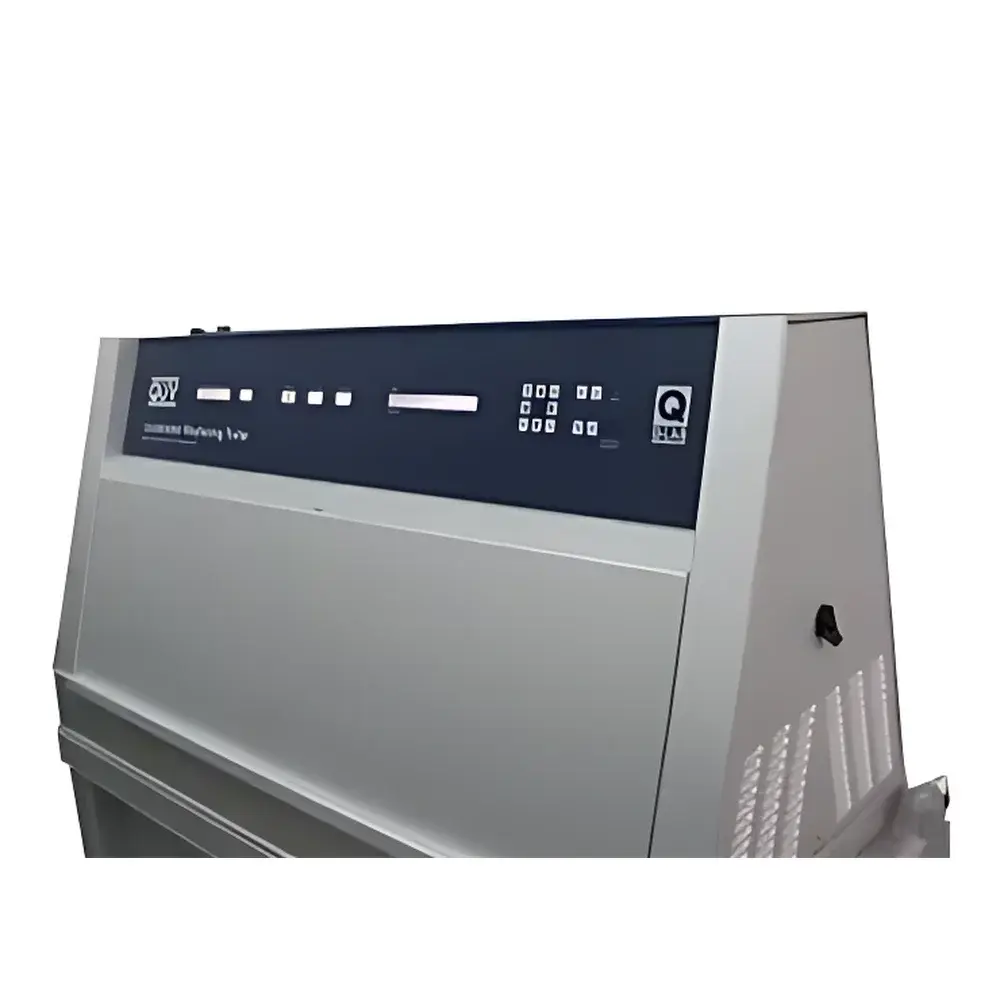
Q-Lab QUV/basic UV Aging Test Chamber
| Brand | Q-Lab |
|---|---|
| Origin | USA |
| Model | QUV/basic |
| UV Wavelength Range | 280–400 nm |
| Compliance | ASTM G151, ASTM G154, ISO 4892-3, ISO 11507, JIS D0205, SAE J2020, GB/T 14522 |
| Control System | Programmable microprocessor controller with self-diagnostic function |
| Condensation Mechanism | Water condensation via heated chamber air and cooled specimen surface |
| Lamp Type | Fluorescent UV-A (UVA-340) or UV-B (UVB-313) lamps |
| Chamber dimensions | Custom-configurable — contact technical support for volume specifications |
| Operating temperature range (black panel) | 30–70 °C (typical, model-dependent) |
| Light exposure cycle | Adjustable UV-only or UV/condensation alternating cycles |
Overview
The Q-Lab QUV/basic UV Aging Test Chamber is an entry-level, cost-optimized accelerated weathering instrument engineered for reproducible simulation of short-wave ultraviolet (UV) radiation and moisture-induced degradation mechanisms. It operates on the fundamental principle of controlled fluorescent UV irradiation—primarily using UVA-340 (mimicking solar UV down to 295 nm) or UVB-313 (extending into more aggressive, sub-solar wavelengths)—combined with a thermally driven condensation cycle that replicates dew formation on material surfaces. Unlike irradiance-controlled variants (e.g., QUV/se or QUV/spray), the QUV/basic model does not integrate SOLAR EYE feedback photometry; therefore, UV intensity remains fixed at nominal lamp output and requires periodic lamp replacement and manual alignment to maintain test consistency. This architecture makes it suitable for comparative exposure studies—where specimens and controls are tested concurrently within the same chamber—rather than absolute irradiance quantification or compliance-critical qualification per ISO 9001 traceability requirements.
Key Features
- Programmable microprocessor-based controller enabling precise sequencing of UV exposure and condensation phases
- Automatic error detection and real-time alarm reporting with fault-code display for rapid troubleshooting
- Auto-shutdown timer with configurable end-of-test behavior (audible alert, system power-down, or status message retention)
- Robust stainless-steel chamber construction with insulated double-wall design for thermal stability and long-term corrosion resistance
- Condensation mechanism achieved by maintaining elevated chamber air temperature while cooling specimen racks—no external water supply required
- Standard lamp rack accommodates eight 40-W fluorescent UV tubes (UVA-340 or UVB-313), with user-accessible mounting for routine maintenance
- No integrated spray or irradiance monitoring subsystem—designed for simplicity, reliability, and lower TCO in high-throughput screening labs
Sample Compatibility & Compliance
The QUV/basic supports flat, rigid, or moderately contoured specimens up to 18 mm thick and 150 mm × 75 mm in footprint—compatible with standard ASTM G154 specimen holders. It complies with core international standards governing UV exposure methodology, including ASTM G154 (practice for fluorescent UV-condensation exposures), ISO 4892-3 (plastics—methods of exposure to laboratory light sources—fluorescent UV lamps), ISO 11507 (paints and varnishes—exposure to artificial weathering), and JIS D0205 (automotive exterior materials). While it meets the procedural requirements of these standards, users requiring irradiance traceability per ISO/IEC 17025 or regulatory submissions under FDA 21 CFR Part 11 must implement external calibration protocols and document lamp aging intervals. Q-Lab recommends quarterly lamp replacement and biannual verification of black-panel temperature uniformity per ASTM G147.
Software & Data Management
The QUV/basic utilizes embedded firmware—not PC-based software—for all operational logic. All cycle parameters—including UV duration, condensation period, total exposure time, and setpoint temperatures—are entered directly via membrane keypad and stored in non-volatile memory. The controller logs runtime hours, cycle counts, and fault events with timestamped entries accessible through the diagnostic menu. For laboratories operating under GLP or GMP frameworks, raw event logs can be manually transcribed or captured via serial interface (RS-232 optional) for inclusion in electronic batch records. Full audit-trail capability, electronic signatures, or automated report generation are not native to this model; integration with third-party LIMS or SCADA systems requires custom scripting and hardware gateways.
Applications
This chamber is routinely deployed in R&D and QC environments for comparative durability assessment across polymer formulations, coatings, automotive trim, architectural sealants, and roofing membranes. Typical use cases include: evaluating yellowing resistance of polycarbonates per ASTM D4329; screening UV stabilizer efficacy in PVC compounds; validating gloss retention of coil-coated steel substrates; assessing chalking behavior in exterior-grade acrylic paints per ISO 2812-3; and conducting preliminary qualification of adhesive bonds under cyclic UV/moisture stress (ASTM C1442). Its fixed-intensity design ensures high inter-laboratory repeatability when used strictly for relative ranking—provided lamp batches, replacement schedules, and specimen orientation are rigorously standardized.
FAQ
Does the QUV/basic support irradiance measurement or automatic lamp output compensation?
No. The QUV/basic lacks SOLAR EYE irradiance feedback and does not adjust lamp power or compensate for spectral drift. Users must rely on scheduled lamp replacement (typically every 1,600–2,000 hours) and manual verification using a calibrated UV radiometer.
Can I run ASTM D4587 (coatings) or ISO 4892-3 (plastics) cycles on this model?
Yes—provided the specified UV lamp type (UVA-340 for daylight simulation, UVB-313 for accelerated failure) and exposure/condensation timing align with the standard’s procedural clauses. However, absolute irradiance values cited in those standards cannot be validated without external instrumentation.
Is the QUV/basic compliant with ISO 9001 or ISO/IEC 17025 calibration requirements?
The unit itself is not ISO/IEC 17025-accredited. Traceable calibration of black-panel temperature sensors and UV irradiance (if performed externally) must be documented separately per your organization’s quality management system.
What maintenance is required beyond lamp replacement?
Monthly cleaning of lamp sockets and reflector surfaces with isopropyl alcohol; quarterly inspection of condensate drain path; annual verification of chamber temperature uniformity per ASTM G147; and biannual check of door gasket integrity.
Can I upgrade a QUV/basic to include SOLAR EYE or spray functionality?
No. SOLAR EYE irradiance control and spray nozzles require structural modifications, additional sensors, and firmware revisions unavailable as field retrofits. Migration to QUV/se or QUV/spray necessitates full system replacement.



