
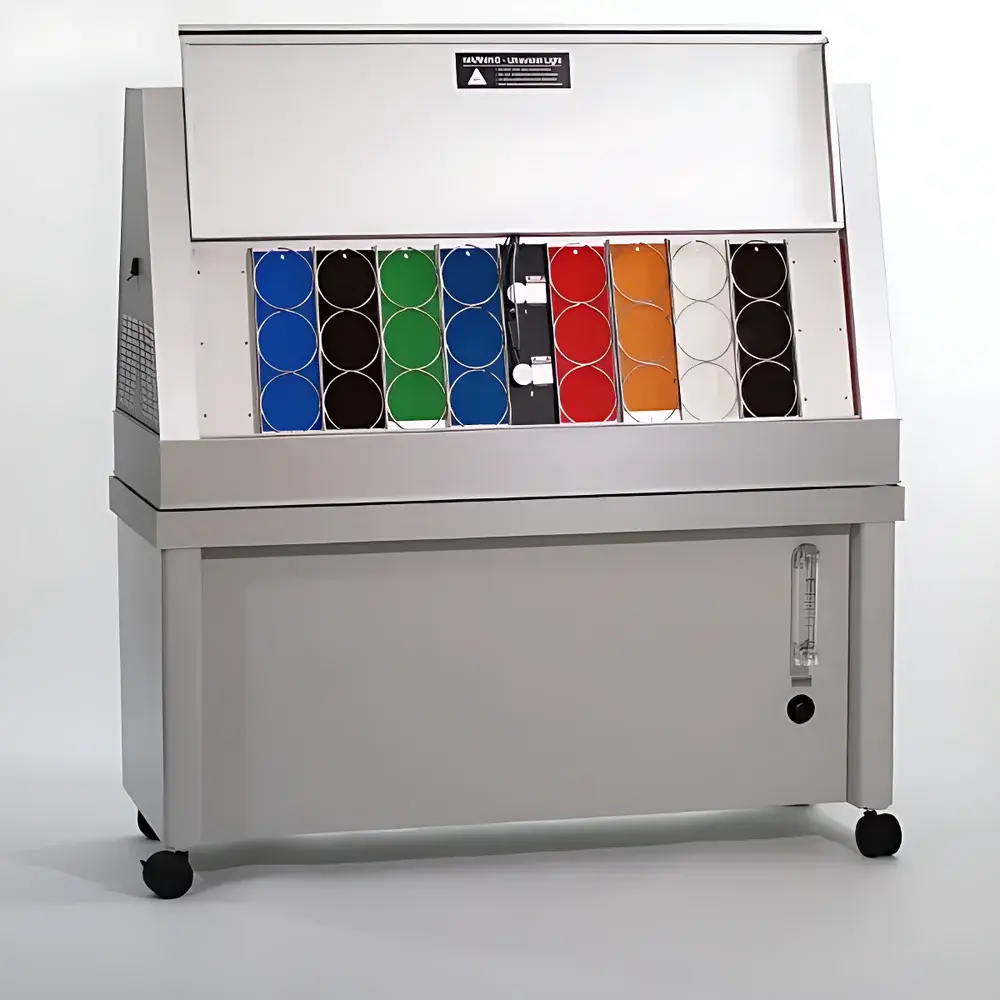
Q-Lab QUV/se Solar Eye UV Aging Test Chamber
| Brand | Q-Lab |
|---|---|
| Origin | USA |
| Manufacturer Type | Authorized Distributor |
| Origin Category | Imported |
| Model | QUV/se |
| Irradiance Range | 0.48–0.95 W/m² @ 340 nm |
| Exposure Time | Adjustable from 1 to 9999 hours |
| UV Wavelength Range | 250–400 nm |
| Chamber Capacity | Up to 48 specimens (75 mm × 150 mm each) |
Overview
The Q-Lab QUV/se Solar Eye UV Aging Test Chamber is an industry-standard accelerated weathering instrument engineered for precision simulation of solar ultraviolet radiation and moisture-induced degradation mechanisms. It operates on the principle of controlled cyclic exposure—alternating between UV irradiation (via fluorescent UVA-340 lamps) and condensation-driven humidity—mimicking the dominant stressors in outdoor atmospheric aging: sunlight, dew, and thermal cycling. Unlike broad-spectrum xenon arc or carbon arc testers, the QUV/se focuses specifically on the short-wave UV band (295–365 nm), where photodegradation of polymers, coatings, adhesives, and automotive finishes is most pronounced. Its design conforms to core principles defined in ASTM G154, ISO 4892-3, and SAE J2020, enabling direct correlation with real-world field performance across months or years of natural exposure—compressed into days or weeks under laboratory control.
Key Features
- Solar Eye irradiance control system maintains precise, repeatable UV intensity at 340 nm (±0.02 W/m²), eliminating lamp-to-lamp variability and drift over time.
- UVA-340 fluorescent lamps replicate the critical short-wavelength region of terrestrial sunlight (295–365 nm), delivering high-fidelity spectral match for polymer and coating degradation studies.
- Condensation mechanism generates realistic dew-like moisture through controlled water vapor saturation on specimen surfaces—no external water supply required beyond standard tap water.
- Third-generation touchscreen controller with dual-line LCD display, intuitive programming interface, and real-time exposure condition monitoring (UV intensity, chamber temperature, cycle phase).
- Integrated self-diagnostic system provides audible/visual alerts, maintenance reminders, and AutoCal™ rapid calibration verification using built-in reference sensors.
- Multi-color LED status indicators enable at-a-glance operational assessment—even from across a busy laboratory floor.
- Robust stainless-steel chamber construction ensures long-term stability, corrosion resistance, and compliance with GLP-aligned lab infrastructure requirements.
Sample Compatibility & Compliance
The QUV/se accommodates up to 48 flat specimens measuring 75 mm × 150 mm, supporting standardized test panels per ASTM D6695, ISO 11341, and GB/T 14522. Its compact footprint and modular rack configuration allow seamless integration into QC labs, R&D facilities, and contract testing centers operating under ISO/IEC 17025-accredited protocols. All Q-Lab instruments are designed and validated to meet electromagnetic compatibility (EMC) per IEC 61326-1 and safety standards per UL 61010-1. The Solar Eye irradiance control system supports traceable calibration against NIST-traceable reference standards, satisfying audit requirements for FDA 21 CFR Part 11–compliant data integrity frameworks when paired with optional Q-Lab’s QUV Data Logger software.
Software & Data Management
While the QUV/se operates autonomously via its embedded controller, optional Q-Lab QUV Data Logger software enables secure, timestamped acquisition of irradiance, temperature, and cycle phase data—exportable in CSV or XML format for statistical process control (SPC) analysis. The software supports user-defined alarm thresholds, electronic signature capture, and audit trail generation compliant with GLP and GMP documentation practices. For laboratories requiring full 21 CFR Part 11 compliance, Q-Lab offers validated IQ/OQ documentation packages and optional network-enabled remote monitoring modules compatible with enterprise LIMS environments.
Applications
The QUV/se is routinely deployed for qualification testing of automotive clearcoats, architectural sealants, PVC roofing membranes, aerospace composites, medical device packaging films, and consumer electronics housings. Its reproducible UV-dose delivery makes it ideal for comparative durability ranking, formulation optimization, supplier qualification, and failure root-cause analysis. In regulatory contexts, it supports submissions to EPA Safer Choice, EU REACH Annex XVII, and ISO 11341-based warranty validation protocols. Research institutions also utilize the QUV/se for fundamental photochemical kinetics studies—particularly where hydrolytic cleavage, Norrish-type reactions, or chromophore bleaching dominate degradation pathways.
FAQ
How does the QUV/se differ from xenon arc weatherometers?
The QUV/se uses fluorescent UV lamps targeting the 295–365 nm range, emphasizing photochemical degradation; xenon arc systems replicate full-spectrum sunlight (including visible and IR), making them more suitable for colorfastness and thermal load evaluation.
Can the QUV/se perform tests requiring water spray?
No—the QUV/se relies solely on condensation for moisture simulation. For spray functionality, the QUV/spray model is required, which adds programmable water spray cycles for thermal shock or mechanical erosion assessment.
Is calibration traceable to international standards?
Yes—Solar Eye irradiance sensors are factory-calibrated against NIST-traceable reference standards, and Q-Lab provides annual recalibration services with documented uncertainty budgets.
What maintenance is required?
Lamp replacement every 1,500–2,000 hours, periodic chamber cleaning, and quarterly verification of condensate reservoir water quality. REPAIRPEDIA™ online diagnostics support reduces mean time to repair (MTTR) by >60% versus conventional service models.
Does the QUV/se comply with ASTM G154 Cycle 1?
Yes—its default UV/condensation cycle aligns precisely with ASTM G154 Cycle 1 (8 hrs UV at 60°C, followed by 4 hrs condensation at 50°C), and all parameters are programmable within defined tolerances.



