
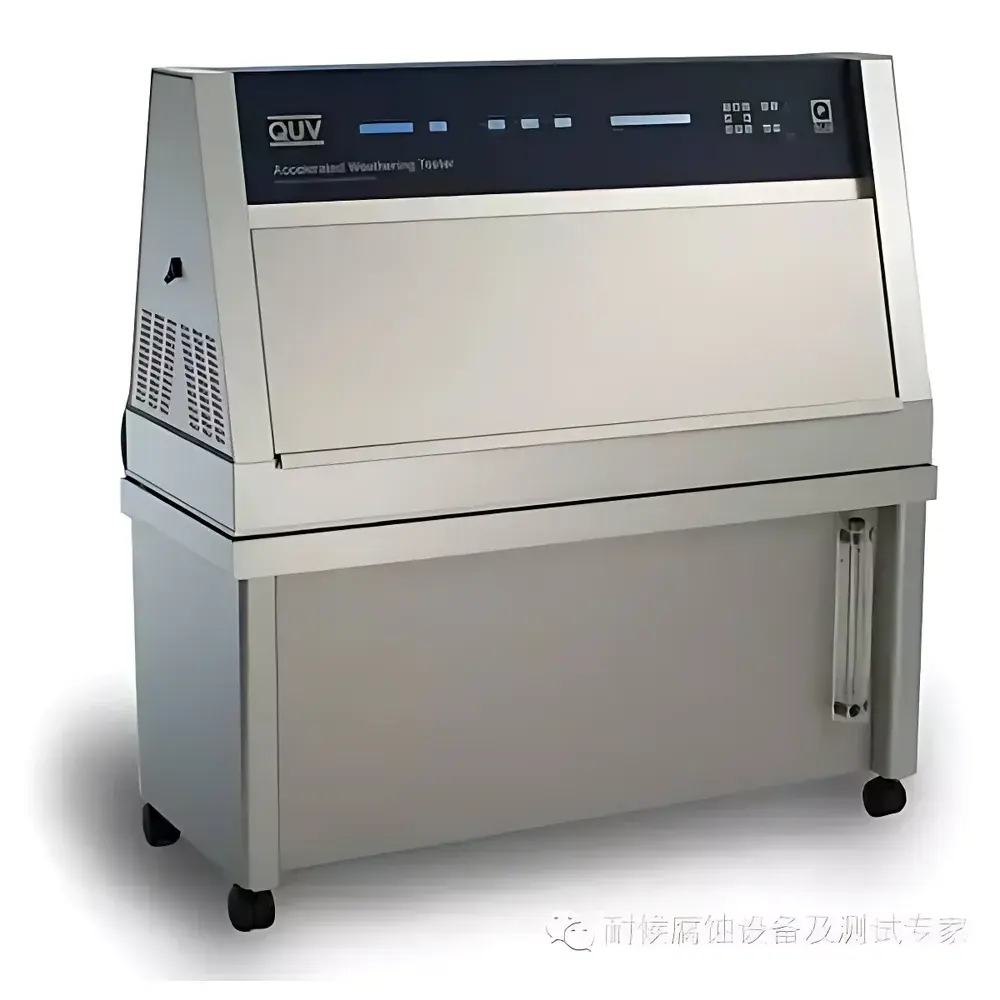
Q-LAB QUV/se/Spray Benchtop UV Aging Test Chamber
| Brand | Q-LAB |
|---|---|
| Origin | USA |
| Manufacturer Type | Authorized Distributor |
| Product Origin | Imported |
| Model | QUV/se/Spray |
| Quotation | Upon Request |
| UV Wavelength Range | 340–400 nm |
| Chamber Dimensions (L×W×H) | 137 × 53 × 135 cm |
| Black Panel Temperature Range | Consult Technical Support |
| Irradiance Control | Solar Eye® Feedback System |
| Condensation Simulation | Yes |
| Water Spray Function | Yes |
| Sample Capacity | Up to 48 standard specimen racks (each holds two 75 × 150 mm samples) |
| Calibration | ISO/IEC 17025-compliant via CR-10 UV Radiometer traceable to NIST |
Overview
The Q-LAB QUV/se/Spray Benchtop UV Aging Test Chamber is an engineered solution for accelerated weathering evaluation of polymeric, coating, automotive, and architectural materials under controlled ultraviolet (UV) irradiation, condensation, and optional water spray exposure. Unlike full-spectrum xenon arc testers, the QUV platform operates on the scientifically validated principle that short-wave UV radiation—particularly in the 340–400 nm range—is the dominant driver of photochemical degradation for most outdoor-exposed durable materials. Its design reflects decades of correlation research between laboratory UV exposure and real-world service life, enabling reproducible, standards-compliant aging assessments without reliance on subjective visual interpretation or uncontrolled environmental variables.
Key Features
- UVA-340 Lamp Configuration: Equipped with fluorescent UVA-340 lamps that closely replicate the solar UV spectrum from 295 nm to 365 nm—the most damaging region for polymer chain scission, pigment fading, and surface embrittlement.
- Solar Eye® Irradiance Control: A closed-loop feedback system continuously monitors and dynamically adjusts lamp output to maintain user-defined irradiance setpoints (e.g., 0.68 W/m²·nm @ 340 nm), compensating for lamp aging, ambient temperature drift, and batch-to-batch spectral variance.
- Condensation Humidity Simulation: Utilizes a proprietary water-jacketed condensation cycle that generates realistic dew formation on test specimens—mimicking nocturnal moisture accumulation critical to hydrolytic degradation mechanisms in coatings and plastics.
- Optional Water Spray Function (QUV/se/Spray): Adds intermittent aqueous exposure to simulate thermal shock, leaching, and erosion effects observed during diurnal rainfall events—particularly relevant for sealants, roofing membranes, and exterior finishes.
- Precision Thermal Management: Independent black panel temperature control ensures accurate specimen surface heating during UV irradiation, supporting accelerated testing at elevated temperatures while maintaining traceability to ASTM G154 and ISO 4892-3 protocols.
- Modular Sample Handling: Accommodates up to 48 standardized specimen racks (75 × 150 mm per position); custom fixtures available for non-planar, curved, or irregular geometries—including automotive trim, textile swatches, and composite laminates.
Sample Compatibility & Compliance
The QUV/se/Spray chamber supports rigid and flexible substrates across industrial sectors including aerospace composites, automotive OEM coatings, photovoltaic encapsulants, and medical device packaging. It complies with over 50 international test standards, including ASTM D4329 (plastics), ASTM D4587 (coatings), ISO 4892-3 (general methods), SAE J2020 (automotive), JIS D0205 (Japanese automotive), and GB/T 14522 (Chinese national standard). All irradiance calibration procedures follow ISO/IEC 17025 requirements using the CR-10 radiometer, with factory certification traceable to the National Institute of Standards and Technology (NIST). The system supports GLP-compliant audit trails when integrated with Q-Lab’s optional Q-Support software.
Software & Data Management
While the QUV/se/Spray operates via intuitive front-panel controls, optional connectivity enables integration with Q-Lab’s Q-Support™ software suite for remote monitoring, automated data logging, and electronic record retention. This configuration satisfies FDA 21 CFR Part 11 requirements for electronic signatures and audit trail generation. Users can define multi-step exposure cycles—including alternating UV/condensation/spray phases—and export timestamped irradiance, temperature, and runtime data in CSV or PDF formats compatible with LIMS environments. Firmware updates are delivered via secure USB interface and include version-controlled release notes aligned with ISO 9001 documentation practices.
Applications
This chamber is routinely deployed in R&D laboratories and quality assurance departments to evaluate: UV resistance of acrylic resins and polycarbonates; gloss retention and chalking behavior in architectural paints; adhesion stability of pressure-sensitive tapes under cyclic wet/dry conditions; yellowing kinetics of optical lenses and LED housing materials; and long-term integrity of fluoropolymer films used in solar backsheet applications. Its high correlation with field performance—validated through decades of parallel outdoor exposure studies at Q-Lab’s Arizona and Florida test sites—makes it a preferred tool for predictive lifetime modeling and supplier qualification programs.
FAQ
What UV wavelength range does the QUV/se/Spray generate?
It delivers UV radiation primarily between 340 nm and 400 nm using UVA-340 fluorescent lamps, optimized for fidelity to terrestrial sunlight below 365 nm.
How is irradiance calibrated and maintained over time?
The Solar Eye® system uses real-time photodiode feedback coupled with periodic verification using a NIST-traceable CR-10 radiometer per ISO 4892-3 Annex B.
Can the QUV simulate rain exposure?
Yes—the “Spray” variant includes programmable water spray nozzles that operate during dark cycles to replicate thermal stress and surface washing effects.
Is condensation simulation physically distinct from humidity control?
Yes—condensation is achieved by cooling the specimen backplate below dew point, causing atmospheric moisture to condense directly onto samples, unlike conventional humidification systems.
Does this model support regulatory compliance for pharmaceutical packaging validation?
While not designed for sterile environments, its irradiance traceability and cycle repeatability support ICH Q1B photostability protocol development for non-sterile primary packaging components.



