
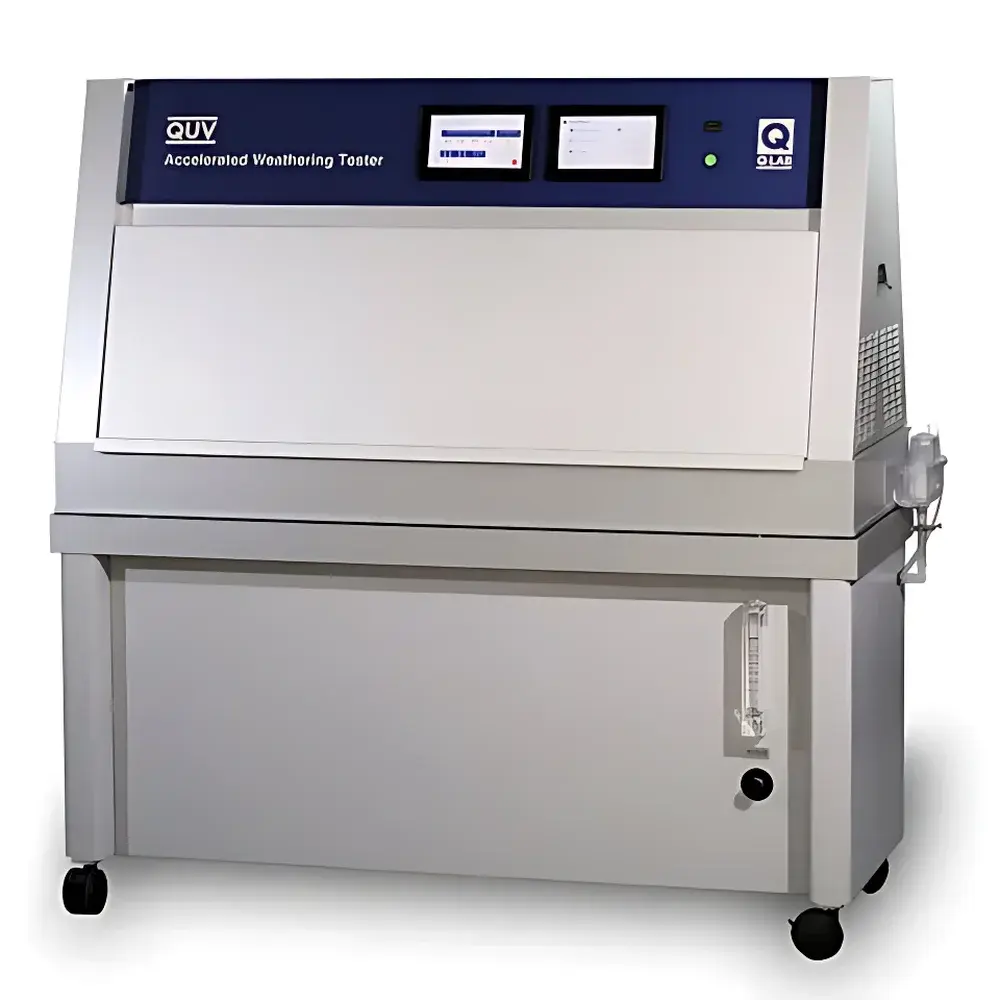
Q-Lab QUV/se UV Accelerated Weathering Tester
| Brand | Q-Lab |
|---|---|
| Origin | USA |
| Model | QUV/se |
| UV Wavelength Range | 280–400 nm |
| Chamber Dimensions (L×W×H) | 137 × 53 × 135 cm |
| Sample Capacity | 48 specimens (75 mm × 150 mm) |
| Irradiance Control | SOLAR EYE closed-loop feedback system |
| Condensation Simulation | Yes |
| Water Spray Option | Not included (standard QUV/se model) |
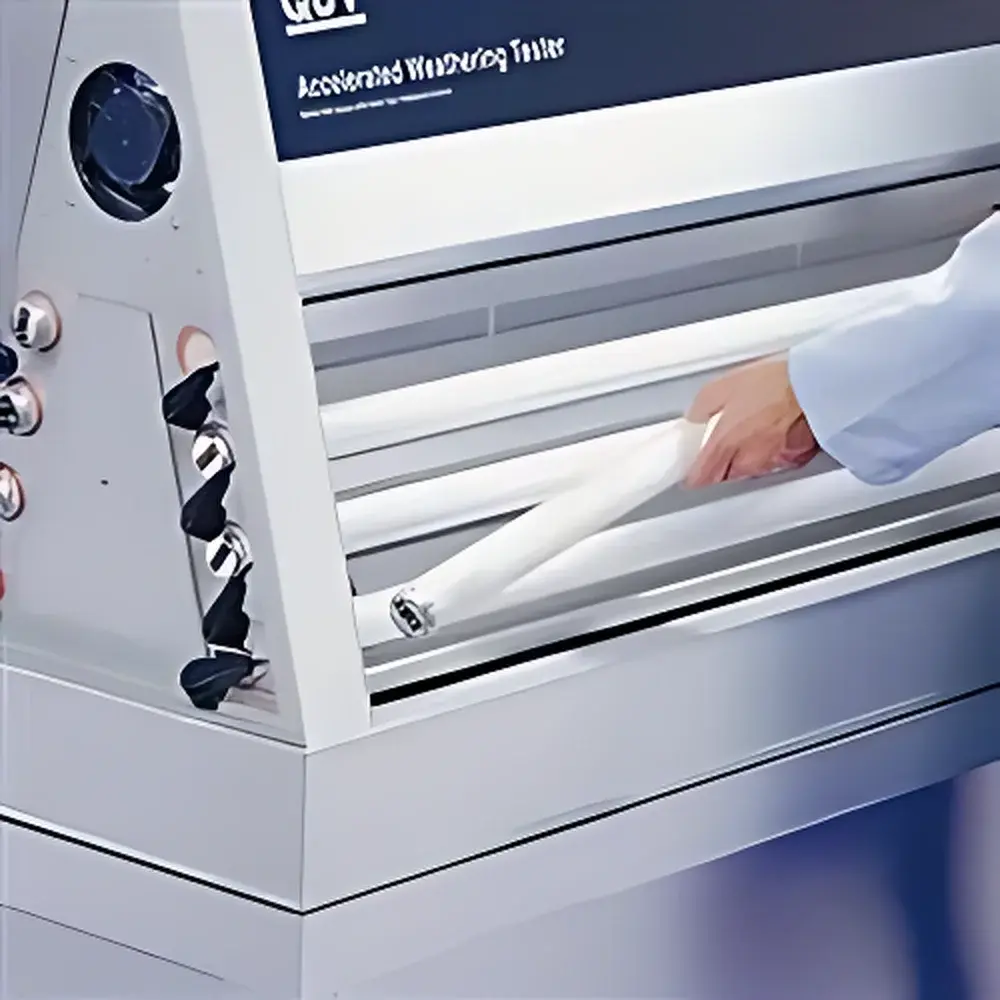
| Lamp Type | UVB-313 or UVA-340 selectable |
| Lamp Life | 5,000 hours (typical) |
| Temperature Range (Irradiation) | 45–80 °C |
| Temperature Range (Condensation) | 40–60 °C |
| Power Supply | 120/60 V/Hz, 16 A or 230/50–60 V/Hz, 8 A |
| Water Consumption | ~8 L/day (condensation only) |
Overview
The Q-Lab QUV/se UV Accelerated Weathering Tester is an industry-standard instrument engineered for precision simulation of solar ultraviolet radiation and moisture-driven degradation mechanisms. It operates on the principle of controlled fluorescent UV exposure—using either UVA-340 lamps (spectrally matched to terrestrial sunlight below 365 nm) or UVB-313 lamps (accelerated short-wave UV)—combined with a patented condensation cycle that replicates nocturnal dew formation. Unlike broad-spectrum xenon arc testers, the QUV/se focuses specifically on the photochemical degradation pathways most relevant to polymer, coating, and pigment systems, where >90% of outdoor photodegradation is driven by UV photons in the 280–400 nm range. Its compact chamber architecture (137 × 53 × 135 cm) supports high-throughput testing while maintaining strict thermal and irradiance uniformity per ASTM G154 and ISO 4892-3 requirements. Designed for continuous unattended operation in GLP-compliant laboratories, the QUV/se delivers reproducible, traceable, and auditable exposure conditions essential for quality control, R&D validation, and regulatory submission.
Key Features
- Patented SOLAR EYE irradiance control system: real-time UV intensity monitoring with automatic lamp power adjustment to maintain setpoint ±5% over lamp lifetime
- Dew-point-controlled condensation cycle: heated water reservoir generates saturated vapor; sample backside cooling induces stable, distilled-water condensate—mimicking natural dew kinetics without mineral deposits
- Interchangeable lamp options: UVA-340 for realistic sunlight correlation or UVB-313 for accelerated stress screening (per ASTM D4329 and ISO 4892-3)
- Robust temperature regulation: independent control of irradiation-phase (45–80 °C) and condensation-phase (40–60 °C) temperatures with ±0.5 °C stability
- Self-diagnostic firmware: automated error logging, maintenance alerts (e.g., lamp aging, water level, sensor drift), and safe shutdown protocols
- Multi-language controller interface: English, French, Spanish, Italian, German—with intuitive menu navigation and real-time exposure parameter display
- Ethernet connectivity standard: enables remote monitoring, data export, and integration with LIMS or MES platforms
Sample Compatibility & Compliance
The QUV/se accommodates up to 48 flat specimens (75 mm × 150 mm) on adjustable stainless-steel racks, supporting rigid panels, films, coatings on substrates, and pre-cut coupons. Optional fixtures extend compatibility to 3D parts, lenses, textiles (ASTM D3424), and adhesives (ASTM C1442). All configurations comply with global material testing standards including ASTM G154 (practice for fluorescent UV exposure), ISO 4892-3 (plastics—laboratory light sources), ISO 11507 (paints and varnishes), SAE J2020 (automotive exterior materials), and NACE TM01-84 (corrosion-resistant coatings). The system’s irradiance traceability is validated against NIST-traceable reference radiometers, and its temperature uniformity meets the ±2 °C spatial tolerance specified in ASTM G151 for exposure apparatus calibration.
Software & Data Management
The embedded controller records time-stamped irradiance (W/m²), black panel temperature, chamber air temperature, and condensation duration at user-defined intervals (default: 1-minute resolution). Data export is supported via Ethernet to Windows-based PCs using Q-Lab’s optional “Virtual Strip Chart” software—a validated application compliant with FDA 21 CFR Part 11 for electronic records and signatures. Audit trails include operator ID, method version, calibration history, and system event logs. For enterprise environments, the QUV/se integrates with Q-Lab’s cloud-based Q-Support Portal for automatic firmware updates, remote diagnostics, and technical support case initiation—enabling rapid root-cause analysis without onsite intervention.
Applications
The QUV/se is routinely deployed across sectors requiring predictive durability assessment under UV/moisture stress: automotive OEMs validate exterior trim and headlamp lenses per GM 9125P; architectural coating manufacturers assess chalk resistance per ASTM D4587; photovoltaic encapsulant suppliers screen yellowing per IEC 61215; and medical device polymer suppliers verify ISO 10993-12 biocompatibility stability. Its acceleration factor—typically 2–5× natural exposure depending on material sensitivity and lamp selection—enables rapid comparative ranking of formulations, batch-to-batch consistency checks, and failure mode identification prior to field deployment. Critical for ISO/IEC 17025-accredited labs, it supports method validation studies required for accreditation scope expansion.
FAQ
What UV lamp types are compatible with the QUV/se?
UVA-340 (peak 340 nm, solar-spectrum match) and UVB-313 (peak 313 nm, high-acceleration) lamps are factory-certified and interchangeable without hardware modification.
Does the QUV/se meet ISO/IEC 17025 calibration requirements?
Yes—the SOLAR EYE system supports NIST-traceable irradiance calibration, and full calibration certificates (including uncertainty budgets) are issued per ISO/IEC 17025 Annex A.3.
Can test parameters be locked to prevent unauthorized changes?
Yes—administrator-level password protection restricts access to method editing, calibration functions, and system configuration.
Is the condensation water required to be deionized?
No—condensation uses distilled-quality water generated internally; tap water is acceptable for reservoir filling per ASTM G154 Section 7.3.
How is compliance with FDA 21 CFR Part 11 ensured?
Through Virtual Strip Chart software: electronic signatures, audit trail retention (>10 years), role-based access control, and system-generated certificate of data integrity.



