
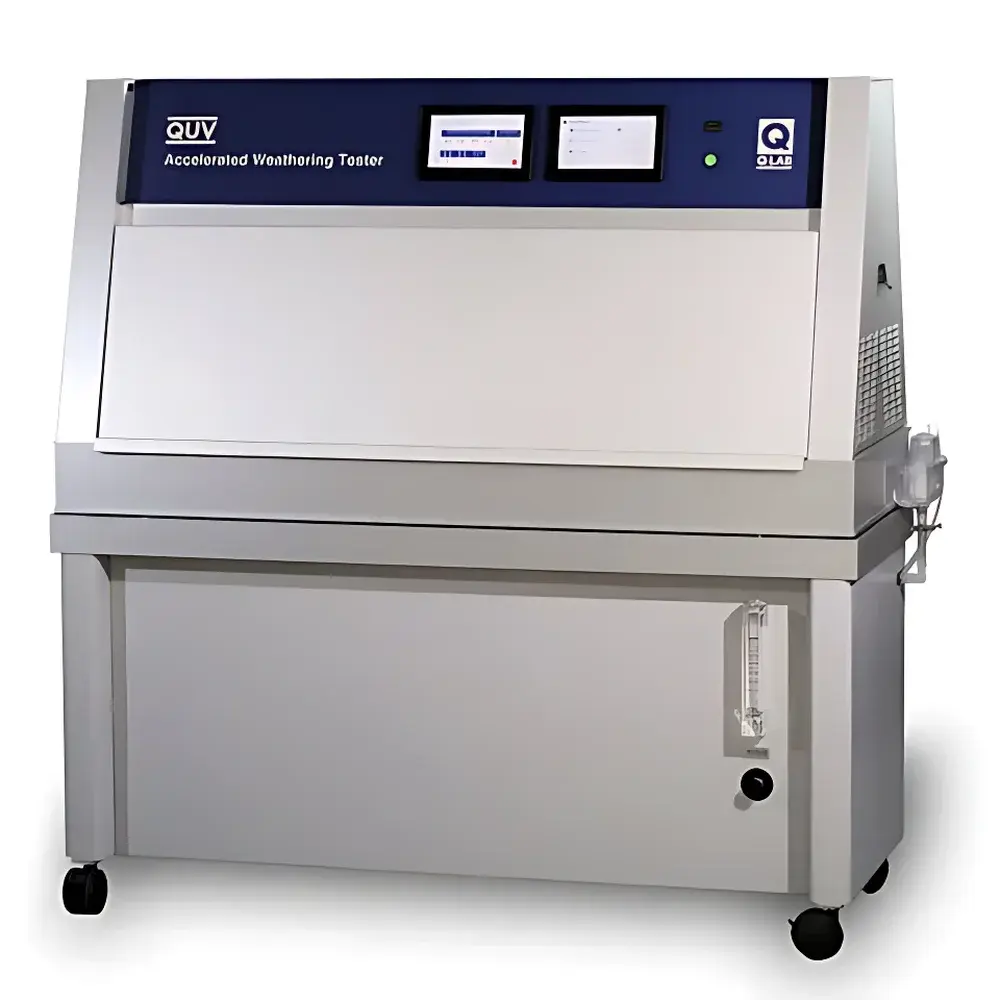
Q-Lab QUV/spray UV Accelerated Weathering Tester
| Brand | Q-LAB |
|---|---|
| Origin | USA |
| Manufacturer Type | Authorized Distributor |
| Product Origin | Imported |
| Model | Q-Lab QUV/spray |
| Test Duration | Adjustable |
| Irradiance Range | Adjustable |
| Lamp Power | Adjustable |
| Humidity Range | Adjustable |
| Light Exposure Temperature Range | 45–80 °C |
| Black Panel Temperature Range | 45–80 °C |
| UV Wavelength Range | 320–400 nm |
| Chamber Internal Dimensions (L×W×H) | 480 mm × 750 mm × 1500 mm |
Overview
The Q-Lab QUV/spray UV Accelerated Weathering Tester is an industry-standard benchtop environmental test chamber engineered for rapid, reproducible simulation of solar UV radiation, moisture condensation, and water spray—three primary drivers of polymeric material degradation. Based on ASTM G154, ISO 4892-3, and SAE J2020 protocols, the QUV/spray employs fluorescent UV lamps (UVA-340, UVB-313EL, or UVA-351) to deliver spectrally accurate irradiance in the 320–400 nm range—the most damaging portion of terrestrial sunlight. Unlike xenon arc systems, the QUV platform prioritizes UV-dominant stress with high irradiance repeatability and minimal thermal load variability. Its integrated spray function enables cyclic wetting events that replicate dew formation, rain impact, and surface leaching mechanisms critical to evaluating coating adhesion, pigment fade resistance, polymer embrittlement, and sealant integrity.
Key Features
- Electronic “Solar Eye” irradiance control system with real-time feedback and automatic lamp power adjustment to maintain setpoint irradiance (e.g., 0.68 W/m² @ 340 nm) across lamp aging cycles
- Black panel temperature sensors mounted directly behind specimens ensure precise, traceable thermal exposure measurement per ASTM D7869 and ISO 4892-3
- Dual-mode moisture delivery: programmable condensation (via heated water reservoir and chamber wall cooling) and calibrated water spray (using deionized water only)
- Modular lamp tray design supports field-swappable UV lamp types: UVA-340 (sunlight-simulating), UVB-313EL (accelerated degradation), UVA-351 (window-filtered sunlight), and FS-40 (general-purpose)
- CR-10 irradiance calibrator included—NIST-traceable, compliant with ASTM E2653 for instrument calibration verification and lamp life extension beyond 1600 hours
- Front-accessible water level indicator and external reservoir fill port simplify daily operation and reduce maintenance downtime
- Stainless steel chamber interior with drip trays and corrosion-resistant hardware ensures long-term reliability under aggressive humidity and saline spray conditions
- Integrated casters, upward-hinged door, and compact footprint (W750 × D480 × H1500 mm) optimize lab floor space utilization without compromising sample capacity
Sample Compatibility & Compliance
The QUV/spray accommodates up to 48 standard specimens measuring 75 mm × 150 mm or 24 specimens of 75 mm × 300 mm, mounted vertically on adjustable specimen racks. Sample thickness adaptability (up to 25 mm) supports rigid panels, flexible films, and textured substrates. All operational parameters—including irradiance, black panel temperature, condensation duration, and spray frequency—are fully programmable and repeatable per test sequence. The system complies with key international standards including ASTM G154 (UV exposure), ASTM D4329 (plastic weathering), ISO 4892-3 (laboratory light exposure), and SAE J2020 (automotive exterior materials). Optional audit trail logging and user access controls support GLP/GMP environments requiring 21 CFR Part 11 compliance when paired with Q-Lab’s optional QUV Software Suite.
Software & Data Management
Standard QUV/spray units include a built-in microprocessor controller with intuitive menu navigation, real-time parameter display, and password-protected programming. Optional QUV Software Suite (v5.2+) enables PC-based test method creation, remote monitoring, automated data export (CSV/Excel), and electronic signature support for regulated laboratories. All irradiance, temperature, and cycle event data are time-stamped and stored internally for ≥30 days. Calibration history—including CR-10 verification logs and lamp usage hours—is retained and exportable for quality audits. Firmware updates are delivered via USB and validated against Q-Lab’s internal release certification protocol.
Applications
- Automotive: Headlamp lens yellowing, bumper paint chalking, interior trim fading, gasket swelling
- Coatings & Inks: UV-curable resin crosslink density, pigment dispersion stability, gloss retention, blister resistance
- Plastics & Polymers: Polypropylene embrittlement, PVC dehydrochlorination, TPO weathering, fluoropolymer UV stability
- Building Materials: Roof membrane cracking, window profile discoloration, sealant adhesion loss, roofing tile efflorescence
- Printing & Packaging: Flexographic ink fade, label adhesion failure, corrugated board delamination under cyclic humidity
FAQ
What UV lamp types are compatible with the QUV/spray?
UVA-340, UVB-313EL, UVA-351, and FS-40 lamps are supported. CW (cool white) lamps are not compatible—they require the dedicated QUV/CW model.
Is deionized water required for all moisture functions?
Deionized water is mandatory for the spray function to prevent nozzle clogging and mineral deposits; condensation mode may use tap water, though deionized water is recommended for extended system longevity.
How is irradiance calibrated and maintained over time?
The CR-10 irradiance calibrator provides NIST-traceable verification. The Solar Eye system automatically compensates for lamp output decay by increasing power output, extending effective lamp life to ≥5000 hours for UVA-340 and UVB-313EL lamps.
Does the QUV/spray meet regulatory requirements for pharmaceutical or medical device testing?
While not FDA-validated out-of-the-box, the system supports IQ/OQ documentation packages and can be configured with 21 CFR Part 11-compliant software and audit trail features for regulated product development workflows.
What is the maximum allowable specimen thickness?
Specimens up to 25 mm thick can be accommodated using the adjustable rack system; thicker samples require custom fixture engineering and may affect airflow uniformity.



