
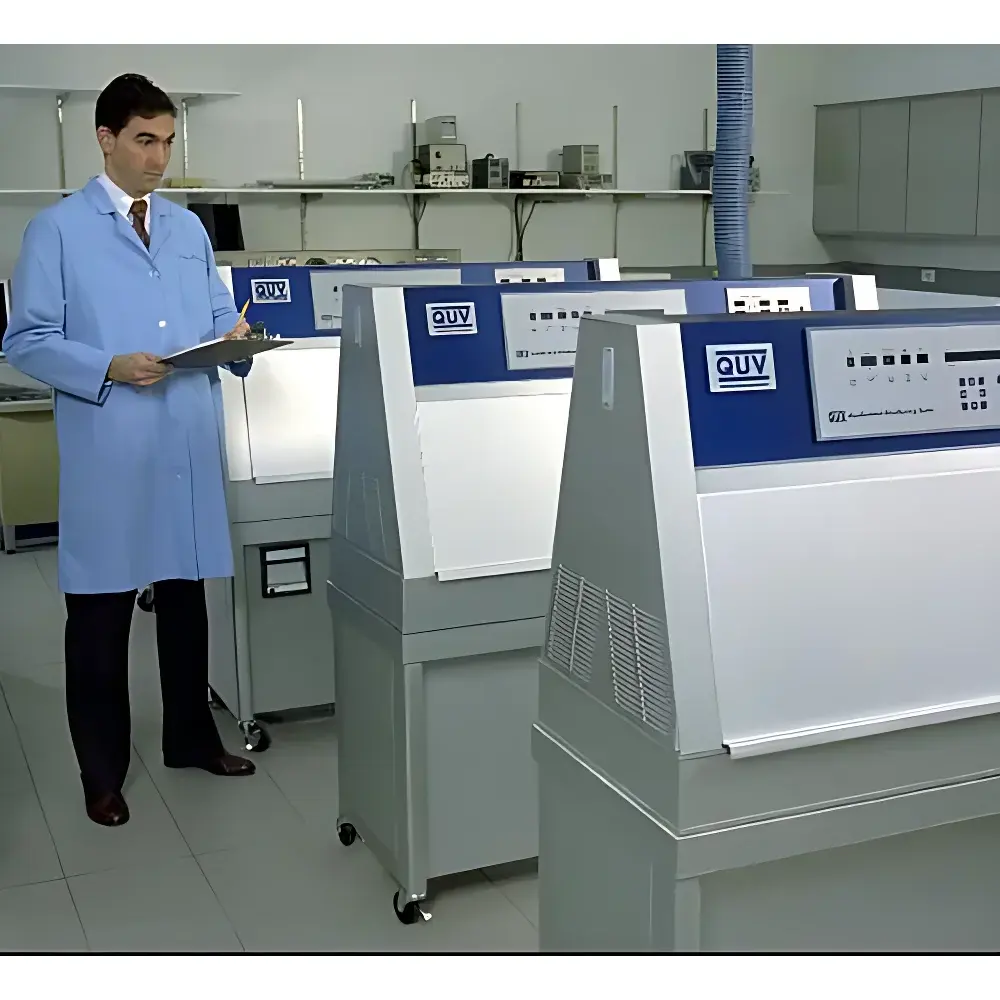
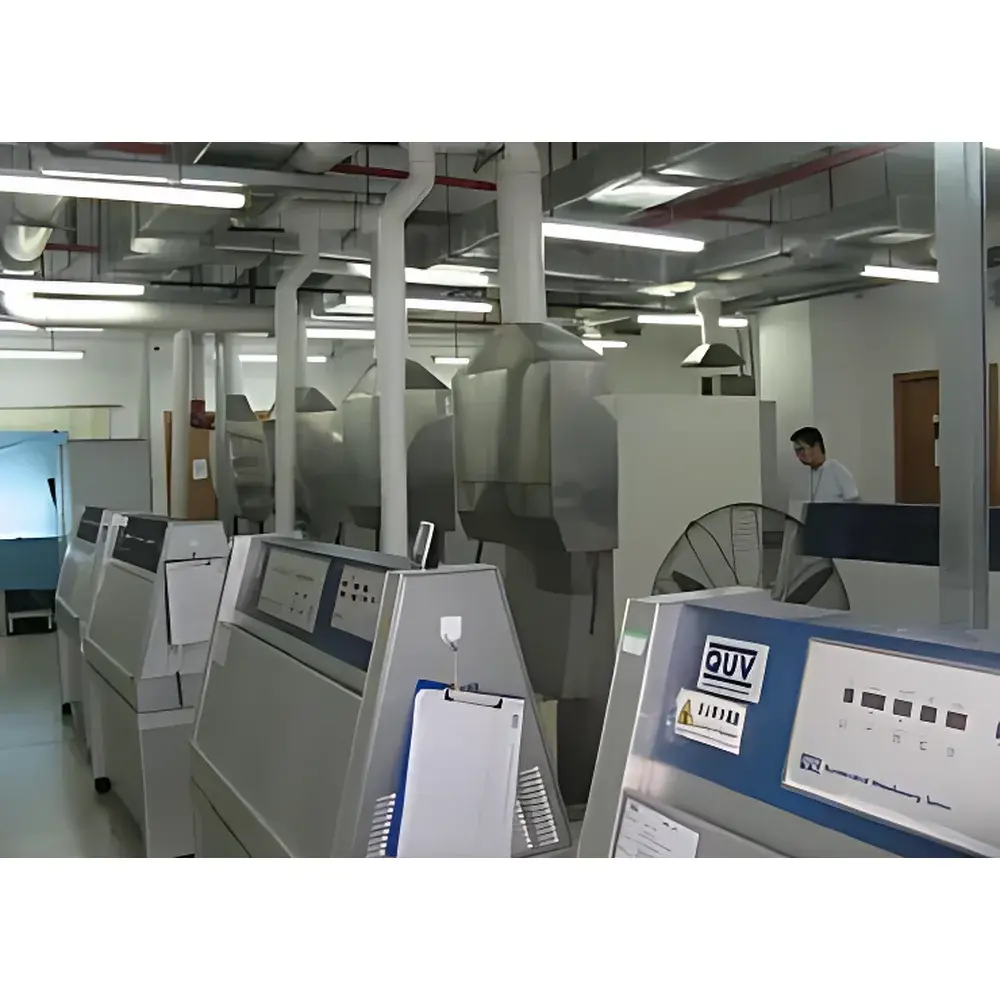
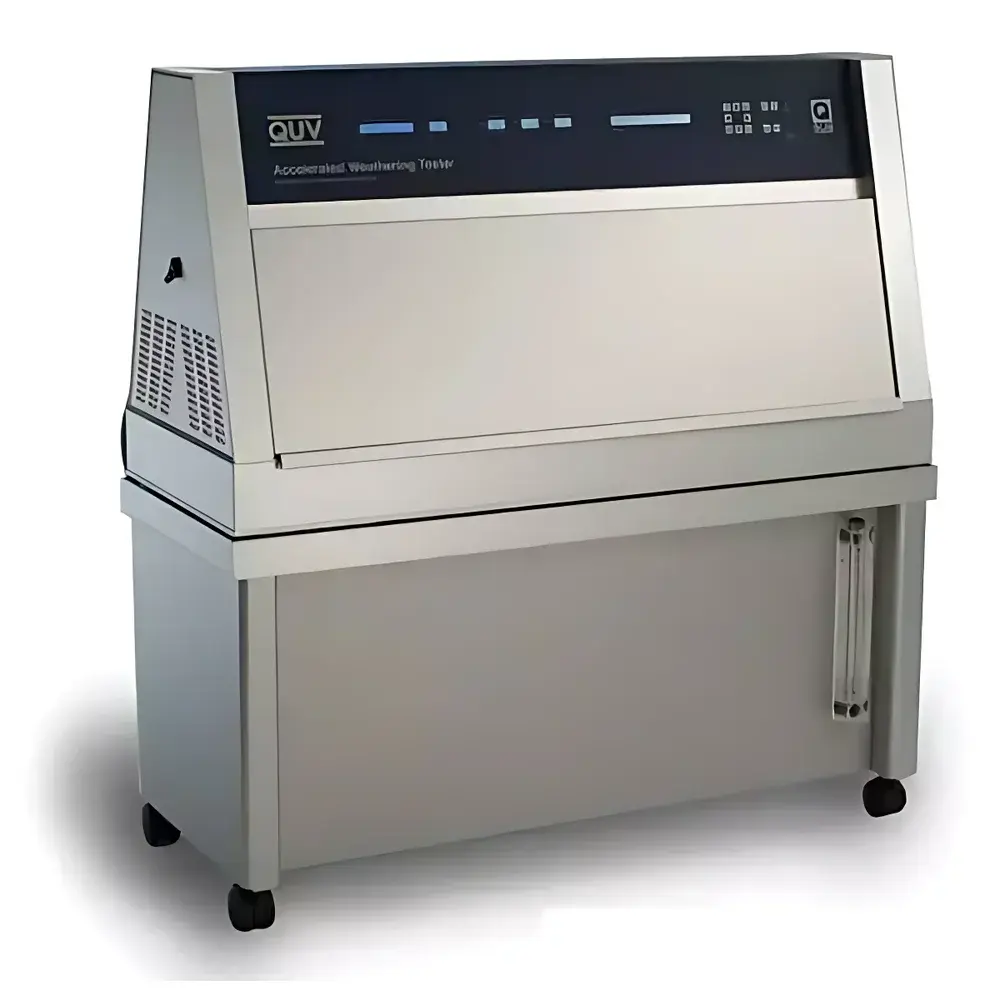
Q-LAB QUV/spray UV Accelerated Weathering Tester
| Brand | Q-LAB |
|---|---|
| Origin | USA |
| Model | QUV/spray |
| UV Wavelength Range | 320–400 nm (UVA-340, UVA-351, UVB-313, QFS-40, Cool White options) |
| Sample Chamber Dimensions | Custom-configurable (standard internal volume: 160 L) |
| Black Panel Temperature Range | 35–80 °C |
| Irradiance Control | SOLAR EYE® broadband or narrowband (340 nm or 313 nm) |
| Condensation Cycle | Distilled-quality water generated via in-situ evaporation/condensation |
| Lamp Life | Up to 5,000 hours (spectral stability maintained per ASTM G154 Annex A1) |
| Compliance | ASTM G154, ISO 4892-3, SAE J2020, JIS D0205, GB/T 14522, FDA 21 CFR Part 11 (via optional software audit trail) |
Overview
The Q-LAB QUV/spray UV Accelerated Weathering Tester is an industry-standard benchtop environmental test chamber engineered for reproducible simulation of solar ultraviolet radiation, moisture condensation, and water spray exposure. It operates on the principle of fluorescent UV irradiation—using proprietary phosphor-coated lamps that emit narrow-band UV spectra matched to critical regions of terrestrial sunlight (e.g., UVA-340 replicating 295–365 nm solar cutoff). Unlike xenon arc systems, which require complex optical filtering and exhibit spectral drift over lamp life, QUV’s fluorescent UV lamps maintain stable spectral power distribution (SPD) for up to 5,000 hours, as validated per ASTM G154 Annex A1. This intrinsic photometric stability ensures high inter-laboratory repeatability and eliminates frequent recalibration or lamp replacement—reducing total cost of ownership while supporting GLP/GMP-aligned validation protocols.
Key Features
- Triple-Exposure Capability: Simultaneous UV irradiation, controlled condensation (via heated water pan and cooled specimen surface), and programmable water spray cycles—mimicking real-world dew formation and intermittent rainfall.
- SOLAR EYE® Irradiance Control: Closed-loop feedback system continuously monitors and adjusts UV output at user-selected wavelengths (340 nm or 313 nm), maintaining ±3% irradiance tolerance per IEC 61215 and ASTM G154 requirements.
- Self-Distilling Condensation System: Tap water in the condensation pan undergoes natural phase-change purification during evaporation and re-condensation—producing distilled-quality moisture without external deionizers or DI water supply.
- Multi-Lamp Compatibility: Interchangeable lamp types—including UVA-340 (sunlight simulation), UVA-351 (through-glass exposure), UVB-313 (accelerated durability screening), QFS-40 (legacy automotive standards), and Cool White (indoor lighting simulation for QUV/cw variant).
- Intuitive Human-Machine Interface: Five-language touchscreen display (English, French, Spanish, Italian, German); real-time exposure condition monitoring; automated self-diagnostic alerts; patented AutoCAL™ calibration verification in under 90 seconds.
- Robust Mechanical Architecture: Stainless steel chamber interior; precision-machined sample racks accommodating specimens up to 20 mm thick; universal mounting slots for custom fixtures (e.g., 3D components, optical lenses, curved substrates).
Sample Compatibility & Compliance
The QUV/spray accommodates flat or contoured specimens up to 160 mm × 70 mm × 20 mm (W × D × H), with optional extended racks for larger geometries. Its standardized sample holder design complies with ASTM D7869, ISO 4892-3, and SAE J2020 specimen mounting conventions. All operational parameters—including irradiance setpoint, black panel temperature, condensation duration, and spray frequency—are fully programmable and logged with time-stamped metadata. When integrated with Q-LAB’s optional QUV Software Suite, the system supports full 21 CFR Part 11 compliance: electronic signatures, role-based access control, immutable audit trails, and secure data export in CSV or PDF format—meeting regulatory expectations for pharmaceutical packaging, automotive coatings, and medical device material qualification.
Software & Data Management
Standard firmware includes onboard data logging (exposure time, temperature, irradiance, cycle status) stored internally for ≥30 days. Optional Q-Support™ software enables remote monitoring, multi-instrument fleet management, and automated report generation compliant with ISO/IEC 17025 documentation standards. All test sequences are saved as encrypted .qvs files, ensuring traceability from method creation through execution and post-analysis. Calibration history—including lamp installation dates, irradiance verification records, and sensor drift logs—is retained indefinitely within the system database. For laboratories under FDA or EU MDR oversight, the optional Part 11 Add-on module provides electronic signature enforcement, audit trail review capability, and configurable retention policies aligned with ALCOA+ principles.
Applications
The QUV/spray is widely deployed across R&D, QC, and regulatory submission workflows for polymer degradation assessment (e.g., polyolefins, PVC, thermoplastic elastomers), automotive exterior trim validation (SAE J2412, J2527), architectural coating durability (AAMA 2605), photovoltaic encapsulant yellowing (IEC 61215), and inkjet print permanence (ISO 18935). Its ability to isolate UV-driven photochemical pathways—decoupled from thermal oxidation or visible-light effects—makes it indispensable for failure root-cause analysis where hydrolytic cleavage, Norrish reactions, or radical-mediated chain scission dominate degradation mechanisms. In quality assurance labs, it serves as a pass/fail gate for incoming raw materials and supplier qualification per ISO 9001 Clause 8.4.2.
FAQ
What UV wavelength ranges does the QUV/spray support?
The system supports multiple lamp types: UVA-340 (295–365 nm), UVA-351 (cut-on ~320 nm, simulating window-filtered sunlight), UVB-313 (270–360 nm, high-acceleration), QFS-40 (broad UVB), and Cool White (visible spectrum, for QUV/cw only).
How is condensation moisture purified without external DI water?
The condensation pan heats tap water to induce evaporation; vapor then condenses on cooler specimen surfaces—effectively performing in-situ distillation, removing minerals and impurities.
Is irradiance calibration traceable to NIST standards?
Yes—Q-LAB’s SOLAR EYE sensors are calibrated against NIST-traceable reference detectors, and calibration certificates include uncertainty budgets per ISO/IEC 17025 requirements.
Can the QUV/spray be validated for GxP environments?
With the Part 11 Add-on and Q-Support™ software, it meets FDA 21 CFR Part 11, EU Annex 11, and ISO 13485 requirements for electronic records and signatures in regulated testing.
What maintenance intervals are recommended for routine operation?
Lamp replacement every 5,000 hours (or per irradiance decay threshold); quarterly sensor verification; annual full-system performance qualification using Q-LAB’s PQ Kit (ASTM E2652-compliant).



