
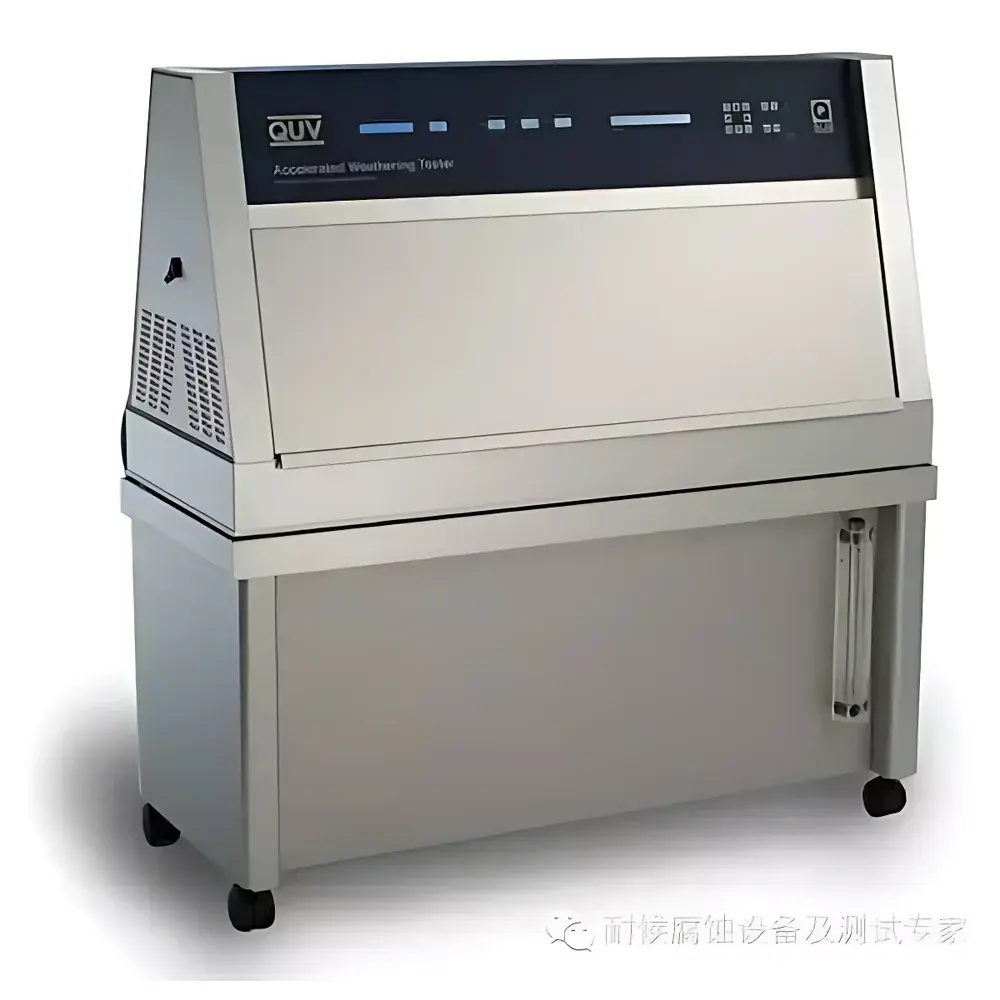
Q-LAB QUV/spray UV Aging Test Chamber
| Brand | Q-LAB |
|---|---|
| Origin | Germany |
| Manufacturer Type | Authorized Distributor |
| Import Status | Imported |
| Model | QUV/spray |
| Illumination Temperature Range | 45–80 °C |
| Black Panel Temperature Range | 40–60 °C |
| UV Wavelength | UVA-340, UVB-313EL, UVA-351 selectable |
| Chamber Internal Dimensions (L×W×H) | 114 × 52 × 42 cm |
| Sample Capacity | 48 specimens (75 mm × 150 mm) |
| Irradiance Control Point | 340 nm |
| Adjustable Irradiance Range | 0.25–1.80 W/m² @ 340 nm |
| Irradiance Display Accuracy | ±0.01 W/m² |
| Lamp Life | ~5,000 hours (dependent on irradiance setting and cycle profile) |
| Power Supply | 230 V / 50 Hz, 1500 W max |
| Weight | 136 kg |
| Water Requirements | Deionized water, resistivity ≥ 200 kΩ·cm, total solids ≤ 1.0 ppm, colloidal silica ≤ 0.1 ppm, pressure 25–80 psi, flow rate ≥ 20 L/min |
Overview
The Q-LAB QUV/spray UV Aging Test Chamber is an industry-standard accelerated weathering instrument engineered for precision simulation of critical degradation factors in outdoor exposure—primarily ultraviolet radiation, moisture condensation, and water spray. Based on the fundamental principles of photochemical degradation and hygrothermal stress, the QUV/spray employs fluorescent UV lamps (UVA-340, UVB-313EL, or UVA-351) to replicate the short-wavelength solar spectrum most responsible for polymer photolysis, pigment fading, and coating embrittlement. Unlike broad-spectrum xenon arc systems, the QUV platform delivers high-intensity, spectrally stable UV output with exceptional repeatability across laboratories and over time. Its integrated spray function introduces controlled, uniform water impingement—mimicking natural rainfall—and complements condensation cycles generated via heated water pan and thermal gradient-driven dew formation. This tri-modal exposure architecture (UV + condensation + spray) enables rigorous, reproducible evaluation of material durability per internationally recognized test protocols.
Key Features
- Triple-exposure capability: simultaneous or sequential control of UV irradiation, condensation, and water spray—each independently programmable and monitored in real time.
- Advanced irradiance control system with closed-loop feedback at 340 nm; maintains setpoint accuracy within ±0.01 W/m² using calibrated broadband sensor and automatic lamp power modulation.
- Integrated black panel thermometer (BPT) and chamber air temperature sensors with independent PID control loops for illumination (45–80 °C) and condensation (40–60 °C) phases.
- Twelve precisely positioned spray nozzles delivering 7 L/min total flow rate, calibrated for uniform coverage across full specimen area without channeling or pooling.
- Self-calibrating irradiance system: eliminates manual entry errors via automated calibration input using traceable NIST-traceable Q-Lab calibration radiometers.
- Intuitive LED-based controller with multi-language interface, real-time parameter display, and event logging—including irradiance history, temperature profiles, and cycle stage transitions.
- Robust stainless-steel chamber construction with insulated double-wall design, corrosion-resistant interior, and maintenance-accessible lamp and water subsystems.
Sample Compatibility & Compliance
The QUV/spray accommodates up to 48 standard test specimens (75 mm × 150 mm), mounted vertically on aluminum racks to ensure consistent exposure geometry and airflow. Specimen holders are compatible with ASTM D6675-compliant mounting fixtures and support both rigid substrates (e.g., coated metals, PVC profiles) and flexible films. The system fully complies with ISO 4892-3 (Plastics — Methods of exposure to laboratory light sources — Part 3: Fluorescent UV lamps), ASTM G154 (Standard Practice for Operating Fluorescent Ultraviolet (UV) Lamp Apparatus for Exposure of Nonmetallic Materials), ASTM G151 (Standard Practice for Exposing Nonmetallic Materials in Accelerated Test Devices that Use Laboratory Light Sources), SAE J2020 (Laboratory Weathering of Automotive Exterior Materials), and Chinese national standards GB/T 5237.2 and HG/T 2454–2006. All operational parameters—including irradiance setpoints, temperature ramps, and cycle sequencing—are fully audit-trail enabled and support GLP/GMP documentation requirements.
Software & Data Management
While the QUV/spray operates autonomously via its embedded microprocessor controller, optional Q-Lab’s Windows-based SOLAR EYE™ software enables remote monitoring, advanced scheduling, and comprehensive data export (CSV, PDF, XML). SOLAR EYE provides full traceability: each test run logs timestamped irradiance values, BPT and chamber temperatures, spray activation events, lamp-on hours, and calibration history. Data integrity conforms to FDA 21 CFR Part 11 requirements when configured with electronic signatures and role-based access control. All stored records include metadata such as operator ID, method version, and instrument serial number—ensuring full compliance during regulatory audits or inter-laboratory round-robin studies.
Applications
The QUV/spray is routinely deployed in R&D, quality assurance, and regulatory submission workflows across automotive OEMs (paint, trim, interior plastics), architectural coatings manufacturers, solar module encapsulant developers, medical device polymer suppliers, and aerospace composites producers. Typical use cases include: evaluating UV stabilizer package efficacy in polyolefins; assessing gloss retention and chalking resistance in exterior architectural paints; validating adhesion durability of laminated safety glass interlayers under wet-UV cycling; benchmarking fluoropolymer film performance in photovoltaic backsheet applications; and supporting IEC 61215 qualification testing for PV module materials. Its ability to isolate UV-driven failure mechanisms—distinct from thermal or visible-light effects—makes it indispensable for root-cause analysis of premature field failures.
FAQ
What UV lamp types are supported, and how do they differ in spectral output?
The QUV/spray accepts three interchangeable lamp types: UVA-340 (best matches solar UV below 365 nm), UVB-313EL (enhanced short-wave UV for aggressive screening), and UVA-351 (simulates UV透过 window glass). Each lamp type is pre-characterized and auto-recognized by the controller.
Is distilled water sufficient for operation, or is deionized water mandatory?
Deionized water with resistivity ≥ 200 kΩ·cm is strictly required. Distilled water alone does not meet conductivity specifications and risks scaling, sensor drift, and nozzle clogging.
Can the QUV/spray perform cyclic tests without manual intervention?
Yes. All exposure sequences—including UV-only, UV/condensation, UV/spray, and multi-step combinations—are fully programmable and execute unattended for up to 999 cycles with automatic transition between phases.
How often must irradiance calibration be performed?
Q-Lab recommends quarterly calibration using a certified Q-Lab UV radiometer; however, the built-in auto-calibration routine allows daily verification without external hardware.
Does the system support validation documentation for ISO/IEC 17025 accredited labs?
Yes. Full IQ/OQ documentation packages, including installation checklists, operational verifications, and uncertainty budgets for irradiance and temperature measurement, are available upon request.



