
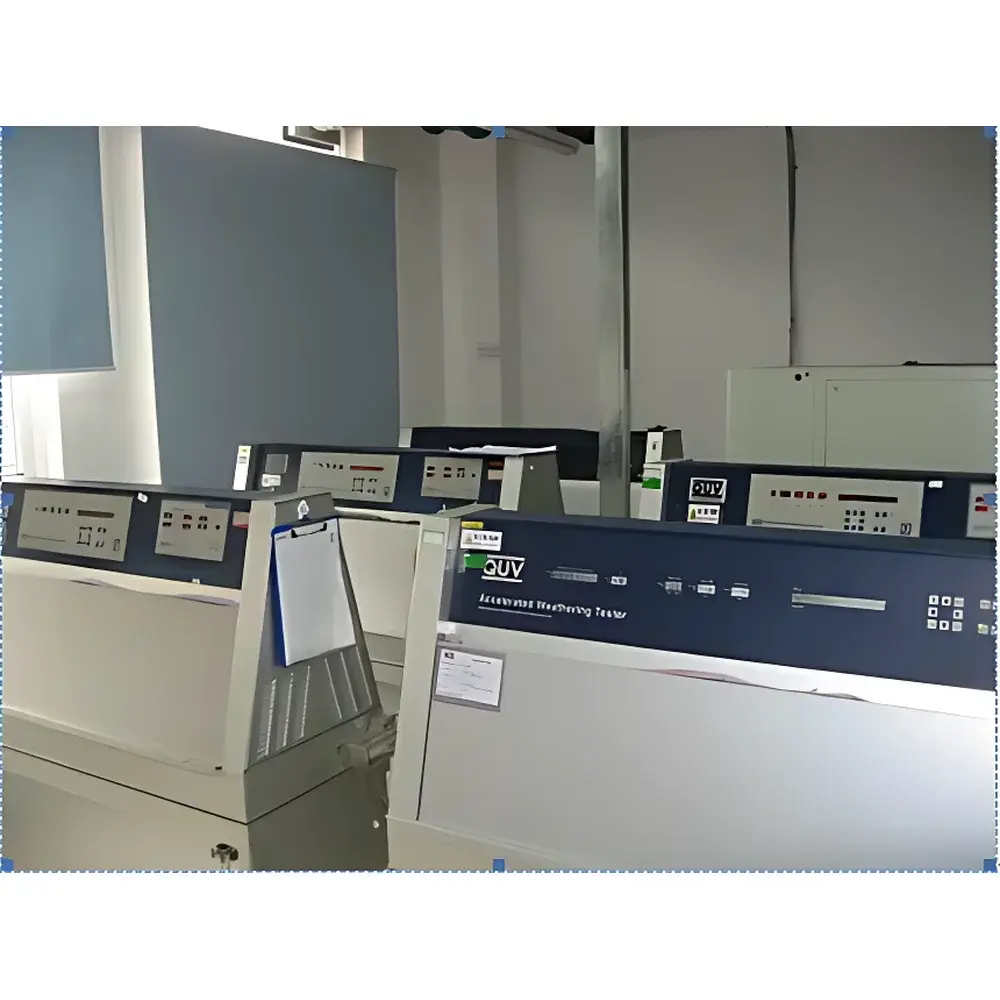
Q-LAB QUV/spray UV Weathering Tester
| Brand | Q-LAB |
|---|---|
| Origin | USA |
| Model | QUV/spray |
| Chamber Dimensions (L×W×H) | Configurable per installation |
| Irradiance Control | Digital feedback-controlled UV lamps |
| Black Panel Temperature Range | 35–75 °C |
| Condensation Temperature Range | 25–60 °C |
| UV Spectral Range | UVA-340 (295–365 nm) or UVB-313 (280–365 nm) |
| Sample Capacity | Up to 48 specimens (75 mm × 150 mm) |
| Compliance | ASTM G154, ASTM G151, ISO 4892-3, ISO 11507, JIS K 5600-7-8, SAE J2020, GM 9125P, NACE TM01-84, and over 50 additional international standards |
Overview
The Q-LAB QUV/spray UV Weathering Tester is an engineered accelerated aging instrument designed to replicate the primary degradation mechanisms induced by outdoor exposure—ultraviolet radiation, moisture condensation, and thermal cycling. Unlike broad-spectrum xenon arc testers, the QUV/spray employs fluorescent UV lamps to deliver highly controlled, repeatable irradiance within critical short-wavelength UV bands. Its core principle rests on the photochemical degradation of organic materials under simulated solar UV stress, where photon energy initiates bond scission, oxidation, and crosslinking reactions in polymers, coatings, adhesives, and composites. The system integrates three synergistic stressors: (1) UV irradiation via calibrated UVA-340 or UVB-313 lamps; (2) condensation cycles that simulate nocturnal dew formation through controlled humidity and surface cooling; and (3) optional water spray functionality to reproduce thermal shock, erosion, and surface wetting effects associated with rainfall. This tri-modal exposure protocol enables correlation with real-world service life—particularly for applications governed by ASTM D4329 (plastics), ASTM D4587 (coatings), or ISO 4892-3 (general polymer testing).
Key Features
- Modular UV Lamp Architecture: Supports interchangeable UVA-340 (peak at 340 nm) and UVB-313 (peak at 313 nm) lamp types—UVA-340 provides best spectral match to terrestrial sunlight below 365 nm; UVB-313 delivers enhanced short-wave intensity for aggressive screening of formulation stability.
- Black Panel Temperature Control: Precision thermocouple-regulated black panel sensor ensures accurate surface temperature monitoring (35–75 °C range), critical for replicating thermal acceleration kinetics per Arrhenius modeling.
- Condensation Cycle Management: Internal water reservoir and controlled chamber cooling generate reproducible condensation periods (typically 4 h), simulating dew accumulation without external humidification systems.
- Optional Water Spray System: Programmable spray nozzles deliver deionized water at ambient or elevated temperatures, enabling simulation of rain-induced thermal shock, leaching, and mechanical erosion—essential for roofing membranes, automotive trim, and architectural sealants.
- Robust Chamber Construction: Stainless steel interior with quartz UV-transmissive viewing window; integrated drain channels and corrosion-resistant hardware ensure long-term operational integrity in high-humidity environments.
- Digital Irradiance Monitoring: Built-in radiometer with automatic lamp output compensation maintains consistent UV intensity across lamp lifetime, complying with ASTM G151 calibration requirements.
Sample Compatibility & Compliance
The QUV/spray accommodates flat-panel specimens up to 75 mm × 150 mm, with standard fixtures supporting up to 48 samples per cycle. Specimen holders are designed for uniform irradiance distribution and minimal shadowing. The system meets stringent regulatory and industry-specific validation criteria—including full compliance with ASTM G154 (fluorescent UV exposure), ASTM G151 (exposure apparatus calibration), ISO 4892-3 (plastics—fluorescent UV methods), and JIS K 5600-7-8 (paints and varnishes). It further satisfies functional requirements of automotive OEM specifications (GM 9125P, Ford CETP 00.00-L-467), aerospace standards (SAE J2020), and corrosion-related protocols (NACE TM01-84, ISO 20340). All test cycles are traceable and auditable per GLP and GMP frameworks, with optional 21 CFR Part 11-compliant software modules available for regulated laboratories.
Software & Data Management
Control and data acquisition are managed via Q-LAB’s proprietary Windows-based SOLAR EYE™ software. The interface supports fully programmable exposure profiles—including multi-step UV/condensation/spray sequences, ramped temperature transitions, and user-defined hold times. Real-time monitoring displays irradiance (W/m² @ 340 nm), black panel temperature, chamber humidity, and elapsed cycle time. All parameters are logged at user-selectable intervals (minimum 1-minute resolution) and exported in CSV or XML format for statistical analysis. Audit trails record operator actions, method changes, and calibration events—fully compliant with FDA 21 CFR Part 11 when configured with electronic signatures and role-based access control. Raw data files include embedded metadata (lamp type, calibration date, sensor serial numbers) to support ISO/IEC 17025 accreditation requirements.
Applications
- Coatings & Inks: Evaluation of gloss retention, chalking resistance, and color stability in automotive clearcoats, industrial paints, and UV-curable inks per ASTM D4587 and ISO 11507.
- Plastics & Polymers: Accelerated degradation assessment of polyolefins, PVC, PC, and elastomers under UV/moisture stress per ASTM D4329 and ISO 4892-3.
- Adhesives & Sealants: Testing cohesive strength loss, interfacial delamination, and hydrolytic stability in structural bonding systems (ASTM C1184, ASTM C1442).
- Roofting & Building Materials: Validation of weatherability in TPO membranes, EPDM, asphalt shingles, and fiber-cement boards per ASTM D4799 and ANSI/RMA IPR-1-1990.
- Automotive Components: Qualification of exterior trim, headlamp lenses, and under-hood plastics against OEM durability targets (SAE J2020, GM 9125P).
- Photovoltaic Encapsulants: Screening of EVA and POE degradation pathways affecting module power output and delamination risk per IEC 61215-2 MQT10.
FAQ
What is the difference between UVA-340 and UVB-313 lamps?
UVA-340 lamps emit UV energy closely matching natural sunlight from 295 to 365 nm and are recommended for realistic outdoor correlation. UVB-313 lamps produce shorter, more energetic wavelengths (280–365 nm) and are used for rapid screening—though they may induce non-representative degradation pathways.
Can the QUV/spray operate without water spray?
Yes—the base configuration includes UV irradiation and condensation cycles only; water spray is an optional add-on module activated only when required by the test standard or application.
How often must UV lamps be replaced?
Lamp replacement intervals depend on accumulated irradiance dose; typical service life is 1,600–2,000 hours for UVA-340 and ~1,000 hours for UVB-313. SOLAR EYE software tracks cumulative exposure and alerts users prior to end-of-life.
Is calibration traceable to NIST standards?
Yes—Q-LAB provides factory calibration certificates traceable to NIST for all irradiance sensors and temperature probes, with optional annual recalibration services available globally.
Does the system support unattended operation?
Yes—fully programmable cycles, automated lamp switching, and fault-detection logic enable 24/7 operation. Optional remote monitoring via Ethernet allows status checks and emergency alerts without physical presence.



