
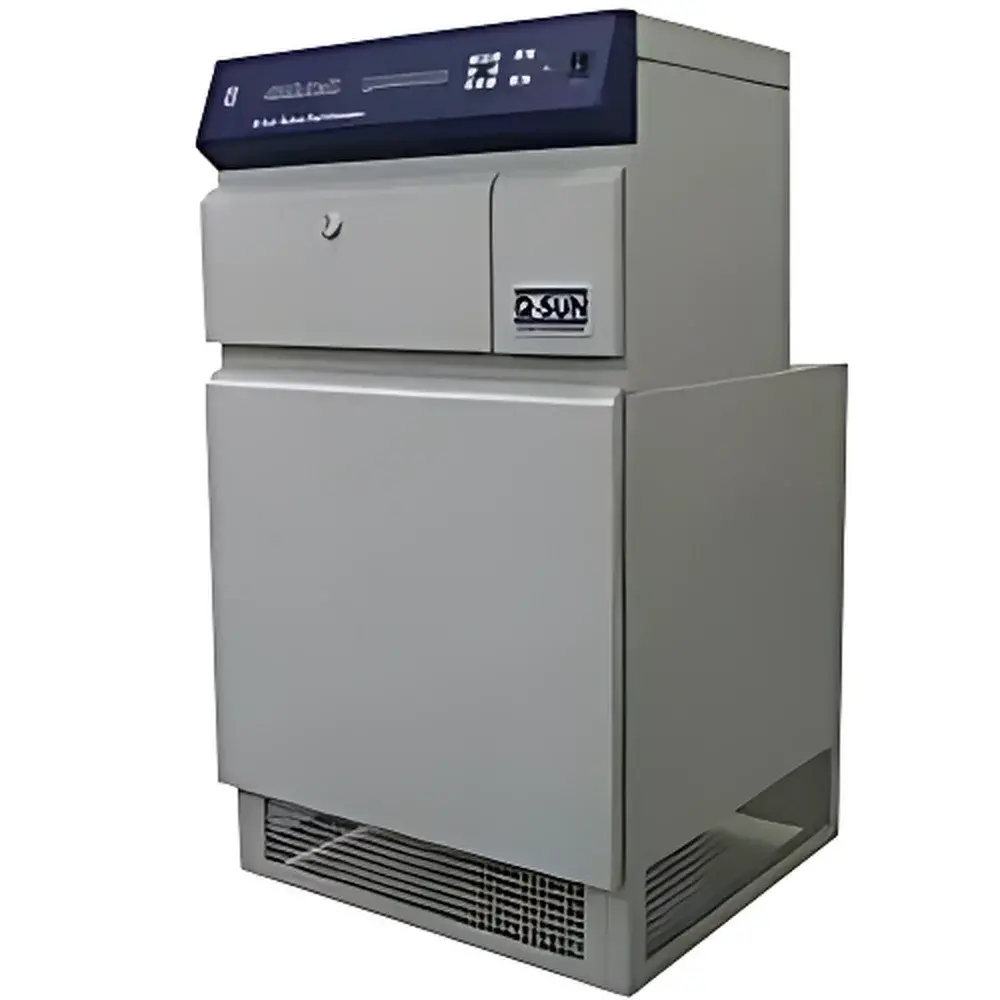
Q-LAB Q-SUN Xe-1-SC Air-Cooled Xenon Arc Weathering Test Chamber
| Brand | Q-LAB |
|---|---|
| Origin | USA |
| Model | Q-SUN Xe-1-SC |
| Xenon Lamp Power | 1800 W |
| Sample Capacity | 17 specimens |
| Sample Tray Dimensions | 25 × 46 cm |
| Sample Size | 51 × 102 mm |
| Sample Tilt Angle | 10° from horizontal |
| Lamp Quantity | 1 full-spectrum xenon arc lamp |
| Black Panel Temperature Range | 15–50 °C (light cycle), 10–40 °C (dark cycle) |
| Water Pressure Requirement | 2.1–6.2 bar (30–90 psi) |
| Water Purity | <1 ppm total dissolved solids, <0.1 ppm suspended silica |
| Water Consumption | 0.1 L/min (during spray) |
| Power Supply | 208 V / 230 V |
| Weight | 124 kg |
Overview
The Q-LAB Q-SUN Xe-1-SC is an air-cooled xenon arc weathering test chamber engineered for high-fidelity simulation of solar radiation, thermal cycling, and moisture exposure—key environmental stressors governing material degradation in real-world service conditions. Unlike water-cooled systems, its air-cooled architecture eliminates dependency on external chilled water infrastructure, enabling flexible laboratory deployment while maintaining stable irradiance output and thermal uniformity across the specimen plane. The chamber employs a single 1800 W xenon arc lamp with precision optical filtering to replicate the full solar spectrum (290–800 nm), including critical UV-B, UV-A, visible, and near-infrared bands. Integrated water spray functionality delivers controlled wetting cycles that emulate natural rain events, while independently regulated black panel temperature sensors ensure accurate surface heating simulation per ASTM G155 and ISO 4892-2 protocols. This configuration supports accelerated aging studies under rigorously defined irradiance, temperature, and humidity profiles—without requiring external humidification systems.
Key Features
- Air-cooled xenon arc lamp system eliminates need for chiller or recirculating water supply—reducing installation complexity and operational overhead.
- Standard Ethernet-based data acquisition interface enables seamless integration into lab-wide monitoring networks and supports automated logging of irradiance, black panel temperature, chamber air temperature, and spray status.
- Multi-language operator interface (English, French, Spanish, Italian, German) facilitates global deployment and compliance with multilingual workplace requirements.
- Pre-calibrated AUTOCAL CR20 irradiance sensor ensures traceable, NIST-traceable calibration of spectral irradiance at 340 nm or 420 nm—critical for inter-laboratory reproducibility.
- Durable Q-SUN optical filters (e.g., Daylight-Q, Window Glass-Q, Extended UV-Q) allow precise spectral matching to specific exposure conditions—including terrestrial sunlight, automotive interior, or filtered window-glass transmission.
- Robust stainless-steel construction with corrosion-resistant internal components ensures long-term reliability under repeated thermal and moisture cycling.
Sample Compatibility & Compliance
The Xe-1-SC accommodates up to 17 flat specimens (51 × 102 mm) mounted on a fixed 10° inclined tray, optimizing irradiance uniformity and runoff dynamics during spray cycles. Its design conforms to the geometric and photometric requirements of major international standards, including ASTM G155 (Practice for Operating Xenon Arc Light Apparatus for Exposure of Non-Metallic Materials), ISO 4892-2 (Plastics — Methods of Exposure to Laboratory Light Sources — Part 2: Xenon-arc lamps), and AATCC TM16 (Colorfastness to Light). It also supports testing per SAE J2412/J2527 for automotive exterior materials, ASTM D4355 (Textiles — Weather Resistance), and ISO 105-B02 (Textiles — Tests for Color Fastness — Colour Fastness to Artificial Light). All filter configurations are validated against spectral power distribution (SPD) reference data per CIE Publication No. 85, ensuring metrological consistency across instrument fleets.
Software & Data Management
The chamber operates via Q-LAB’s proprietary Q-SUN software suite, which provides intuitive test programming, real-time parameter visualization, and audit-ready data export (CSV, PDF, XML). The system maintains full 21 CFR Part 11 compliance through electronic signatures, role-based access control, and immutable audit trails for all method changes, calibration events, and run logs. Data integrity is reinforced by automatic timestamping, sensor health diagnostics, and alarm-triggered notifications via email or SNMP traps. Raw irradiance and temperature histories are stored with millisecond resolution, supporting post-test statistical analysis and correlation with physical property changes measured off-line (e.g., gloss loss, color ΔE, tensile strength retention).
Applications
This chamber is routinely deployed in R&D and QC laboratories for evaluating photochemical stability and weathering resistance of coatings (automotive OEM, architectural, industrial), polymeric films and composites (PP, PC, ABS, TPO), textile dyes and finishes, pharmaceutical packaging (HDPE, PET, laminates), cosmetic containers, food-contact plastics, and safety glazing (laminated glass, polycarbonate). Its ability to decouple UV intensity, thermal load, and moisture application enables mechanistic studies—such as distinguishing UV-initiated chain scission from hydrolytic degradation—supporting root-cause analysis and formulation optimization.
FAQ
What spectral filters are available for the Xe-1-SC, and how do they differ?
Q-LAB offers multiple certified optical filters: Daylight-Q simulates unfiltered noon sunlight; Window Glass-Q replicates UV-filtered indoor exposure through standard float glass; Extended UV-Q enhances short-wavelength UV output for aggressive screening. Each filter is characterized by its spectral irradiance distribution and calibrated for use with the CR20 sensor.
Does the Xe-1-SC require external humidification?
No—the Xe-1-SC does not incorporate active humidity control. Humidity effects are introduced solely via water spray cycles, making it suitable for tests where condensation or dew formation is not required.
How often must the xenon lamp and filters be replaced?
Lamp life is typically 1,500–2,000 hours depending on operating irradiance setpoint; filters maintain spectral fidelity for ≥5,000 hours under normal use. Q-SUN software tracks cumulative lamp hours and recommends replacement based on irradiance decay thresholds.
Is the Xe-1-SC compatible with GLP or GMP-regulated environments?
Yes—when configured with Q-SUN software and optional 21 CFR Part 11 modules, the system meets GLP (OECD Principles) and GMP (ICH Q5C) documentation and traceability requirements for stability testing.
Can test methods be exported and shared between multiple Xe-1-SC units?
Yes—test protocols (.qsp files) are fully portable across Q-SUN instruments, enabling method harmonization across global manufacturing sites and contract testing labs.



