
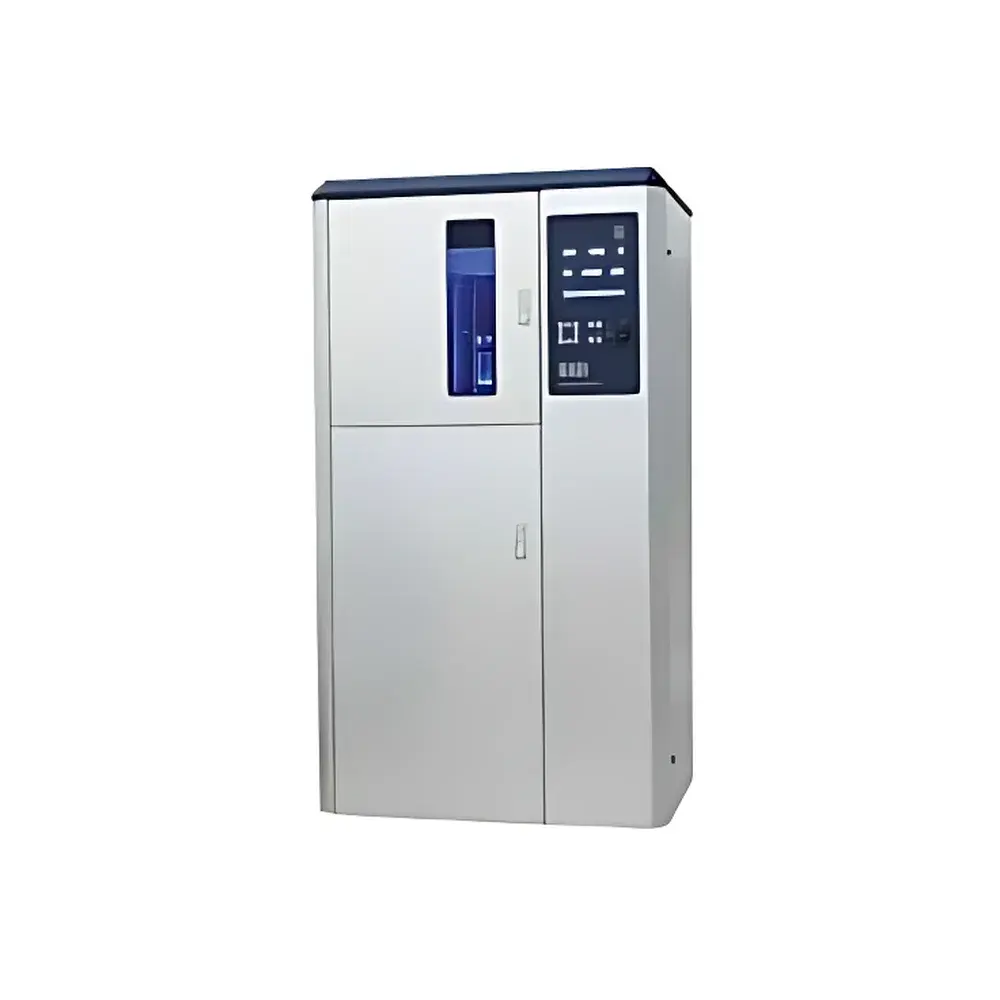
Q-Lab Q-SUN Xe-2 Rotating Drum Xenon Arc Weathering Test Chamber
| Brand | Q-Lab |
|---|---|
| Origin | USA |
| Model | Q-SUN Xe-2 |
| Xenon Lamp Power | 1800 W |
| Sample Capacity | 31 specimens (46 mm × 122 mm) |
| Lamp Life | ~1500 hours |
| Cooling Type | Air-cooled xenon lamp |
| Filter Options | Daylight, Window Glass, Extended UV |
| Irradiance Control | Solar Eye® closed-loop feedback system |
| Humidity Control | Standard RH control (requires deionized water) |
| Water Spray | Optional, top-mounted, operable in both light and dark cycles |
| Temperature Monitoring | Black panel temperature (35–105 °C), chamber air temperature |
| Compliance | Designed to meet ASTM G155, ISO 4892-2, SAE J2527, AATCC TM16, ISO 105-B02, GB/T 16422.2, and other international weathering standards |
Overview
The Q-Lab Q-SUN Xe-2 Rotating Drum Xenon Arc Weathering Test Chamber is an engineered solution for accelerated exposure testing of materials under simulated full-spectrum sunlight, moisture, and thermal stress. Utilizing a single 1800 W air-cooled xenon arc lamp, the Xe-2 reproduces the spectral power distribution of natural daylight—filtered through precision optical filters—to emulate outdoor solar irradiance across UV, visible, and near-infrared wavelengths. Its rotating drum sample holder ensures uniform exposure by continuously repositioning specimens relative to the lamp axis, minimizing directional bias and enhancing test reproducibility. Unlike static flat-bed configurations, the drum geometry supports consistent irradiance distribution and facilitates high-throughput evaluation of small-format samples (up to 31 specimens per cycle). The system is calibrated and validated for compliance with key international standards including ASTM G155, ISO 4892-2, SAE J2527, and AATCC TM16, making it suitable for R&D, quality assurance, and regulatory submission workflows in automotive, coatings, textiles, plastics, and packaging industries.
Key Features
- Air-cooled 1800 W xenon lamp with typical service life of 1500 hours—reducing operational cost and eliminating complex water-cooling infrastructure
- Solar Eye® irradiance control system: real-time photometric monitoring and automatic lamp power adjustment to maintain target irradiance (e.g., 0.35 W/m² @ 340 nm or 1.10 W/m² @ 420 nm)
- Integrated black panel temperature sensor with adjustable setpoint range from 35 °C to 105 °C; chamber air temperature independently monitored and controlled
- Standard relative humidity control (RH), requiring deionized water supply, with continuous display and logging of RH%, black panel temperature, and chamber temperature
- Optional top-mounted water spray system—operational during both irradiation and dark cycles—to simulate dew, rain, and thermal shock effects
- Rotating drum sample carrier accommodating 31 specimens (46 mm × 122 mm); tool-free installation and removal for rapid sample turnover
- Multi-language touchscreen controller (English, French, Spanish, Italian, German) with self-diagnostic routines, fault logging, and automatic safety shutdown protocols
- Ethernet connectivity supporting remote monitoring, audit-ready data export, and integration into laboratory information management systems (LIMS)
Sample Compatibility & Compliance
The Q-SUN Xe-2 accommodates rigid and flexible planar specimens up to 46 mm × 122 mm, including films, foils, coated panels, textile swatches, and polymer strips. Its drum-based geometry ensures minimal shadowing and homogeneous exposure across all positions. The system supports standardized filter configurations—including Daylight (Q/B), Window Glass (Q/FS40), and Extended UV (Q/UV)—to replicate specific environmental conditions required by ASTM D4329 (plastics), ISO 105-B02 (textiles), or SAE J2412 (automotive interior materials). All operational parameters—including irradiance, temperature, humidity, and spray timing—are traceable and configurable to satisfy GLP, GMP, and FDA 21 CFR Part 11 requirements when paired with validated software and electronic record-keeping procedures.
Software & Data Management
The embedded controller provides real-time visualization of exposure parameters and stores full-cycle logs with timestamps, setpoints, and measured values. “Virtual Bar Chart” PC software enables automated acquisition of irradiance, temperature, and RH data via Ethernet, with CSV export, trend plotting, and customizable reporting templates. Data files include digital signatures and metadata required for ISO/IEC 17025-compliant calibration records. Remote diagnostics support allows Q-Lab technical staff to access anonymized system status logs—subject to user authorization—for rapid troubleshooting without on-site intervention. Audit trails capture all parameter changes, user logins, and system events, fulfilling documentation rigor expected in regulated environments.
Applications
- Accelerated photochemical degradation assessment of automotive trim, dashboards, and exterior coatings
- Colorfastness and gloss retention evaluation of architectural paints and industrial finishes
- UV stability screening of medical device polymers and pharmaceutical packaging materials
- Lightfastness validation of inkjet inks, labels, and graphic arts substrates per ISO 105-B02 and AATCC TM16
- Correlation studies between laboratory exposure and real-world field performance using established acceleration factors
- Pre-qualification of new formulations prior to outdoor exposure campaigns at Q-Lab’s Arizona or Florida test sites
FAQ
What standards does the Q-SUN Xe-2 comply with?
The Q-SUN Xe-2 is configured and validated to meet ASTM G155, ISO 4892-2, SAE J2527, AATCC TM16, ISO 105-B02, GB/T 16422.2, and other globally recognized weathering test methods.
Is deionized water mandatory for operation?
Yes—both the humidity control system and optional water spray function require deionized or distilled water to prevent mineral buildup, nozzle clogging, and sensor drift.
Can the Xe-2 perform cyclic tests with alternating light/dark and wet/dry phases?
Yes—the controller supports fully programmable exposure cycles, including irradiation-only, light + spray, dark + spray, and humidity-only segments, with independent setpoints for each phase.
How is irradiance calibrated and maintained over time?
The Solar Eye® sensor continuously measures irradiance at user-selected wavelengths (e.g., 340 nm or 420 nm) and adjusts lamp output in real time; annual recalibration using NIST-traceable reference sensors is recommended.
What maintenance is required for the xenon lamp and filters?
Lamp replacement is recommended after ~1500 hours of operation; optical filters should be inspected quarterly and replaced per manufacturer guidelines or when spectral deviation exceeds ±5% of nominal transmission.



