
Q-LAB Q-SUN Xe-3-HC Xenon Arc Weathering Test Chamber
| Brand | Q-LAB |
|---|---|
| Origin | USA |
| Model | Xe-3-HC |
| Sample Capacity | 55 specimens |
| Sample Tray Dimensions | 451 mm × 718 mm (17.75 in × 28.25 in) |
| Max Load per Tray | 23 kg (50 lbs) |
| RH Range | 20–95% |
| Power Supply | 208/230 V ±10%, 3-Φ, 50/60 Hz, 44 A or 400 V ±10%, 3-Φ, 50/60 Hz, 26 A |
| External Dimensions (W×H×D) | 780 × 940 × 940 mm (30.5 × 37 × 37 in) |
| Refrigeration Unit Weight | 85 kg (186 lbs) |
| Water Inlet Pressure | 0.7–6.2 bar (10–90 psi) |
| Humidifier Water Consumption | 44 L/day |
| Filter Options | Daylight, Window Glass, Extended UV |
Overview
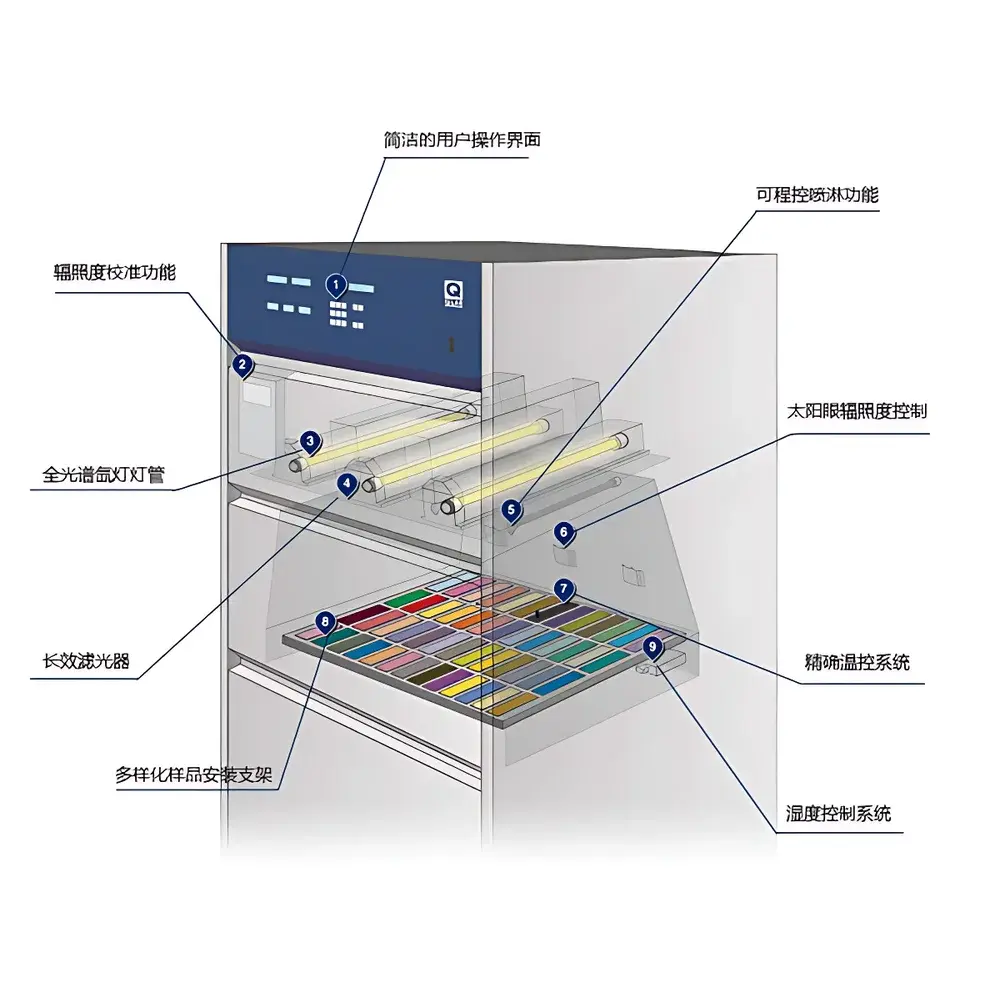
The Q-LAB Q-SUN Xe-3-HC Xenon Arc Weathering Test Chamber is a full-spectrum, benchtop-scale accelerated weathering instrument engineered for precision simulation of solar radiation, temperature, and humidity exposure conditions encountered in real-world outdoor and indoor environments. Based on the well-established Q-SUN platform, the Xe-3-HC employs three independently controlled xenon arc lamps to replicate the spectral power distribution (SPD) of natural sunlight—spanning UV, visible, and near-infrared wavelengths—with high fidelity. This enables quantitatively reproducible photochemical degradation studies essential for evaluating material durability, color stability, gloss retention, and chemical resistance across diverse industrial sectors. Unlike narrow-band UV fluorescent systems, xenon arc technology delivers broadband irradiance closely aligned with CIE Standard Illuminant D65 and ISO 4892-2 requirements, making it the preferred method for ASTM G155, ISO 11341, AATCC TM16, and SAE J2527-compliant testing protocols.
Key Features
- Triple-lamp xenon arc source providing uniform irradiance distribution across large sample area (451 mm × 718 mm)
- Interchangeable optical filter system: daylight-filtered (for direct sun exposure simulation), window-glass-filtered (for indoor/fade testing), and extended-UV-filtered (for aggressive UV acceleration)
- Integrated humidity control with independent monitoring and regulation of relative humidity (20–95%), black panel temperature (BPT), and chamber air temperature
- Optional refrigerated cooling system enabling precise low-temperature operation (down to 10°C BPT), critical for thermally sensitive materials such as pharmaceuticals, cosmetics, and certain polymer formulations
- Onboard pure water purification system and condensate drainage pump—designed for continuous humidification using deionized or distilled water only, ensuring consistent RH performance and minimizing mineral deposits
- Intuitive touchscreen interface supporting five languages (English, French, Spanish, Italian, German) with built-in self-diagnostic routines, fault logging, service alerts, and fail-safe shutdown sequences
Sample Compatibility & Compliance
The Xe-3-HC accommodates up to 55 standard-sized specimens (e.g., 76 mm × 127 mm or 100 mm × 150 mm) on its slide-out tray assembly, with maximum load capacity of 23 kg per tray. Its modular design supports flat-panel, rigid, and semi-flexible substrates—including coated metals, textiles, plastics, paints, adhesives, composites, and architectural finishes—without requiring custom fixtures. All operational parameters are traceable and configurable to meet regulatory expectations for GLP and GMP environments. The system complies with data integrity standards including FDA 21 CFR Part 11 when paired with validated software configurations; audit trails, electronic signatures, and user-access controls can be implemented via optional Q-LAB’s SunTest™ Data Management Suite.
Software & Data Management
Control and data acquisition are managed through Q-LAB’s proprietary SunTest™ operating firmware, which records time-stamped irradiance (W/m² @ 340 nm), chamber temperature, black panel temperature, and relative humidity at user-defined intervals (as frequent as every 30 seconds). Raw measurement logs are exportable in CSV format for external analysis or integration into LIMS platforms. Optional SunTest™ Data Management Software adds role-based access control, automated report generation (PDF/Excel), trend visualization, and long-term data archival compliant with ISO/IEC 17025 documentation requirements. Calibration certificates for irradiance sensors and temperature/humidity probes are available upon request and traceable to NIST standards.
Applications
- Automotive: Evaluating dashboard materials, exterior trim, headlamp lenses, and sealants under simulated South Florida or Arizona exposure profiles
- Coatings & Paints: Accelerated assessment of chalking, cracking, blistering, and color shift per ASTM D4587 and ISO 11341
- Textiles & Apparel: Determining lightfastness of dyed fabrics and functional finishes per AATCC TM16 and ISO 105-B02
- Pharmaceuticals & Cosmetics: Stability testing of packaging components and product formulations under photostability stress conditions (ICH Q1B)
- Building Materials: Assessing UV resistance of roofing membranes, cladding systems, and sealant joints per ASTM D4459 and EN 1297
- Renewables: Qualifying encapsulant durability and backsheet yellowing in PV module qualification per IEC 61215 and UL 1703
FAQ
What type of water must be used in the Xe-3-HC humidification system?
Deionized or distilled water is mandatory. Tap or softened water introduces mineral contaminants that cause scaling, sensor drift, and premature failure of the humidifier and water purification components.
Can the Xe-3-HC operate without the refrigeration option?
Yes—the base configuration operates using forced-air convection cooling only. Refrigeration is an optional upgrade required when test specifications demand black panel temperatures below ambient or sustained operation below 35°C.
Is calibration of irradiance sensors included with purchase?
A factory calibration certificate is provided with each new unit. Annual recalibration is recommended and available through Q-LAB’s certified service centers or authorized partners.
How does the Xe-3-HC ensure irradiance uniformity across the sample plane?
Optical reflectors, lamp alignment jigs, and programmable lamp intensity balancing algorithms maintain ±15% irradiance uniformity over the entire 451 mm × 718 mm exposure area per ISO 4892-2 Annex B.
Does the system support remote monitoring and control?
Remote access is supported via Ethernet connection using Q-LAB’s SunTest™ Remote Monitor software, enabling real-time parameter viewing, alarm notifications, and limited operational control from off-site locations.



