
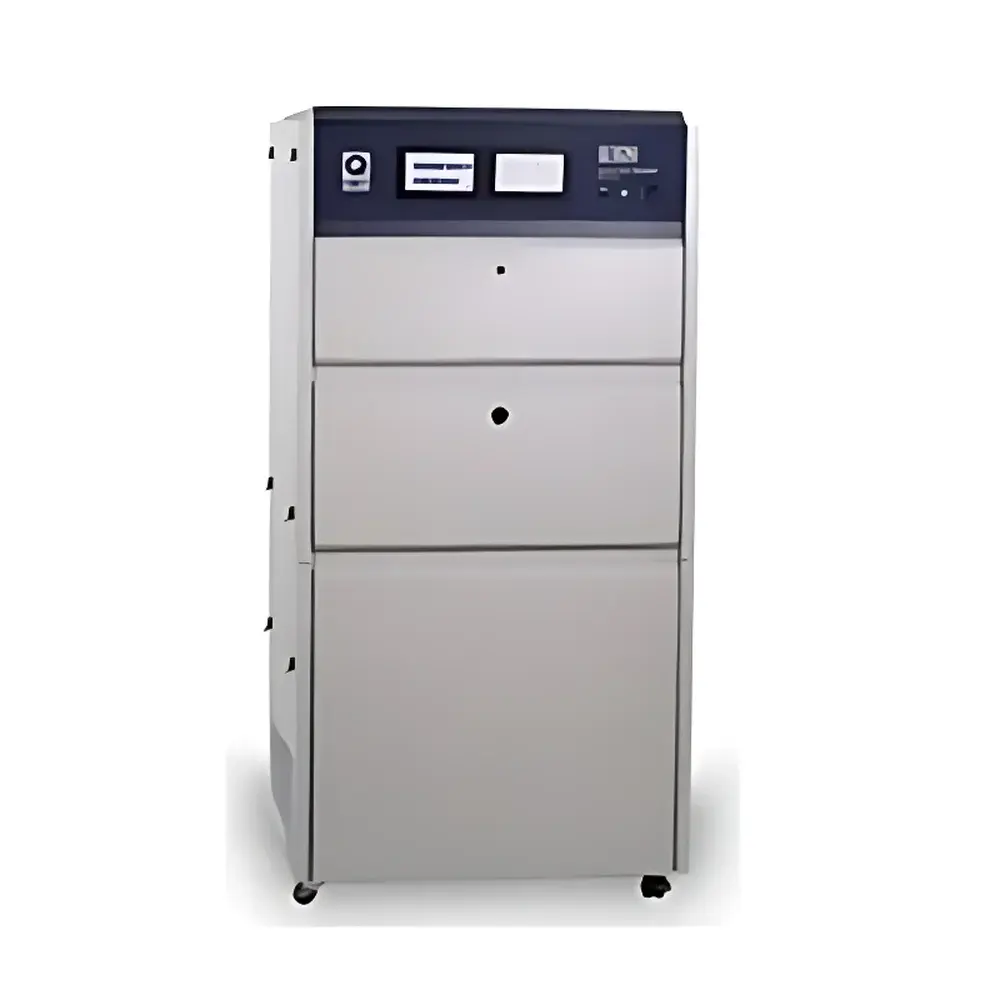
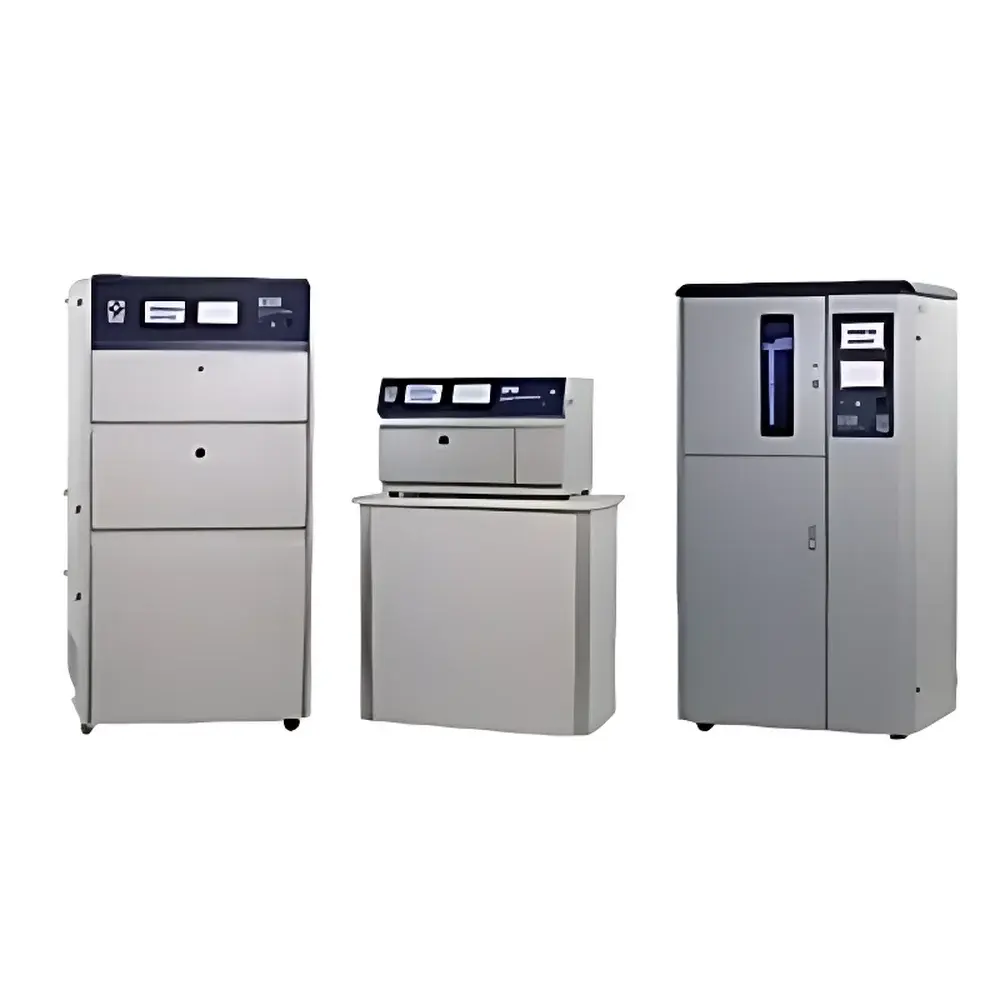
Q-LAB Q-SUN Xe-3-HSC Xenon Arc Weathering Test Chamber
| Brand | Q-LAB |
|---|---|
| Origin | USA |
| Model | Q-SUN Xe-3-HSC |
| Xenon Lamp Power | 1800 W |
| Irradiance Range | ≤1800 W/m² |
| Light Exposure Duration | 1–9999 h (continuously adjustable) |
| Humidity Range | up to 95% RH |
| Cooling System | Integrated refrigeration unit |
| Lamp Configuration | 3 air-cooled xenon arc lamps |
| Lamp Lifetime | ~1500 hours |
| Water Requirements | Deionized or purified water for humidity and spray functions |
Overview
The Q-LAB Q-SUN Xe-3-HSC Xenon Arc Weathering Test Chamber is an engineered environmental simulation system designed to replicate the full-spectrum solar radiation—UV, visible, and near-infrared—under controlled temperature, humidity, and wetting conditions. Based on the internationally recognized principles of xenon arc accelerated weathering per ASTM G155, ISO 4892-2, and SAE J2527, this chamber enables precise, reproducible evaluation of material degradation mechanisms including color shift, gloss loss, chalking, cracking, and embrittlement. The Xe-3-HSC variant integrates three critical environmental stressors: humidity control (H), water spray (S), and mechanical refrigeration (C). This configuration is especially suited for thermally sensitive indoor materials—such as pharmaceuticals, cosmetics, inks, and polymer-based medical packaging—where maintaining low specimen surface temperatures (<60 °C black panel) during extended irradiation is essential to avoid non-physiological thermal aging artifacts.
Key Features
- Triple-Function Environmental Simulation: Simultaneous and independent control of irradiance, relative humidity (up to 95% RH), water spray cycles (top-mounted dual nozzles), and refrigerated chamber/panel temperature—enabling realistic outdoor and indoor service condition replication.
- Air-Cooled Xenon Arc Source: Three 1800 W air-cooled xenon lamps deliver stable, uniform irradiance (≤1800 W/m²) across the 290–800 nm spectral range. Lamp output closely matches terrestrial sunlight when paired with appropriate optical filters (Daylight, Window Glass, Extended UV).
- Black Panel Temperature Control: Dual-sensor feedback loop regulates specimen surface temperature using a calibrated black panel thermometer (BPT), with setpoint range from 42 °C to 120 °C. Refrigeration extends low-temperature capability down to ambient +5 °C, critical for heat-sensitive formulations.
- Purified Water Management System: Integrated deionized water delivery for both humidity generation and spray function; automatic low-conductivity monitoring ensures compliance with ASTM D4329 and ISO 4892-2 purity requirements.
- Intuitive Touchscreen Controller: Multilingual interface (English, French, Spanish, Italian, German) with real-time display of irradiance, BPT, chamber air temperature, RH, and spray status. Built-in self-diagnostic routines log faults, trigger maintenance alerts, and support safe shutdown protocols.
Sample Compatibility & Compliance
The Q-SUN Xe-3-HSC accommodates flat-panel specimens up to 127 mm × 254 mm (5″ × 10″) per rack, with capacity for up to 48 standard test coupons per exposure cycle. Its modular sample tray design supports diverse geometries—including rigid plastics, coated metals, textiles, and laminated films—without requiring custom fixtures. All operational parameters comply with regulatory testing frameworks used in global quality assurance: ASTM D2565 (plastics), ASTM D4329 (plastics—water immersion), ISO 11341 (paints and varnishes), AATCC TM16 (textiles), and IEC 60068-2-5 (electrotechnical products). Data integrity meets GLP/GMP expectations via optional Ethernet connectivity and audit-trail-capable software logging aligned with FDA 21 CFR Part 11 requirements.
Software & Data Management
Standard Ethernet port enables seamless integration into laboratory network infrastructure. Optional Q-SUN Virtual Strip Chart Software provides automated acquisition and timestamped storage of all critical exposure parameters—including irradiance (W/m² @ 340 nm), black panel temperature (°C), relative humidity (% RH), spray activation timing, and lamp operating hours. Data exports natively to CSV and XML formats for traceability, statistical analysis (e.g., ANOVA, regression modeling), and inclusion in regulatory submission dossiers. Remote diagnostics are supported through secure email transmission of controller logs directly to Q-LAB Technical Support, facilitating rapid root-cause analysis without onsite intervention.
Applications
- Accelerated stability testing of pharmaceutical solid dosage forms under ICH Q1B guidelines (photostability)
- Colorfastness validation of cosmetic packaging and printed labels per ISO 105-B02
- UV resistance qualification of automotive interior trim materials (SAE J2412, GMW14124)
- Weathering performance benchmarking of architectural coatings (ASTM D4587, ISO 11341)
- Long-term durability assessment of OLED display encapsulation layers and flexible electronics substrates
- Validation of UV-curable adhesives and dental composites under clinically relevant irradiance profiles
FAQ
What types of optical filters are compatible with the Q-SUN Xe-3-HSC?
The system supports three standardized filter configurations: Daylight (CIE No. 1), Window Glass (CIE No. 3), and Extended UV (CIE No. 4)—each altering spectral distribution to match specific end-use environments.
Is deionized water mandatory for operation?
Yes. Both humidity generation and spray functions require water with conductivity ≤1 µS/cm to prevent mineral deposition on optics, sensors, and chamber surfaces—ensuring long-term calibration stability and compliance with ASTM D4329.
How does the refrigeration system enhance test fidelity for heat-sensitive samples?
By actively suppressing chamber and black panel temperatures during high-irradiance cycles, the integrated compressor prevents thermal runaway—preserving chemical integrity and enabling correlation with real-world indoor shelf-life data where ambient temperatures rarely exceed 40 °C.
Can the controller store multiple test protocols?
Yes. Up to 100 user-defined exposure programs—including ramp rates, dwell times, spray intervals, and humidity profiles—can be saved, recalled, and executed without reconfiguration.
What documentation is provided for IQ/OQ/PQ validation?
Q-LAB supplies factory calibration certificates, installation qualification checklists, operational qualification templates, and preventive maintenance logs—all structured to align with ISO/IEC 17025 and GxP laboratory validation standards.



