
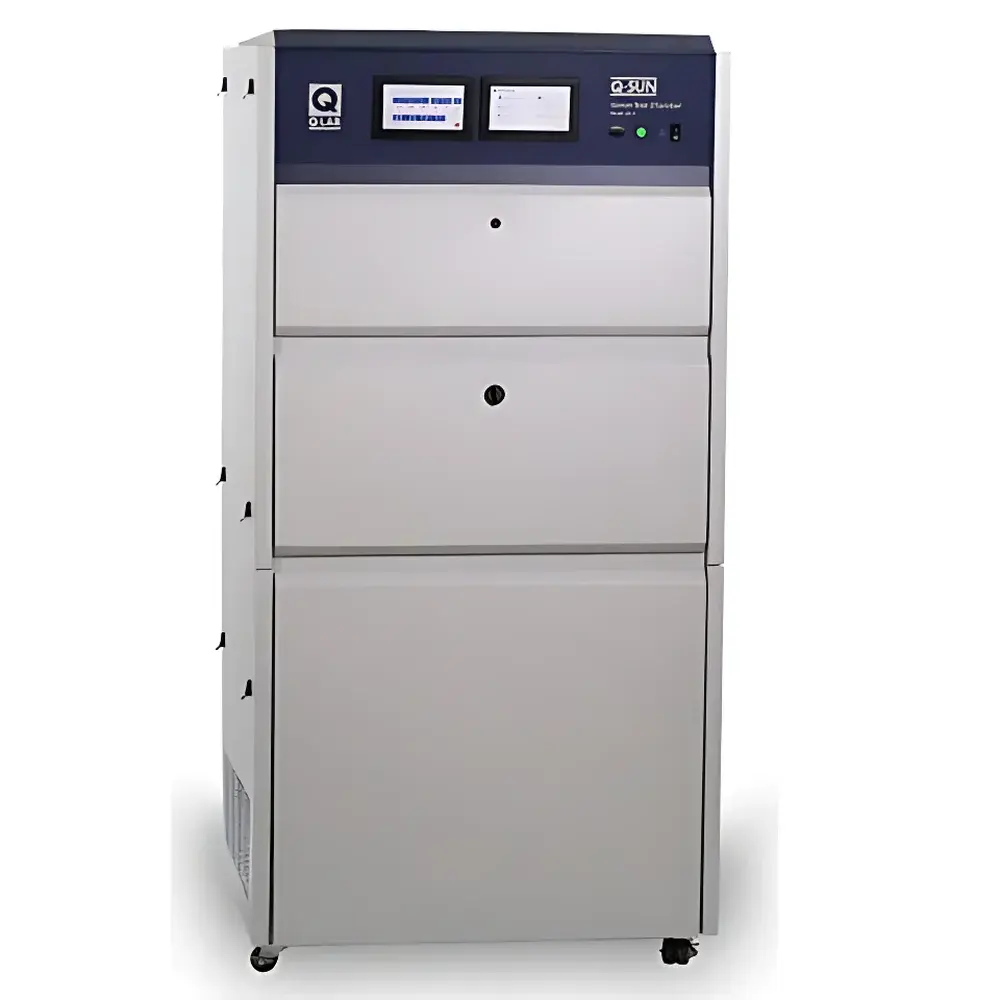
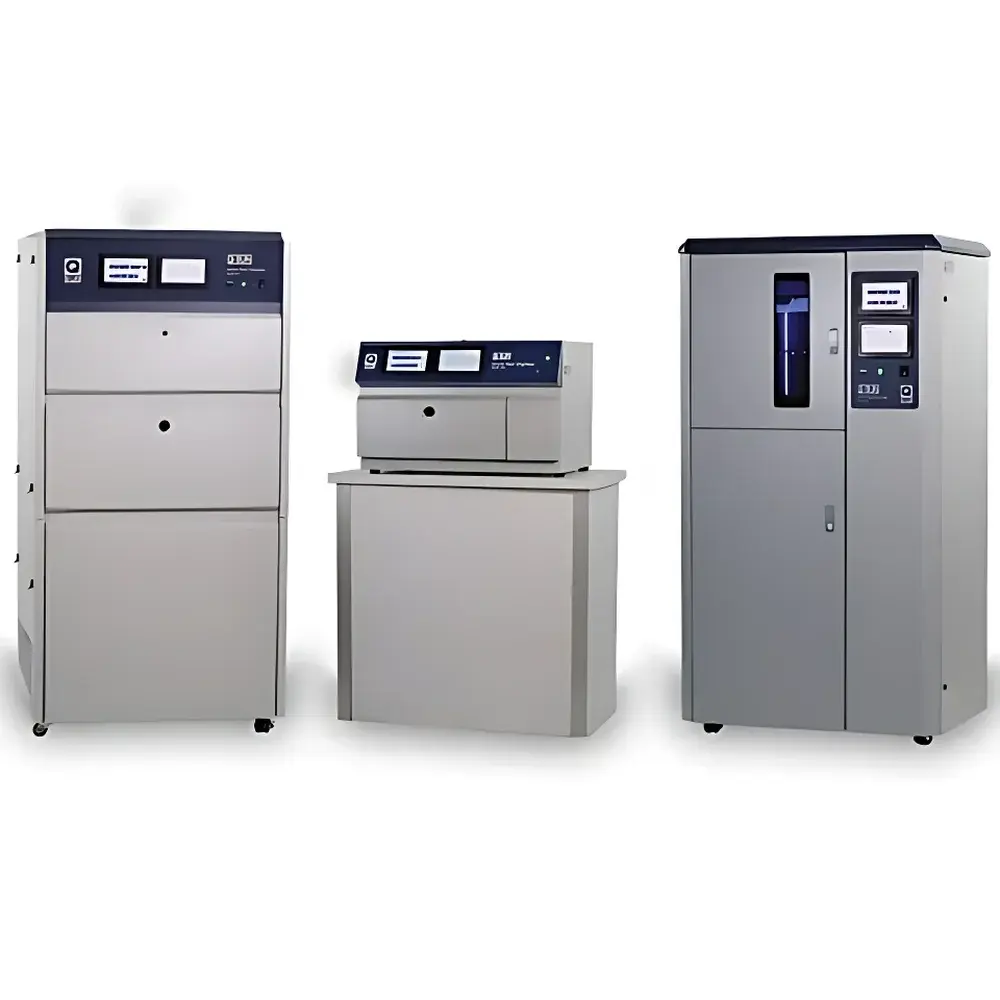
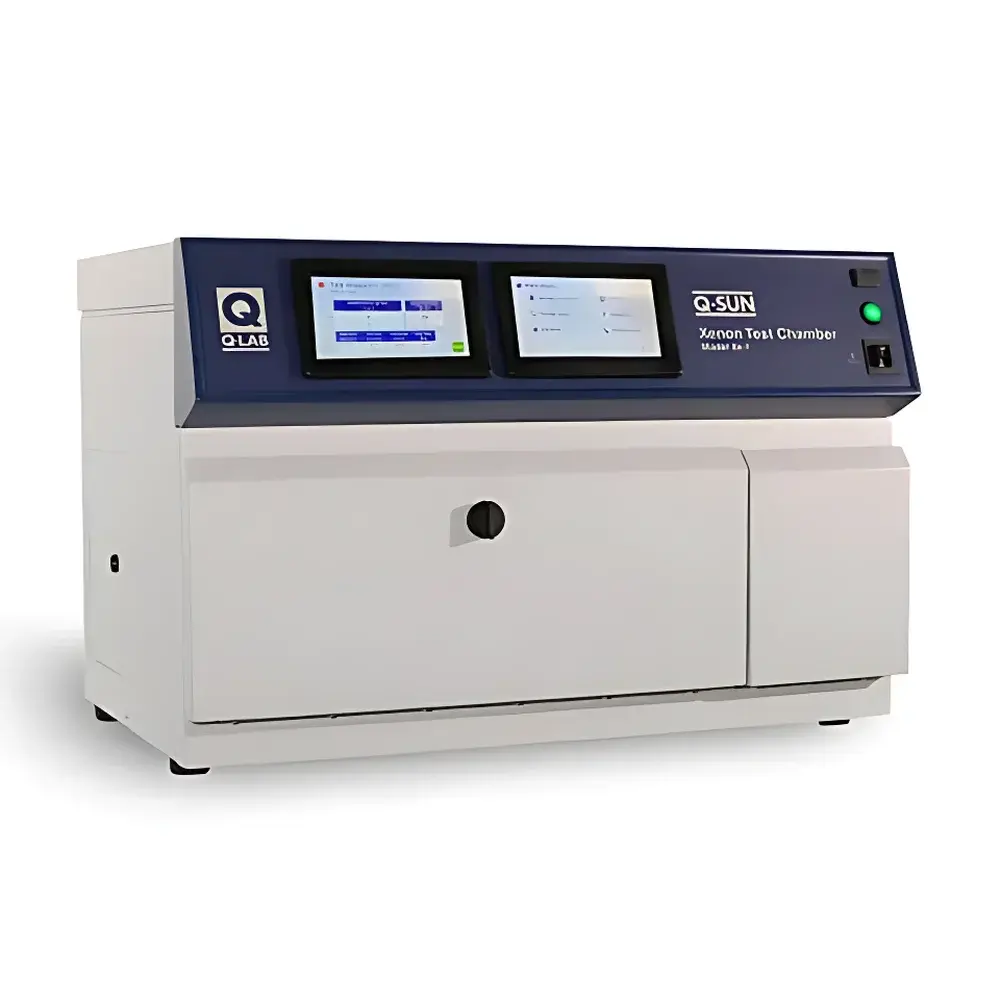
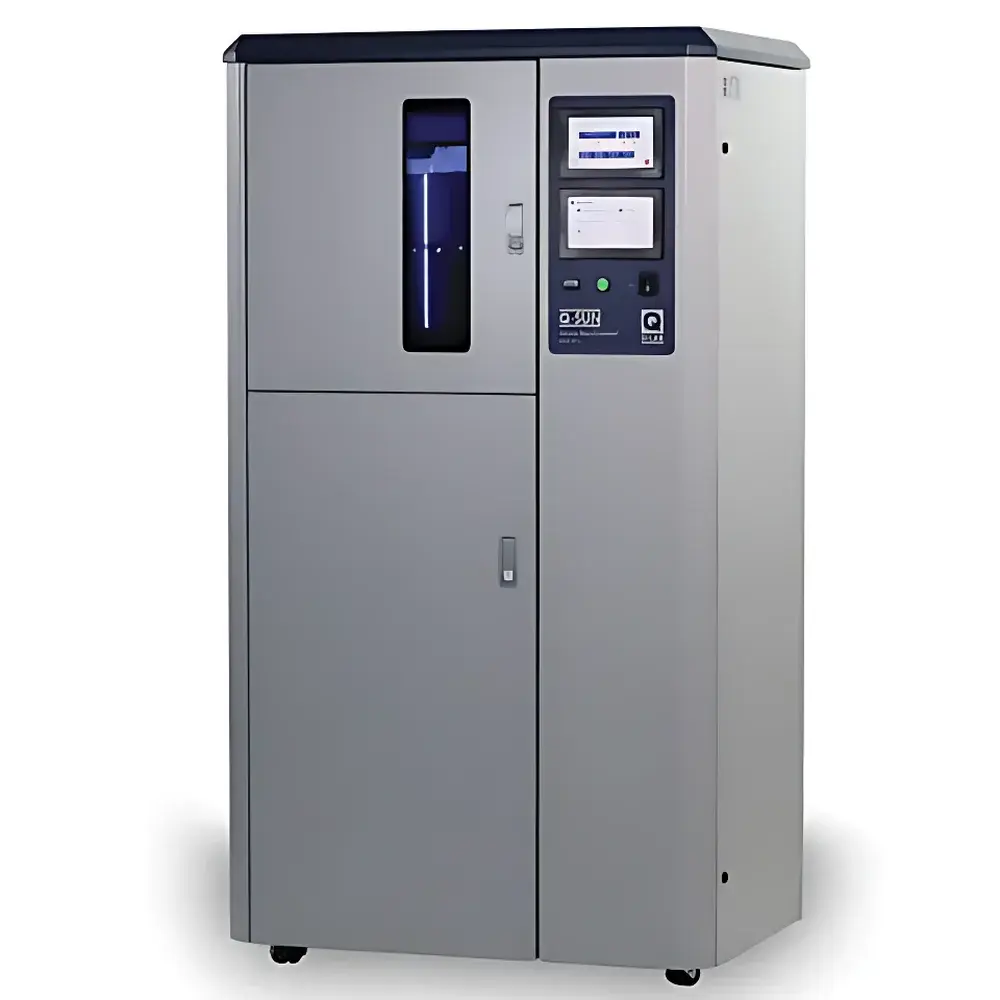
Q-LAB Q-SUN Xe-3 Xenon Arc Weathering Test Chamber
| Brand | Q-LAB |
|---|---|
| Origin | USA |
| Model | Q-SUN Xe-3 |
| Light Source | Air-Cooled Xenon Arc Lamp (3-lamp configuration) |
| Spectral Range | Full-spectrum solar simulation (290–800 nm) |
| Irradiance Control | SOLAR EYE® broadband or narrowband (340 nm, 420 nm, or TUV) |
| Black Panel Temperature Range | 42–120 °C |
| Chamber Air Temperature Range | Ambient to 75 °C (standard) |
| Relative Humidity Range | 10–95% RH (controlled) |
| Sample Tray Dimensions | 451 mm × 718 mm |
| Max. Sample Capacity | 51 specimens (51 mm × 102 mm) |
| Lamp Life | ~1500 hours |
| Filter Options | Daylight, Window Glass (Window-Q, Window-B/SL, Window-IR), Extended UV (UV-Q/B) |
| Optional Features | Water Spray (front-only), Dual Spray (primary + secondary liquid), Back Spray, Refrigerated Chiller, Ethernet Interface, AUTOCAL® Self-Calibration System |
Overview
The Q-LAB Q-SUN Xe-3 Xenon Arc Weathering Test Chamber is an engineered solution for accelerated material degradation testing under controlled, reproducible solar-spectrum irradiation. Utilizing three air-cooled xenon arc lamps, the Xe-3 delivers full-spectrum radiation (290–800 nm), closely matching terrestrial sunlight—including critical UV, visible, and near-infrared bands—enabling high-fidelity simulation of outdoor and indoor exposure conditions. Unlike UV fluorescent or metal halide systems, xenon arc technology provides spectrally accurate irradiance essential for evaluating color shift, gloss loss, chalking, cracking, and polymer chain scission in coatings, plastics, textiles, automotive interiors, and pharmaceutical packaging. The chamber integrates simultaneous black panel temperature (BPT) and chamber air temperature control, humidity regulation (10–95% RH), and programmable light/dark cycles—ensuring test parameters align with internationally recognized exposure protocols such as ISO 4892-2, ASTM G155, SAE J2527, and AATCC TM16. Its horizontal sample orientation, combined with optional spray modules, replicates realistic wet/dry cycling dynamics observed in natural weathering.
Key Features
- Air-cooled xenon lamp architecture: Eliminates complex water cooling infrastructure, reducing installation footprint, maintenance frequency, and total cost of ownership.
- SOLAR EYE® irradiance feedback control: Continuously monitors and adjusts lamp output at user-selected wavelengths (340 nm, 420 nm, or TUV), ensuring ±5% irradiance stability over time and across lamp life.
- Patented AUTOCAL® system: Enables on-site, operator-initiated calibration of irradiance and temperature sensors without external instrumentation—minimizing downtime and supporting GLP-compliant audit trails.
- Modular environmental simulation: Standard humidity control; optional front spray, dual spray (for sequential or co-applied liquids such as acid rain simulants), back spray (per SAE J2412), and refrigerated chiller (extending low-temperature operation to 31 °C at 50% RH).
- Horizontal sample tray (451 × 718 mm): Accommodates flat, curved, and 3D specimens—including bottles, cosmetic containers, and automotive trim—with adjustable-height fixtures ensuring uniform irradiance exposure and realistic moisture retention.
- Embedded Ethernet interface: Supports remote monitoring, data logging (via Q-LAB’s QUASAR™ software), firmware updates, and integration into centralized lab management systems compliant with FDA 21 CFR Part 11 requirements.
Sample Compatibility & Compliance
The Q-SUN Xe-3 accepts diverse specimen geometries—from rigid panels and flexible films to irregular 3D components—without requiring custom mounting hardware. Standard fixtures include textile clamps (X-10255-X), narrow/wide bottle holders (X-10183/X-10184), and height-adjustable 3D part supports (X-10476-K). All filter sets (Daylight, Window-Q/B/SL/IR, UV-Q/B) are optically stable and require no routine replacement except Window-IR, which is specified for IR-sensitive applications. The system meets critical compliance benchmarks: ISO 4892-2 (plastics—xenon arc exposure), ASTM D4329 (plastics—fluorescent UV), ASTM G155 (non-metallic materials), AATCC TM16 (textile colorfastness), and IEC 60068-2-5 (environmental testing). Humidity and spray functions operate exclusively with purified water (≥1 MΩ·cm resistivity) to prevent mineral deposition and sensor drift—consistent with ISO 9001 and ISO/IEC 17025 laboratory quality management expectations.
Software & Data Management
QUASAR™ software—provided standard with all Q-SUN Xe-3 configurations—offers intuitive test programming, real-time parameter visualization (irradiance, BPT, RH, chamber temp), and automated report generation in PDF/CSV formats. Each test run logs timestamped metadata, including lamp hours, filter type, calibration history, and operator ID—supporting traceability for regulatory submissions. Audit trail functionality complies with FDA 21 CFR Part 11 requirements for electronic records and signatures. Remote access via secure HTTPS enables cross-site collaboration and centralized fleet monitoring. Calibration certificates for CR20 irradiance meters and CT202 black panel thermometers are issued annually by Q-LAB’s ISO/IEC 17025-accredited calibration laboratory, with NIST-traceable documentation included.
Applications
The Q-SUN Xe-3 serves R&D, QC, and regulatory validation labs across industries where photostability and environmental durability are mission-critical. In automotive engineering, it validates dashboard materials per SAE J2412 and J2527. In pharmaceuticals, it supports ICH Q1B photostability testing under controlled irradiance and temperature—particularly when paired with the refrigerated chiller option for thermolabile formulations. Textile and apparel labs use it for AATCC TM16 colorfastness assessment under window-glass-filtered spectra. Paint and coating manufacturers rely on daylight-filtered exposure to correlate accelerated results with years of Florida or Arizona field data. Packaging developers apply dual-spray configurations to simulate urban pollution effects on barrier films and printed labels. Its scalability—from single-unit academic labs to multi-chamber production validation suites—makes it suitable for both exploratory screening and formal release testing.
FAQ
What lamp lifetime can be expected, and how is lamp replacement performed?
Each air-cooled xenon lamp operates for approximately 1500 hours under standard irradiance settings. Replacement requires no tools: unplug the lamp connector, loosen two retaining screws, and remove the lamp housing from the front-access panel—typically completed in under five minutes per lamp.
Is filter replacement required during normal operation?
Standard Daylight and Window-Q/B/SL filters exhibit no spectral degradation over time and do not require scheduled replacement. Only the Window-IR filter—used in infrared-sensitive applications—requires periodic renewal per manufacturer guidelines.
Can the Xe-3 meet FDA 21 CFR Part 11 requirements for electronic records?
Yes. QUASAR™ software includes role-based user authentication, electronic signatures, immutable audit trails, and secure data export—fully aligned with Part 11 technical and procedural controls for regulated environments.
What water purity specifications are mandatory for humidity and spray functions?
Purified water with resistivity ≥1 MΩ·cm (equivalent to ASTM D1193 Type IV or ISO 3696 Grade 3) is required to prevent scaling, nozzle clogging, and sensor contamination—ensuring long-term measurement integrity.
How does the dual-spray option function, and what secondary fluids are compatible?
The dual-spray system uses a dedicated external reservoir, centrifugal pump, and filtration module to deliver a second fluid—such as synthetic acid rain (pH 3.0–4.0), detergent solutions, or saline—simultaneously or sequentially with deionized water spray, enabling multi-stress corrosion and soiling studies.



