
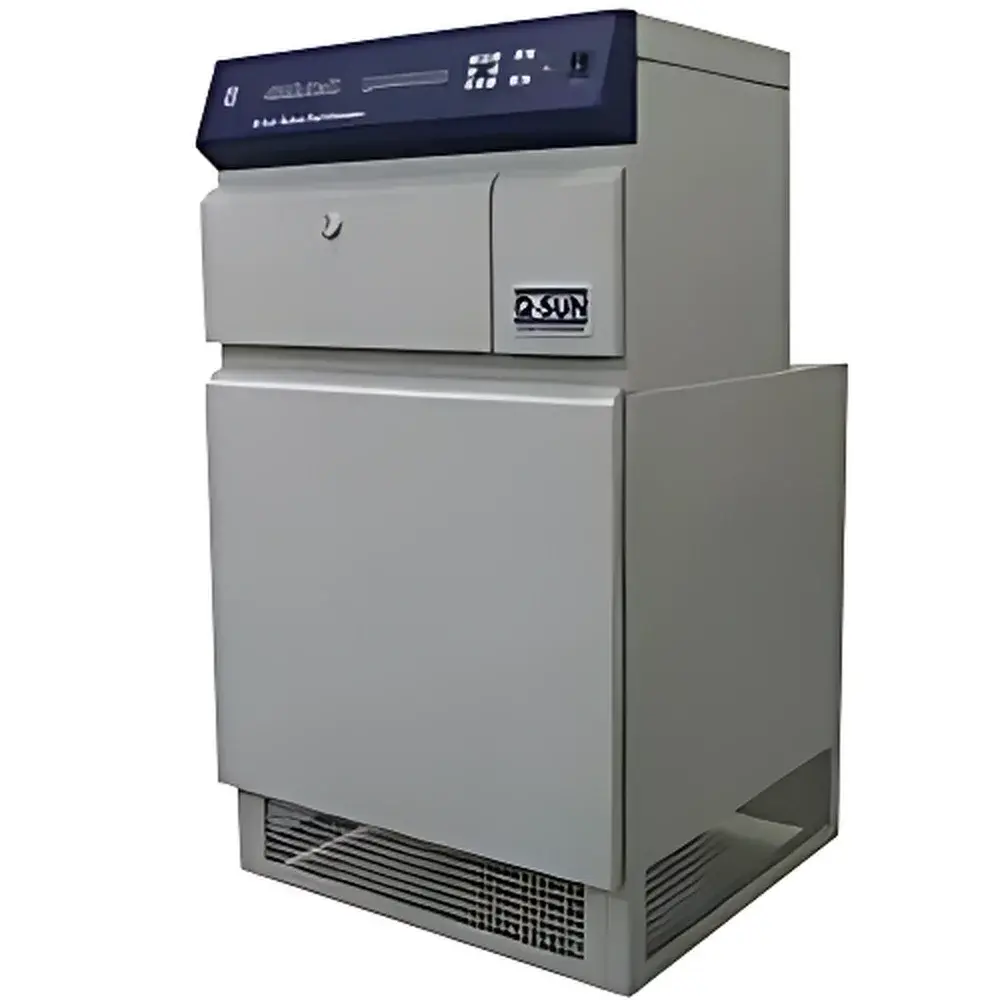

Q-Lab Xe-1 Benchtop Xenon Arc Weathering Test Chamber
| Brand | Q-Lab |
|---|---|
| Origin | USA |
| Model | Xe-1 |
| Lamp Type | Air-Cooled Xenon Arc Lamp |
| Lamp Lifetime | 1500 hours |
| Sample Tray Dimensions | 251 mm × 457 mm |
| Max Sample Capacity | 15 pieces of 51 mm × 102 mm |
| Black Panel Temperature Range | 35–103 °C |
| Irradiance Control | SOLAR EYE broadband or narrowband (340 nm, 420 nm, TUV) |
| Filter Options | Daylight-Q / Daylight-B/B, Window-Q / Window-B/SL / Window-IR, Extended UV-Q/B |
| Cooling | Ambient air-cooled (optional refrigerated cooling unit available) |
| Interface | Ethernet-enabled touchscreen controller with self-diagnostic alerts |
| Compliance | Designed to support ASTM G155, ISO 4892-2, SAE J2527, AATCC TM16, ISO 11341, and other xenon arc weathering standards |
Overview
The Q-Lab Xe-1 Benchtop Xenon Arc Weathering Test Chamber is an engineered solution for accelerated material degradation testing under controlled solar-spectrum irradiation. Utilizing a high-intensity, air-cooled xenon arc lamp, the Xe-1 replicates the full spectral output of natural sunlight—spanning ultraviolet (UV), visible, and near-infrared (NIR) regions—with exceptional fidelity. Unlike UV fluorescent or metal halide sources, xenon arc technology delivers spectrally accurate irradiance that closely matches terrestrial solar radiation (AM1.5G), enabling predictive correlation between laboratory exposure and real-world outdoor service life. The chamber operates continuously—24/7, unattended—delivering reproducible, traceable, and standardized exposure conditions essential for quality control, R&D validation, and regulatory compliance in coatings, polymers, textiles, automotive interiors, and packaging materials.
Key Features
- Air-cooled xenon arc lamp system (1500-hour rated lifetime), eliminating water infrastructure requirements and reducing maintenance complexity and operational cost.
- SOLAR EYE irradiance monitoring and feedback control system, supporting selectable irradiance setpoints at 340 nm (UV-B critical), 420 nm (visible edge), or total UV (TUV) bandwidths—ensuring precise, repeatable radiant exposure across test cycles.
- Black panel temperature (BPT) control as standard, with optional air temperature sensor integration; BPT range spans 35–103 °C, directly influencing photochemical reaction kinetics and thermal aging mechanisms.
- Patented AUTOCAL calibration protocol enables rapid, on-site verification and adjustment of irradiance and temperature sensors without external instrumentation—minimizing downtime and supporting GLP-compliant calibration records.
- Modular filter architecture: Single-filter configuration supports three spectral families—Daylight (for outdoor exposure simulation), Window Glass (for indoor/filtered-spectrum applications), and Extended UV (for accelerated stress testing per automotive or aerospace specifications).
- Horizontal sample orientation with sliding tray (251 × 457 mm) accommodates flat specimens, 3D parts, and irregular geometries; up to fifteen 51 × 102 mm samples can be loaded simultaneously.
- Ethernet-connected embedded controller with intuitive touchscreen interface, real-time data logging, self-diagnostic alerts, and remote monitoring capability—fully compatible with LIMS and enterprise data management systems.
Sample Compatibility & Compliance
The Xe-1 accommodates diverse substrate types—including painted panels, plastic injection-molded components, textile swatches, printed films, and elastomeric seals—without requiring custom fixtures. Its open-tray design permits direct mounting of dimensional parts and multi-layer assemblies. The chamber is designed and validated to meet the optical, thermal, and temporal requirements of internationally recognized weathering standards, including ASTM G155 (Practice for Operating Xenon Arc Light Apparatus), ISO 4892-2 (Plastics—Methods of Exposure to Laboratory Light Sources—Part 2: Xenon-Arc Methods), SAE J2527 (Surface Vehicle Standard for Accelerated Exposure of Automotive Exterior Materials), and AATCC TM16 (Colorfastness to Light). Filter selection (e.g., Daylight-B/B for exterior durability, Window-IR for interior automotive plastics) ensures alignment with application-specific spectral weighting functions defined in these standards. All Q-Lab filters are manufactured from fused silica and stabilized borosilicate glass; their transmission profiles remain stable over time—except Window-IR, which requires periodic replacement per manufacturer guidelines to maintain IR cutoff integrity.
Software & Data Management
The Xe-1’s embedded controller runs Q-Lab’s proprietary firmware, supporting configurable test profiles, multi-step ramping (irradiance, temperature, humidity), and event-triggered actions (e.g., pause on sensor fault, email alert on cycle completion). Data—including irradiance (W/m²), black panel temperature (°C), chamber ambient temperature (°C), elapsed time, and system status—is logged at user-defined intervals (minimum 1-minute resolution) and exported via Ethernet to CSV or XML formats. Audit trails record all parameter changes, calibration events, and operator logins—supporting FDA 21 CFR Part 11 compliance when deployed in regulated environments. Integration with Q-Lab’s SunTest™ software suite enables centralized fleet management, statistical trend analysis, and automated report generation aligned with ISO/IEC 17025 documentation requirements.
Applications
The Xe-1 serves as a primary tool for evaluating photostability, color retention, gloss loss, chalking, cracking, and mechanical property degradation in materials exposed to solar radiation. Typical use cases include: qualification of automotive clearcoats per OEM specifications (e.g., GMW14124, Ford CETP); validation of architectural coating formulations against ASTM D4587 (UV-condensation exposure); assessment of textile lightfastness per ISO 105-B02; and screening of polymer additives (HALS, UVAs) for synergistic stabilization performance. Its benchtop footprint and low total cost of ownership (TCO)—including lamp replacement cost, energy consumption, and filter longevity—make it suitable for academic labs, contract testing facilities, and Tier-2 suppliers requiring routine, standards-compliant weathering capability without facility-level infrastructure investment.
FAQ
What spectral filters are compatible with the Xe-1?
The Xe-1 accepts three filter families: Daylight (Q or B/B variants), Window Glass (Q, B/SL, or IR), and Extended UV (Q/B). Each is optimized for specific exposure conditions and referenced in relevant ASTM, ISO, and SAE test methods.
Is humidity control available on the Xe-1?
No—humidity control is not integrated into the Xe-1 platform. For combined light/humidity testing, Q-Lab recommends the larger Xe-2 or Xe-3 chamber models equipped with spray and humidity modules.
Can the Xe-1 operate unattended for extended durations?
Yes—the system is designed for continuous, fully automated operation with built-in safety interlocks, thermal cutoffs, and lamp-end-of-life detection. Remote monitoring via Ethernet enables 24/7 oversight without manual intervention.
How often must the xenon lamp be replaced?
Lamp replacement is recommended after 1500 hours of operation, as specified by Q-Lab. Performance degradation beyond this point compromises irradiance stability and spectral match accuracy.
Does the Xe-1 support GLP or GMP audit requirements?
When configured with full audit trail logging, electronic signatures, and calibrated sensor records, the Xe-1 meets foundational GLP principles and supports GMP-aligned validation protocols—particularly when paired with Q-Lab’s calibration and service documentation packages.



