
Q-LAB Xe-1-S Xenon Arc Weathering Test Chamber
| Brand | Q-LAB |
|---|---|
| Origin | USA |
| Model | Q-LAB Xe-1-S |
| Xenon Lamp Power | 1800 W |
| Lamp Type | Air-Cooled Single Xenon Arc Lamp |
| Lamp Lifetime | 1500 hours |
| Sample Tray Dimensions | 251 mm × 457 mm |
| Max Sample Capacity | 15 pcs of 51 mm × 102 mm specimens |
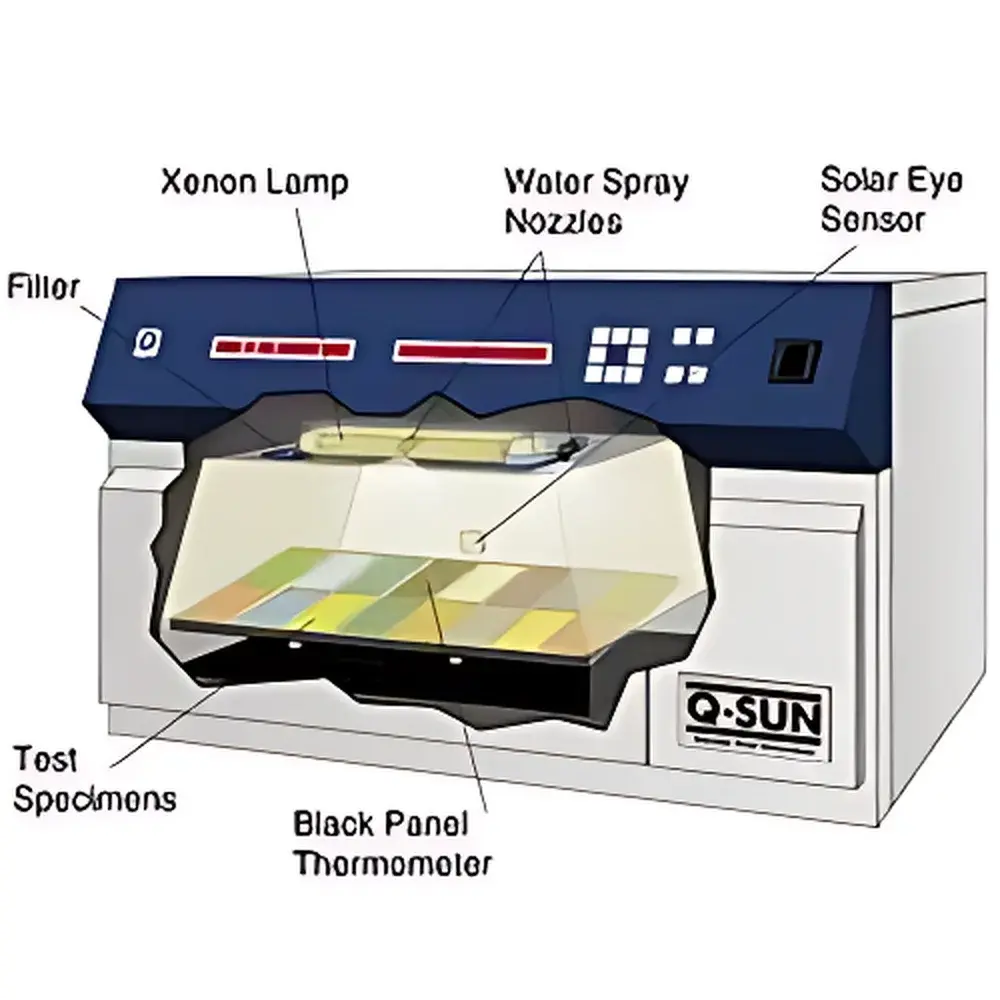
| Irradiance Control | SOLAR EYE® Spectral Radiometer (340 nm, 420 nm or TUV) |
| Temperature Monitoring | Black Panel Thermometer (35–103 °C), optional Air Temperature Sensor |
| Humidity Control | Optional Water Spray System (deionized water required) |
| Filter Options | Daylight, Window Glass, Window IR (replacement required) |
| Compliance | ASTM G155, ISO 4892-2, SAE J2527, AATCC TM16, ISO 11341, GB/T 16422.2 |
| Interface | Built-in Ethernet, Touchscreen UI, Auto-Diagnostic Alerts |
| Calibration | AUTOCAL® System, CR20 Radiometer & CT202 Thermometer Support |
Overview
The Q-LAB Xe-1-S Xenon Arc Weathering Test Chamber is a compact, single-lamp, air-cooled xenon arc exposure system engineered for accelerated weathering and light stability evaluation of materials under controlled laboratory conditions. It employs a 1800 W xenon arc lamp to reproduce the full solar spectrum — spanning UV (295–400 nm), visible (400–800 nm), and near-infrared (800–1100 nm) radiation — with spectral fidelity unmatched by fluorescent or metal halide alternatives. Unlike water-cooled systems, its air-cooled lamp architecture reduces thermal management complexity, lowers operational cost, and enhances long-term reliability. The chamber operates continuously in automated cycles, enabling 24/7 exposure at irradiance levels equivalent to peak summer noon sunlight — significantly accelerating degradation kinetics while maintaining physical and chemical relevance to real-world outdoor service life. Its design complies with core international standards for material weathering, including ASTM G155, ISO 4892-2, SAE J2527, and AATCC TM16, making it suitable for R&D, quality assurance, and regulatory-compliant testing environments.
Key Features
- Air-cooled 1800 W xenon arc lamp with typical 1500-hour service life — no external chiller required, minimal maintenance overhead
- SOLAR EYE® irradiance control system with real-time spectral monitoring at user-selectable wavelengths (340 nm, 420 nm, or TUV broadband)
- Black panel thermometer (BPT) as standard temperature sensor; optional air temperature sensor for ambient thermal profiling
- Deionized water spray system with dual top-mounted nozzles — programmable during light or dark phases to simulate dew, rain, and humidity cycling
- Patented AUTOCAL® calibration interface for rapid field verification of irradiance and temperature sensors using CR20 and CT202 reference instruments
- Horizontal sample tray (251 mm × 457 mm) with slide-out mechanism for rapid specimen loading/unloading and in-situ visual assessment
- Modular optical filter system: Daylight-Q, Window Glass-Q, and Window IR-Q filters — all stable over time except Window IR-Q, which requires periodic replacement
- Touchscreen HMI with built-in Ethernet connectivity, event logging, alarm history, and remote monitoring capability
Sample Compatibility & Compliance
The Xe-1-S accommodates flat, curved, and three-dimensional specimens up to 15 standard 51 mm × 102 mm coupons per cycle. Its horizontal exposure plane ensures uniform irradiance distribution and eliminates shadowing artifacts common in vertical configurations. The chamber supports diverse material classes — polymers, coatings, textiles, automotive interior/exterior components, packaging films, and architectural finishes — without requiring custom fixtures. All operational protocols align with GLP-aligned test documentation practices. Data integrity is maintained via timestamped exposure logs, sensor calibration records, and diagnostic event tracking — fully compatible with FDA 21 CFR Part 11 audit trail requirements when deployed within validated IT infrastructure. Regulatory compliance extends to ISO/IEC 17025-accredited laboratories conducting accredited weathering tests per ISO 4892-2 and ASTM G155 Annex A1.
Software & Data Management
The embedded controller firmware provides intuitive cycle programming, including irradiance setpoints, temperature ramp profiles, humidity spray timing, and dark/light phase durations. Exposure parameters are stored in non-volatile memory and exportable via Ethernet to LIMS or enterprise QA databases in CSV or XML format. Real-time sensor outputs (irradiance, BPT, chamber air temp, spray status) are logged at user-defined intervals (1–60 min). Built-in self-diagnostic routines monitor lamp voltage, cooling fan RPM, spray solenoid function, and filter degradation indicators — triggering actionable alerts before performance drift occurs. Calibration data from CR20 radiometers and CT202 thermometers is directly ingested into the system’s calibration registry, supporting traceable metrology workflows compliant with ISO/IEC 17025 Clause 6.5.
Applications
The Xe-1-S delivers high-fidelity simulation for critical photostability and durability assessments across multiple sectors. In automotive R&D, it validates pigment fade resistance and dashboard material cracking under combined UV/heat/humidity stress. Coating manufacturers use it to benchmark gloss retention, chalking, and adhesion loss in architectural and industrial finishes. Textile labs rely on its spectral accuracy for AATCC TM16-compliant colorfastness-to-light testing. Packaging developers assess UV-induced polymer chain scission in pharmaceutical blister foils and food-grade laminates. Academic researchers apply it to photochemical degradation kinetics studies where reproducible, spectrally resolved irradiance is essential. Its compact footprint and low total cost of ownership make it especially suited for small-scale QA labs needing full-spectrum xenon testing without infrastructure retrofitting.
FAQ
What type of water must be used for the spray system?
Deionized or distilled water is mandatory. Tap or softened water will cause nozzle clogging and mineral deposits on specimens.
Is the Xe-1-S suitable for testing 3D parts?
Yes — the horizontal tray accepts irregularly shaped components; optional fixtures are available for vertical or angled mounting.
How often does the Window IR filter require replacement?
Typically every 1,200–1,500 hours of lamp operation; other filters remain stable throughout lamp life.
Can irradiance be controlled at multiple wavelengths simultaneously?
No — SOLAR EYE® operates at one selected wavelength (340 nm, 420 nm, or TUV) per test cycle; switching requires reconfiguration.
Does the system support GLP-compliant audit trails?
Yes — when integrated with validated network storage and user access controls, all exposure logs, calibration events, and alarms meet GLP data integrity requirements.
What is the recommended recalibration interval for CR20 and CT202 instruments?
Annual return-to-factory recalibration is recommended; field verification using AUTOCAL® should be performed before each critical test series.



