
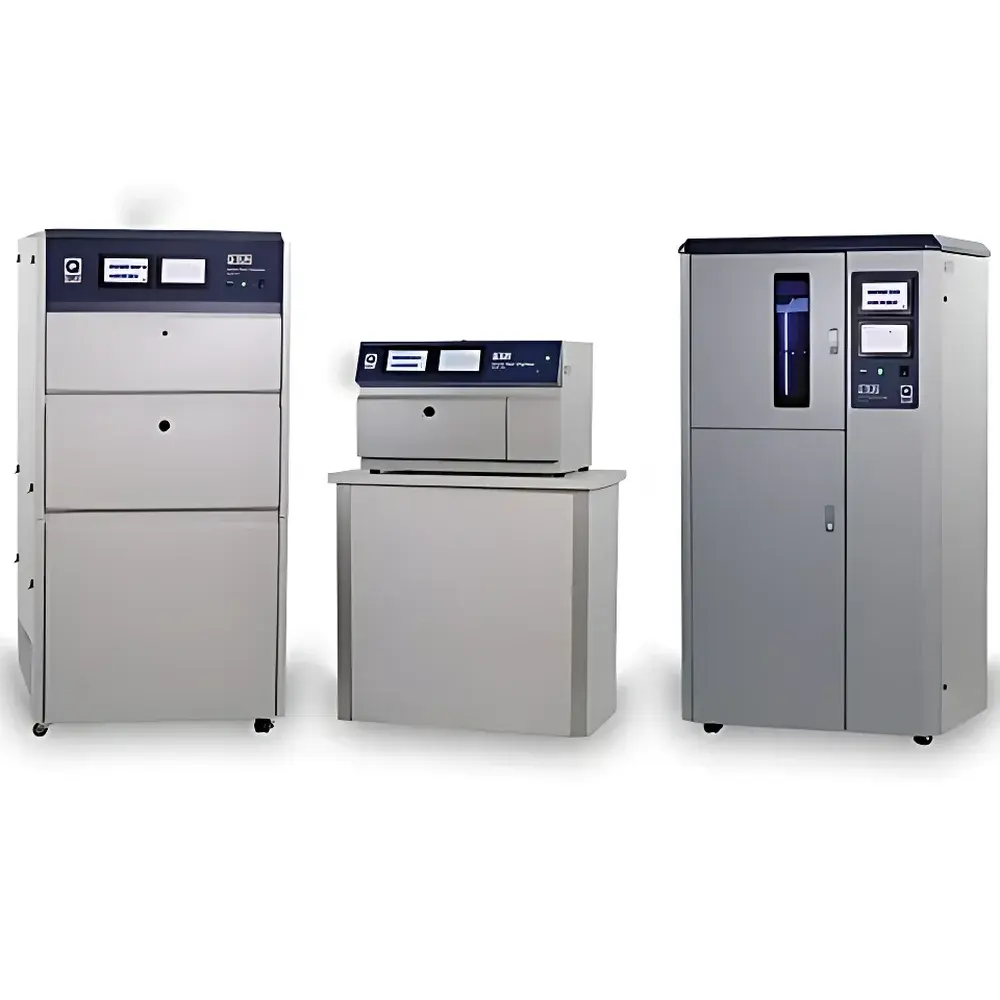
Q-LAB Xe-3 Xenon Arc Weathering Test Chamber
| Brand | Q-LAB |
|---|---|
| Origin | USA |
| Model | Xe-3 |
| Lamp Power | 1800 W |
| Lamp Configuration | Triple-air-cooled xenon arc lamps |
| Sample Tray Dimensions | 451 mm × 718 mm (sliding drawer design) |
| Humidity Control | Integrated RH control (range: 10–95% RH, non-condensing) |
| Water Spray Options | Standard front spray, optional dual-spray (secondary fluid), back-spray, and low-temperature operation |
| Compliance | Designed to support ASTM G155, ISO 4892-2, SAE J2527, AATCC TM16, ISO 11341, and other international weathering standards |
| Software Interface | Q-Lab’s proprietary Windows-based SunTest software with audit trail, user access levels, and data export (CSV, PDF) |
Overview
The Q-LAB Xe-3 Xenon Arc Weathering Test Chamber is an engineered solution for accelerated light stability, colorfastness, and weathering evaluation of polymeric, coated, textile, and composite materials. It employs three high-intensity, air-cooled 1800 W xenon arc lamps filtered to replicate the full solar spectrum—spanning UV (290–400 nm), visible (400–800 nm), and near-infrared (800–1100 nm) irradiance—with spectral fidelity traceable to natural sunlight under standardized atmospheric conditions. Unlike narrowband UV sources, the xenon arc system enables photodegradation mechanisms that closely mirror outdoor exposure, including photooxidation, pigment fading, polymer chain scission, and surface microcracking. The chamber’s optical architecture integrates precision-calibrated quartz envelope filters (e.g., Daylight, Window Glass, Extended UV) to simulate diverse environmental exposures—urban, subtropical, automotive under-glass, or interior lighting—ensuring test relevance across global regulatory and industrial specifications.
Key Features
- Triple-lamp xenon arc system: Delivers uniform irradiance distribution across a large 451 mm × 718 mm sliding sample tray, accommodating both flat specimens and three-dimensional components without reorientation.
- Integrated humidity control: Maintains programmable relative humidity (10–95% RH, non-condensing) via heated humidification and refrigerated dehumidification, enabling correlation with hygrothermal degradation pathways in coatings, adhesives, and elastomers.
- Dual-fluid spray capability (Xe-3-DS option): Unique among full-size xenon chambers, this configuration supports simultaneous application of two distinct aqueous solutions—e.g., deionized water and synthetic acid rain (pH 3.0–4.5) or detergent solution—to assess synergistic chemical-mechanical weathering effects per SAE J2527 Annex C or ISO 11341 Annex B.
- Back-spray module (Xe-3-BS option): Meets SAE J2412 and J2527 requirements for rear-side wetting, critical for evaluating multi-layer automotive trim, laminated glass interlayers, and architectural glazing systems.
- Modular lamp and filter service: Air-cooled xenon lamps (rated life ≥1500 h) and long-life optical filters are field-replaceable without tools or realignment; calibration verification is supported by NIST-traceable radiometers and Q-Lab’s LX-5060 spectral aging report.
- Robust thermal management: Dual-stage cooling and forced-air convection ensure stable black-panel temperature (BPT) control (typically 35–110°C), minimizing thermal gradients during extended cycles.
Sample Compatibility & Compliance
The Xe-3 accommodates diverse geometries—including rigid panels, molded plastic parts, fabric swatches, painted metal substrates, and packaged consumer goods—via interchangeable fixtures (e.g., X-10476-K 3D component holder, X-10255-X textile frame). Its operational envelope satisfies key international test method requirements: ASTM G155 (Cycle A/B/C), ISO 4892-2 (Method A/B), AATCC TM16-2021 (Option 3), ISO 11341 (Method 1/2), and SAE J2527 (with BS/DS options). All configurations support GLP-compliant operation when paired with SunTest software’s 21 CFR Part 11–ready audit trail, electronic signatures, and role-based user permissions.
Software & Data Management
SunTest software provides intuitive cycle programming, real-time irradiance monitoring (W/m² @ 340 nm or 420 nm), and automated pass/fail reporting against user-defined thresholds. Data logs include timestamped irradiance, chamber temperature, black-panel temperature, relative humidity, and spray activation status. Export formats include CSV (for statistical analysis in JMP or Minitab), PDF (for QA documentation), and XML (for LIMS integration). Calibration history, maintenance records, and operator activity are retained with immutable timestamps to satisfy internal quality audits and external regulatory inspections.
Applications
The Xe-3 is deployed across R&D, QC, and certification laboratories for: accelerated UV resistance validation of automotive exterior paints and plastics per OEM specifications (e.g., Ford CETP, GMW14872); colorfastness assessment of textiles and inks per AATCC and ISO standards; durability screening of architectural sealants, roofing membranes, and PVC siding; and formulation optimization of UV stabilizers in polyolefins and engineering resins. Its ability to decouple irradiance, humidity, and liquid exposure makes it indispensable for failure root-cause analysis in field-return investigations.
FAQ
What spectral filters are available for the Xe-3, and how do they differ?
Q-Lab offers Daylight (Q/B), Window Glass (WG), and Extended UV (EU) filters. Each modifies the xenon output to match specific exposure environments—e.g., WG simulates indoor through-glass degradation, while EU enhances short-wavelength UV for aggressive polymer testing.
Is the Xe-3 compatible with ISO 4892-2 Cycle 1A and 1B?
Yes—its programmable irradiance setpoints, dark/light cycling, and humidity control fully support all ISO 4892-2 exposure sequences, including those requiring condensation phases.
Can I use tap water for the spray system?
No—only deionized or distilled water (conductivity <5 µS/cm) is permitted to prevent nozzle clogging and mineral deposition on samples or optics.
How often must the xenon lamps be recalibrated?
Radiometric calibration is recommended every 500 hours of operation or prior to critical qualification runs, using Q-Lab’s calibrated reference sensors and traceable procedures.
Does the Xe-3 support remote monitoring and alarm notifications?
Yes—via optional Ethernet connectivity and SunTest’s network-enabled alert system, which sends email/SMS notifications for out-of-spec conditions, door open events, or lamp end-of-life warnings.



