
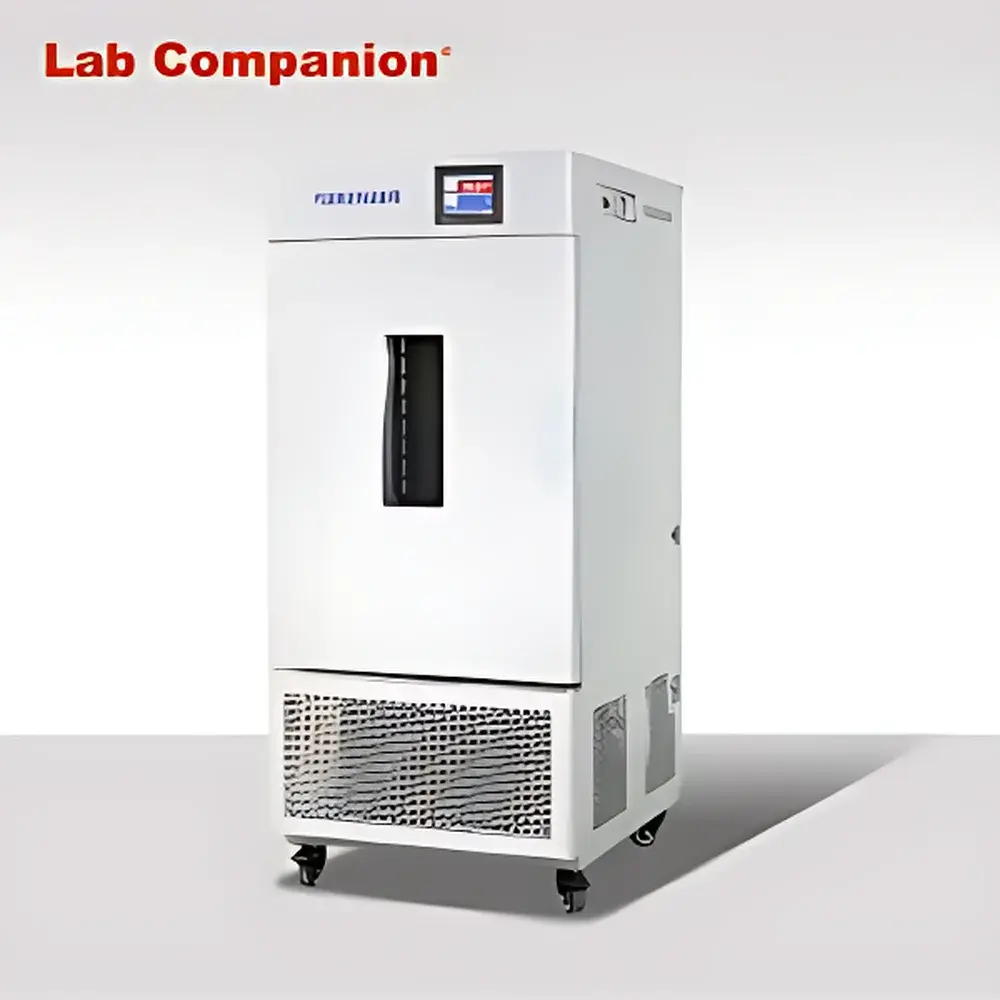
LabCompanion HLT-500 High-Low Temperature Cycling Chamber
| Brand | LabCompanion |
|---|---|
| Origin | Guangdong, China |
| Manufacturer Type | Direct Manufacturer |
| Product Category | Domestic |
| Model | HLT-500 |
| Price Range | USD 4,200 – 7,000 (FOB) |
| Temperature Range | −20 °C to +150 °C |
| Refrigeration Method | Mechanical Compression Cooling |
| Explosion-Proof Option | Standard (Non-Explosion-Proof) |
| Temperature Fluctuation | ±0.5 °C |
| Temperature Uniformity | ±2.0 °C |
| Temperature Deviation | ±2.0 °C |
| Heating Rate | 1.0–3.0 °C/min |
| Cooling Rate | 1.2 °C/min |
| Working Chamber Dimensions | 500 × 600 × 500 mm (W × H × D) |
Overview
The LabCompanion HLT-500 High-Low Temperature Cycling Chamber is an engineered environmental test system designed to evaluate the thermal resilience and functional stability of electronic components, polymers, metallic alloys, rubber compounds, and other industrial materials under controlled, dynamically alternating temperature conditions. Based on the principle of programmable thermal cycling—where specimens undergo repeated transitions between defined low-temperature and high-temperature setpoints—the chamber enables standardized simulation of real-world thermal stress profiles encountered during storage, transportation, and operational life cycles. Unlike static temperature exposure systems, the HLT-500 supports ramp-and-soak protocols with user-defined dwell times, transition rates, and cycle counts—critical for assessing thermally induced degradation mechanisms such as interfacial delamination, solder joint fatigue, coefficient-of-thermal-expansion (CTE) mismatch failure, and glass transition behavior in polymeric matrices.
Key Features
- Robust stainless-steel working chamber constructed from SUS304 grade austenitic stainless steel—resistant to thermal cycling fatigue, corrosion, and long-term oxidation exposure
- High-efficiency polyurethane foam insulation (≥100 mm thickness) with optimized density distribution to minimize thermal bridging and reduce steady-state heat loss
- Double-layer, electrically heated, low-emissivity observation window with integrated anti-frost heating circuitry—ensuring unobstructed visual monitoring across full operating range
- High-integrity silicone rubber gasket sealing system (rated for −40 °C to +200 °C service), providing >99.8% chamber integrity under dynamic pressure differentials
- Modular refrigeration architecture utilizing environmentally compliant R-404A or R-507A refrigerant (subject to regional regulatory compliance), paired with a high-torque scroll compressor and microchannel condenser for stable low-temperature pull-down performance
- Optional accessories include calibrated PT100 sensor ports (up to 4×), shielded feedthroughs for instrumentation cables, and DIN-rail mounting kits for integration into automated test benches
Sample Compatibility & Compliance
The HLT-500 accommodates test specimens up to 150 kg gross load (distributed evenly) and supports standard sample mounting configurations—including horizontal tray racks, vertical fixture plates, and custom bracket interfaces. Its thermal performance conforms to multiple international and national environmental testing standards, including but not limited to: IEC 60068-2-1 (Cold Test), IEC 60068-2-2 (Dry Heat), IEC 60068-2-14 (Change of Temperature), ASTM D3418 (Transition Temperatures of Plastics), and MIL-STD-810H Method 502.7 (Low Temperature) and Method 501.7 (High Temperature). The unit is also fully compatible with GLP-compliant validation protocols and supports IQ/OQ documentation packages per ISO/IEC 17025 requirements. All control firmware and data logging modules are designed to meet traceability requirements aligned with FDA 21 CFR Part 11 for electronic records and signatures where applicable.
Software & Data Management
The HLT-500 is equipped with an embedded 7-inch TFT touchscreen controller running LabCompanion’s proprietary TC-OS v3.2 firmware—a deterministic real-time operating system supporting multi-segment thermal profiles with up to 99 programmable steps per cycle. Profile parameters—including target temperatures, ramp rates, soak durations, cycle repetition counts, and alarm thresholds—are configured via intuitive graphical interface or imported/exported as CSV files. Internal data logging records chamber air temperature (measured at three spatially distributed Class A PT100 sensors), controller setpoint, compressor status, and fault history at user-selectable intervals (1 s to 60 min resolution). Raw log files are stored on removable SD card (included) and can be exported for post-processing in MATLAB, Python (NumPy/Pandas), or Excel. Optional Ethernet/Wi-Fi connectivity enables remote monitoring, centralized fleet management via LabCompanion CloudLink™, and audit-trail generation compliant with ISO 9001:2015 clause 8.5.2 (Identification and traceability).
Applications
- Qualification testing of PCB assemblies and semiconductor packaging under JEDEC JESD22-A104 thermal cycling conditions
- Evaluation of elastomeric seal integrity and compression set recovery in automotive fluid systems
- Accelerated aging studies of lithium-ion battery cells under extreme thermal transients
- Thermal shock screening of aerospace-grade composites per ASTM D5766/D5766M
- Validation of medical device sterilization packaging stability per ISO 11607-2 Annex C
- Material selection support for cryogenic instrumentation housings and high-temperature sensor enclosures
FAQ
What is the difference between temperature cycling and thermal shock testing?
Temperature cycling involves gradual, controlled transitions between upper and lower temperature limits with defined ramp rates and dwell periods; thermal shock employs near-instantaneous transfer between extreme environments—typically implemented in two- or three-chamber configurations. The HLT-500 performs cycling only; it does not support mechanical specimen transfer mechanisms required for true thermal shock.
Can the chamber be validated for GMP environments?
Yes—the HLT-500 supports full qualification (IQ/OQ/PQ) with documented calibration certificates for all critical sensors, traceable to NIST or equivalent national metrology institutes. Optional 21 CFR Part 11-compliant software add-ons are available upon request.
Is remote operation supported out of the box?
Standard configuration includes RS485 Modbus RTU for PLC integration. Ethernet-based remote access and cloud telemetry require optional TC-Net module installation and licensing.
What maintenance intervals are recommended?
Compressor oil and refrigerant filter driers should be replaced every 24 months under continuous operation; door gaskets inspected quarterly; chamber interior cleaned biannually with isopropyl alcohol to prevent residue buildup affecting thermal response accuracy.
Does the unit comply with RoHS and REACH directives?
Yes—all structural materials, wiring harnesses, and electronic subassemblies are certified RoHS 2011/65/EU and REACH SVHC-free per current candidate list updates. Declaration of Conformity is supplied with each shipment.



