
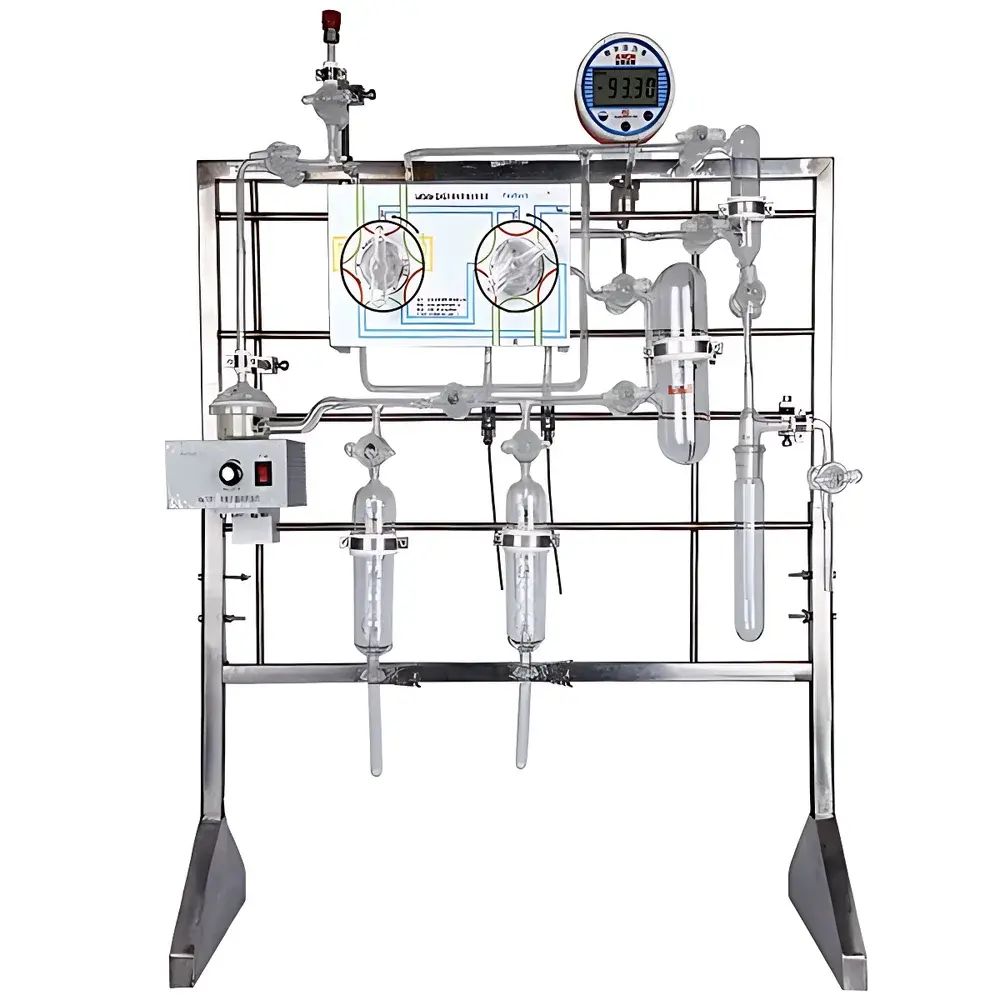
LabSolar-IIIAG High-Integrity Photocatalytic Water Splitting System
| Origin | Beijing, China |
|---|---|
| Manufacturer Type | Authorized Distributor |
| Origin Category | Domestic |
| Model | LabSolar-IIIAG |
| Quotation | Available Upon Request |
| Temperature Range | Ambient Only |
| Temperature Control Accuracy | ±0.5 °C at Ambient |
| Reaction Units | 1 |
| Reaction Volume | 150 mL |
| Vacuum Level (Absolute) | ≤0.1 MPa |
| Operating Pressure Range | 0 kPa to Atmospheric |
| Gas-Tightness | ≤1 kPa pressure drift over 24 h |
| Circulation Pump | Brushless Magnetic Drive, ≥4000 rpm |
| Quantitative Loop Volume | 1.5 mL |
| Gas Storage Vessel | 250 mL borosilicate glass |
| Condenser | Spherical reflux condenser |
| Cold Trap | Integrated for low-boiling component separation |
| Total Internal Tubing Volume | 150 mL |
| Minimum Tubing ID | 3 mm |
| Valves | 13 high-precision borosilicate glass valves with lapped sealing surfaces |
| Vacuum Grease | Dow Corning® high-performance vacuum grease (–40 °C to 200 °C, low vapor pressure, chemical resistant) |
| Sample Introduction | Manual on-line injection via glass multi-port valve with integrated quantitative loop |
| Linearity (H₂) | R² > 0.999 across 100 μL–10 mL range |
| Repeatability (RSD) | <3% for quadruplicate injections at identical concentration |
Overview
The LabSolar-IIIAG is a fully glass, high-integrity photocatalytic water splitting system engineered for quantitative gas evolution studies under controlled illumination. It operates on the principle of closed-loop, continuous gas circulation and periodic sampling—enabling precise measurement of H₂, O₂, CO, CH₄, and other gaseous products generated during heterogeneous photocatalysis or photoelectrocatalysis. Unlike metal-bodied reactors, its all-borosilicate-glass architecture eliminates catalytic surface adsorption, ion leaching, and redox interference—critical for accurate quantum yield determination and mechanistic validation. Designed for ambient-temperature operation only, the system integrates vacuum integrity, inert gas handling, and optical compatibility with UV–vis light sources (e.g., 300 W Xe lamps with AM1.5G filters or monochromatic LED arrays). Its modular layout supports both sacrificial and overall water splitting configurations, and it complies with fundamental requirements for reproducible gas-phase reaction monitoring in ISO 10678:2010 (photocatalysis — determination of photocatalytic activity) and ASTM E2712-21 (standard guide for photocatalytic materials testing).
Key Features
- All-borosilicate-glass construction ensures chemical inertness, zero metallic contamination, and full optical transparency for uniform irradiation.
- Dual septum-free seven-way glass sampling manifold prevents carrier gas misdraw and cross-contamination between sampling cycles.
- Brushless magnetic-drive circulation pump (≥4000 rpm) delivers robust, spark-free gas recirculation—eliminating hydrogen explosion hazards and electrochemical interference from wire-conducted current.
- 13 precision-lapped borosilicate glass valves provide leak-tight switching; each valve pair undergoes matched surface grinding for sub-kPa-level sealing performance.
- Integrated spherical condenser and cold trap suppress water vapor ingress into GC detectors and vacuum pumps—extending instrument lifetime and improving baseline stability.
- 150 mL internal volume with 3 mm minimum ID tubing minimizes flow resistance while maintaining sufficient residence time for homogeneous gas mixing.
- 250 mL expandable storage vessel accommodates CO₂ preloading for reduction experiments or buffer volume for pressure stabilization during long-term runs.
Sample Compatibility & Compliance
The LabSolar-IIIAG is compatible with suspended powder catalysts (e.g., TiO₂, g-C₃N₄, MOFs), immobilized films on conductive substrates (FTO, ITO), and photoelectrodes in three-electrode electrochemical cells. Reaction vessels are interchangeable and configurable for top-irradiation, side-irradiation, or immersion-type setups. The system meets structural and operational prerequisites for GLP-compliant gas evolution assays when paired with calibrated GC-TCD/FID systems. Its vacuum integrity (≤1 kPa/24 h drift) satisfies ASTM D2879-20 (vapor pressure by isoteniscope) and supports trace-gas quantification per ISO 10156:2010 (gas cylinder contents analysis). All wetted parts comply with USP Class VI biocompatibility standards for inertness and extractables.
Software & Data Management
The LabSolar-IIIAG is hardware-controlled manually via valve sequencing and vacuum gauge monitoring; no embedded firmware or proprietary software is included. However, it interfaces seamlessly with third-party data acquisition platforms (e.g., LabVIEW, MATLAB, or GC vendor software) through analog pressure/vacuum outputs and TTL-triggered sampling signals. For audit-ready workflows, users may integrate it into 21 CFR Part 11–compliant environments using external electronic lab notebooks (ELNs) that log valve actuation timestamps, pressure readings, and GC integration results with user authentication and version control. Calibration curves (H₂: 100 μL–10 mL, R² > 0.999) and repeatability records (RSD < 3%) are maintained per ISO/IEC 17025:2017 clause 7.7 on measurement traceability.
Applications
- Quantitative H₂/O₂ evolution kinetics in photocatalytic overall water splitting (e.g., SrTiO₃:Rh, CoP-modified BiVO₄).
- Photoelectrocatalytic bias-assisted water oxidation/reduction on WO₃ or Fe₂O₃ photoanodes.
- CO₂ photoreduction to CH₄, CO, or C₂H₄ under simulated solar irradiation.
- Action spectrum derivation and apparent quantum yield (AQY) calculation at discrete wavelengths (ISO 25037:2022).
- Stability assessment of co-catalyst-loaded semiconductors over >100 h continuous operation.
- Gas-phase isotope labeling studies (e.g., H₂¹⁸O splitting) enabled by ultra-high gas-tightness and low-adsorption pathways.
FAQ
Is temperature control available beyond ambient conditions?
No—the LabSolar-IIIAG is designed exclusively for ambient-temperature operation. External thermostatic jackets or immersion chillers may be added, but the base system lacks integrated heating or cooling elements.
Can the system be automated for unattended sampling?
Not natively. Automation requires external pneumatic actuators, programmable logic controllers (PLCs), or GC autosampler integration—none of which are supplied with the standard configuration.
What vacuum pump specifications are recommended for optimal performance?
A single-stage rotary vane pump with ≥6 L/s pumping speed and ultimate vacuum ≤5 × 10⁻² mbar is specified. Oil-free diaphragm pumps are not recommended due to insufficient ultimate vacuum and higher backstreaming risk.
Does the system support real-time gas analysis without offline GC injection?
No—it relies on discrete manual injection into an external gas chromatograph. In-situ FTIR or mass spectrometry coupling requires custom flange adapters and bypass manifolds, not included in the standard package.
How is calibration traceability established for H₂ quantification?
Users must perform external calibration using certified gas standards (e.g., NIST-traceable 1% H₂ in Ar). The 1.5 mL quantitative loop enables volumetric consistency, and linearity validation (R² > 0.999) is required before each experimental campaign.



