
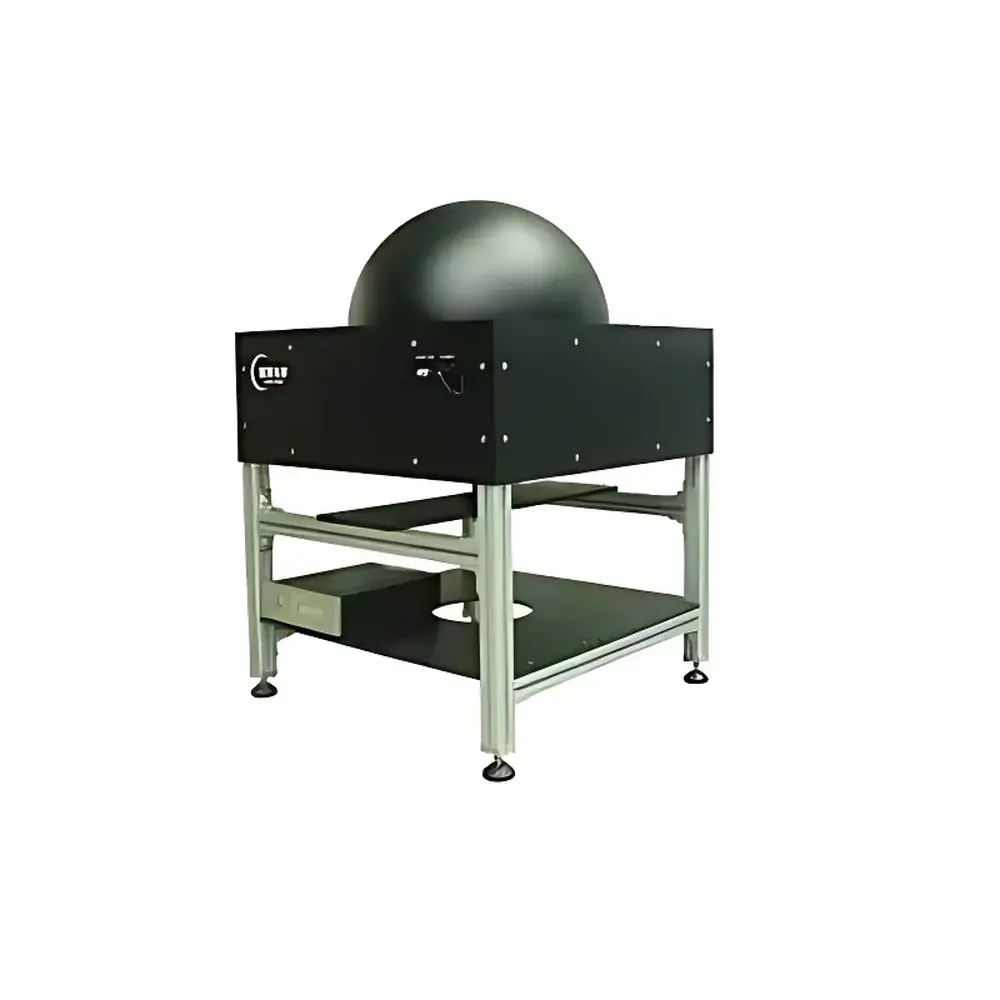
LabSphere Uniform Illumination Source for Wide-Field Camera Flat-Field Calibration
| Brand | LabSphere |
|---|---|
| Origin | USA |
| Model | Integrating Sphere Light Source |
| Luminance Range | 0–10,000 cd/m² |
| Uniformity at Port | ≥99% |
| Luminance Stability (after warm-up) | ±0.5% |
| Color Temperature Control | Software-Adjustable (2700K–6500K) |
| Real-Time Output Monitoring | Integrated photodiode feedback |
| Control Interface | USB/Ethernet with SDK for custom integration |
Overview
The LabSphere Uniform Illumination Source for Wide-Field Camera Flat-Field Calibration is an engineered integrating sphere-based optical calibration system designed to meet the stringent spatial uniformity and spectral stability requirements of ultra-wide-angle (UWA) and fisheye imaging systems. It operates on the fundamental principle of diffuse multiple-scattering within a highly reflective PTFE-coated spherical cavity, generating spatially homogeneous radiance at the exit port—essential for accurate flat-field correction (FFC), white balance calibration, and dynamic range characterization. Unlike conventional collimated or LED-array light sources, this system delivers Lambertian emission geometry ideal for imaging sensors with field angles up to 220°, where vignetting, pixel response non-uniformity (PRNU), and angular sensitivity variations are most pronounced. Its design conforms to ISO 15739 (Electronic still-picture imaging — Noise measurements) and supports traceable calibration workflows compliant with ISO/IEC 17025-accredited laboratories.
Key Features
- ≥99% spatial uniformity across the exit port aperture—validated per CIE 127:2007 measurement guidelines using calibrated imaging photometry.
- Luminance stability of ±0.5% over 8-hour continuous operation after thermal stabilization (typical warm-up time: <15 min), ensuring repeatability in high-throughput production test environments.
- Programmable color temperature control from 2700 K to 6500 K in 100 K increments, enabling standardized D-series illuminant simulation (D50, D65) and cross-platform white point validation.
- Real-time closed-loop intensity monitoring via integrated NIST-traceable silicon photodiode, compensating for long-term LED drift and correcting for sample-dependent reflectance/absorption effects during in-situ calibration.
- Full remote control via USB 2.0 or Ethernet interface, supporting SCPI-compatible command set and comprehensive SDK (C/C++, Python, MATLAB) for automated test sequence integration into ATE or vision inspection platforms.
- Modular mechanical interface accommodating standard M42, C-mount, and custom fixture adapters—enabling direct mounting of UWA lenses or sensor modules at the sphere’s output port without optical relay elements.
Sample Compatibility & Compliance
This illumination source is optimized for flat-field calibration of CMOS and CCD image sensors used in automotive ADAS cameras, AR/VR passthrough optics, panoramic security systems, and smartphone front/rear modules. It supports both monochrome and RGB Bayer-pattern sensors, as well as multi-spectral configurations (e.g., NIR-enhanced). The system complies with ASTM E308-22 (Standard Practice for Computing the Colors of Objects by Using the CIE System), ISO 12232:2019 (Digital still cameras — Determination of exposure index, ISO speed ratings, standard output sensitivity, and recommended exposure index), and aligns with FDA guidance for optical performance verification of medical imaging devices under 21 CFR Part 11 when deployed in validated software environments.
Software & Data Management
The included LabSphere Control Suite provides GUI-based configuration of luminance level, CCT, ramp profiles, and dwell times. All instrument parameters—including photodiode readings, thermal sensor logs, and LED drive current—are timestamped and exportable in CSV or HDF5 format. Audit trail functionality records user actions, parameter changes, and firmware updates—supporting GLP/GMP-compliant documentation requirements. For enterprise integration, RESTful API endpoints enable synchronization with MES/QMS platforms (e.g., Siemens Opcenter, ETQ Reliance), while the SDK permits embedding calibration routines directly into Python-based CI/CD pipelines for camera firmware validation.
Applications
- Flat-field correction coefficient mapping for fisheye lenses (180°–220° FOV) in autonomous vehicle surround-view systems.
- Dynamic range evaluation (ISO 15739 SNR curves) across variable scene luminances (0.1–10,000 cd/m²).
- White balance gain matrix derivation under multiple correlated color temperatures for computational photography pipelines.
- PRNU and DSNU (Photo Response Non-Uniformity / Dark Signal Non-Uniformity) characterization per EMVA 1288 standards.
- Validation of lens shading correction algorithms in mobile SoC ISP blocks prior to tape-out.
- Reference source for transfer standard calibration of imaging goniophotometers and near-field scanners.
FAQ
What is the maximum field angle supported for direct port-mounted calibration?
Up to 220° diagonal field of view, provided the lens entrance pupil is positioned at the sphere’s port plane with minimal vignetting.
Does the system support spectral power distribution (SPD) reporting?
Yes—optional integrated spectroradiometer module (model SP-100) enables full SPD acquisition (380–780 nm, FWHM ≤2.5 nm) synchronized with luminance control.
Can the source be integrated into a Class 100 cleanroom environment?
The housing meets IP52 ingress protection rating; optional stainless-steel enclosure and low-outgassing PTFE coating are available for semiconductor fab use.
Is firmware update capability included?
Yes—over-the-air (OTA) firmware updates via Ethernet are supported, with version rollback and cryptographic signature verification.
What documentation is supplied for regulatory compliance?
NIST-traceable calibration certificate (including uniformity map and stability report), CE Declaration of Conformity, RoHS/REACH compliance dossier, and ISO 9001 quality system audit summary.






