
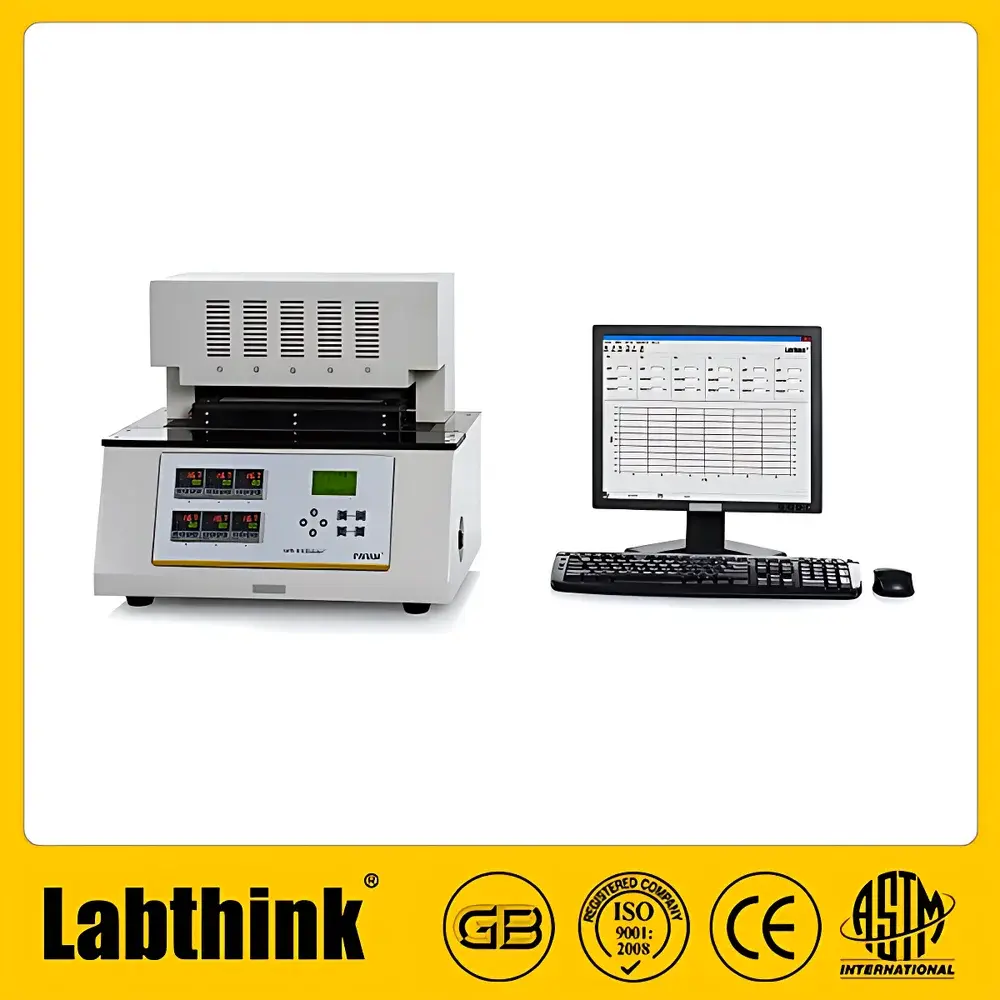

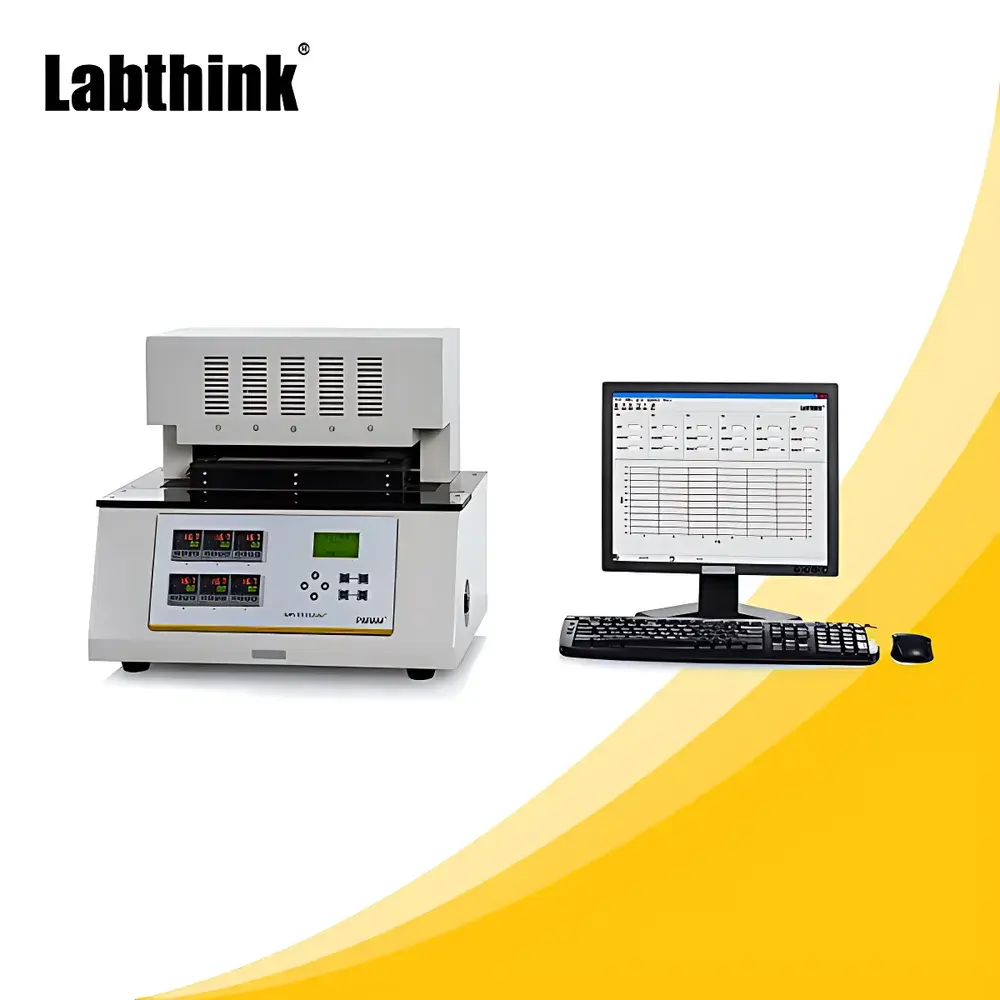
Labthink GHS-03 Dual Five-Point Gradient Heat Sealer
| Brand | Labthink |
|---|---|
| Model | GHS-03 |
| Origin | Shandong, China |
| Manufacturer | Labthink Instruments Co., Ltd. |
| Application | Heat seal parameter optimization for flexible packaging films and laminates |
| Heat Seal Temperature Range | 25–250 °C |
| Temperature Control Accuracy | ±0.2 °C |
| Temperature Gradient Across Five Stations | ≤20 °C |
| Heat Seal Pressure Range | 0.1–0.7 MPa |
| Heat Seal Time Range | 0.1–999.9 s |
| Sealing Surface Dimensions | 40 mm × 10 mm × 5 stations |
| Power Supply | AC 220 V, 50 Hz |
| Net Weight | 72 kg |
| Dimensions (L×W×H) | 576 × 430 × 510 mm |
| Compressed Air Requirement | 0.1–0.7 MPa via Ø8 mm polyurethane tubing (user-supplied) |
Overview
The Labthink GHS-03 Dual Five-Point Gradient Heat Sealer is an engineered laboratory instrument designed for systematic thermal sealing characterization of flexible packaging materials—including plastic films, coextruded laminates, metallized substrates, coated papers, and pouch-grade composites. It operates on the principle of controlled resistive heating combined with pneumatic pressure application across five independently regulated sealing zones. Unlike single-point sealers, the GHS-03 simultaneously evaluates heat seal integrity across a calibrated temperature gradient, enabling precise identification of the optimal sealing window—the narrow range where seal strength, hot tack, and seal integrity converge without degradation (e.g., melt-through, channeling, or polymer degradation). This capability supports critical process validation in packaging development, quality assurance, and regulatory documentation under ISO 22000, ASTM F2029, and pharmaceutical packaging standards such as YBB00122003-2015.
Key Features
- Five independent sealing stations, each equipped with a dedicated pneumatic cylinder and digitally controlled heating element—ensuring mechanical and thermal isolation between test points.
- Digital PID temperature control with ±0.2 °C stability and rapid thermal equilibration (<60 s from ambient to 200 °C), minimizing drift during extended testing cycles.
- Simultaneous dual-sample capability: two specimens can be processed in parallel, each undergoing five distinct thermal profiles—doubling throughput without compromising repeatability.
- Modular heater assembly with quick-disconnect terminals enables field replacement of heating elements without tools or calibration recalibration.
- Integrated safety architecture: thermally insulated upper platen, automatic thermal cutoff at 260 °C, and dual-mode initiation (manual keypad + foot switch) to reduce operator exposure during high-temperature operation.
- Microprocessor-based control system with backlit LCD interface, intuitive menu navigation, and non-volatile memory for storing up to 100 test protocols.
Sample Compatibility & Compliance
The GHS-03 accommodates standard ASTM D882 and ISO 11339 specimen widths (up to 100 mm), with nominal sealing area per station fixed at 40 mm × 10 mm. It supports both symmetrical (film-to-film) and asymmetrical (e.g., foil-to-polymer) seals, accommodating thickness variations from 20 µm to 500 µm. All thermal and mechanical parameters are traceable to NIST-traceable reference standards. The instrument complies with QB/T 2358 (China), ASTM F2029 (US), and YBB00122003-2015 (Chinese Pharmacopoeia), and its operational logs meet GLP/GMP data integrity requirements when paired with optional RS232 communication and timestamped printouts. No internal battery or volatile memory is used; all settings persist through power loss.
Software & Data Management
While the GHS-03 operates as a standalone benchtop unit, optional RS232 serial interface enables bidirectional communication with external PCs running Labthink’s proprietary SealMaster™ data acquisition software (v3.2+). This software supports automated protocol execution, real-time graphing of seal strength vs. temperature curves, statistical analysis (mean, SD, CV%), and export to CSV or PDF formats compliant with FDA 21 CFR Part 11 audit trail requirements. The built-in thermal printer provides immediate hardcopy output of test ID, date/time stamp, parameter set, and raw seal time/pressure/temperature values—eliminating manual transcription errors during QC release testing.
Applications
- Determination of minimum seal initiation temperature (MSIT) and maximum seal degradation temperature (MSDT) for new film formulations.
- Validation of heat seal parameters prior to packaging line commissioning or changeover (e.g., new substrate, ink system, or adhesive).
- Root cause analysis of package failure modes—including delamination, seal creep, or leakage—by correlating seal morphology (via post-test microscopy) with thermal profile data.
- Supporting accelerated aging studies by establishing baseline seal integrity at defined thermal histories.
- Training and qualification of packaging technicians in thermal process mapping and DOE-based seal optimization.
FAQ
Does the GHS-03 require external calibration certification?
Yes—annual calibration verification against traceable temperature (±0.1 °C platinum RTD) and pressure (±0.01 MPa) standards is recommended per ISO/IEC 17025 guidelines. Labthink provides calibration templates and certified reference procedures.
Can the five sealing stations operate at identical temperatures?
Yes—though designed for gradient testing, the instrument allows uniform temperature setting across all stations for comparative baseline studies or method transfer verification.
Is compressed air supply included with the system?
No—users must provide clean, dry, oil-free compressed air (0.1–0.7 MPa) via Ø8 mm polyurethane tubing. A standard industrial air regulator/filter unit is recommended upstream.
What maintenance intervals are specified for routine operation?
Heater surface cleaning after every 500 cycles; pneumatic cylinder lubrication every 6 months; thermal sensor verification annually. Full service manual and spare parts list are provided with shipment.






