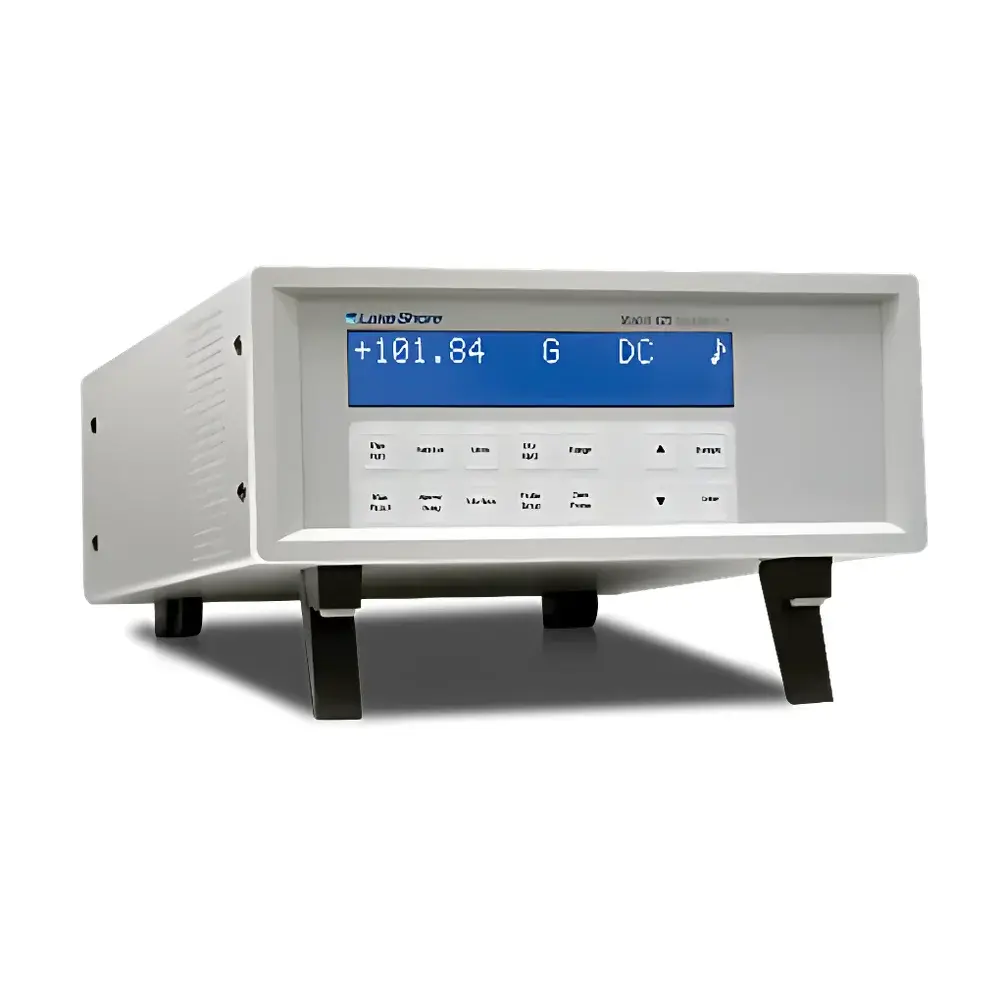
Lake Shore 425 Gaussmeter
| Brand | Lake Shore |
|---|---|
| Origin | USA |
| Manufacturer Status | Authorized Distributor |
| Origin Category | Imported |
| Model | 425 |
| Price | Upon Request |
Overview
The Lake Shore 425 Gaussmeter is a precision benchtop magnetic field measurement instrument engineered for high-reproducibility DC and AC flux density characterization in industrial, quality assurance, and R&D environments. Based on Hall-effect transduction principles, the 425 employs temperature-compensated, linearized Hall sensor technology to deliver traceable, NIST-compatible magnetic field measurements across an exceptionally wide dynamic range—from 50 mG up to 350 kG (35 T). Its architecture integrates real-time probe compensation algorithms, 4¾-digit DC resolution (0.0001 G minimum), and dual-mode operation (DC + AC) with selectable bandwidths—enabling reliable quantification of both static permanent magnet fields and time-varying electromagnetic fields encountered in motor testing, magnetic separator validation, and pulsed-field applications. Designed specifically for high-throughput magnet sorting and pass/fail verification in OEM manufacturing lines, the 425 meets the operational rigor demanded by ISO 9001-certified production facilities and supports GLP-compliant documentation workflows via USB data streaming.
Key Features
- DC measurement range: 50 mG to 350 kG with ±0.20% basic accuracy (±0.2% of reading + 0.05% of full scale)
- AC measurement capability from 10 Hz to 10 kHz; dual-band configuration (narrowband: 10–400 Hz; broadband: 50 Hz–10 kHz)
- 4¾-digit resolution in DC mode (e.g., 0.0001 G at 350 G range); 3¾-digit resolution in AC mode
- Real-time linearization and temperature compensation applied per probe serial number during operation
- Hot-swappable Hall probe interface (15-pin D-sub) enabling seamless probe interchange without power cycling
- Onboard relay output and audible alarm for automated go/no-go decision logic based on user-defined thresholds
- USB 2.0 interface supporting up to 30 readings/second streaming to host PC with timestamped ASCII or CSV export
- Intuitive front-panel navigation with context-sensitive prompts, auto-ranging, relative mode, and Min/Max hold functions
Sample Compatibility & Compliance
The 425 Gaussmeter is compatible with Lake Shore’s full family of calibrated Hall probes—including the HST series (up to 350 kG) and HSE series (optimized for lower-field stability)—all supplied with individual calibration certificates traceable to NIST standards. Probe interchangeability is supported via automatic recognition of probe-specific coefficients stored in EEPROM. The instrument complies with IEC 61000-4-3 (radiated immunity) and IEC 61000-4-6 (conducted immunity) for electromagnetic compatibility in industrial settings. While not certified for intrinsic safety, its Class I, Division 2 rating permits use in non-hazardous environments per NEC Article 500. Data integrity and audit readiness are enhanced through deterministic USB readout timing and optional integration with laboratory information management systems (LIMS) under FDA 21 CFR Part 11–compliant configurations when paired with validated software clients.
Software & Data Management
The 425 operates autonomously but fully supports external data acquisition via standard USB CDC (Communications Device Class) protocol—requiring no proprietary drivers on Windows, macOS, or Linux platforms. Raw ASCII-formatted readings include field value, unit, timestamp, probe ID, and status flags. Third-party scripting (Python, LabVIEW, MATLAB) can implement custom pass/fail logic, statistical process control (SPC) charting, or automated report generation. Optional Lake Shore-supplied software provides graphical trending, histogram analysis, and batch export with metadata tagging (operator ID, sample ID, test sequence). All measurements retain full traceability: each probe’s unique calibration curve, temperature coefficient, and linearity correction matrix are embedded and applied in real time—ensuring compliance with ASTM A977 (Standard Test Method for Magnetic Properties of Permanent Magnet Materials) and ISO/IEC 17025 requirements for accredited testing laboratories.
Applications
- Permanent magnet grading and binning in automotive, aerospace, and consumer electronics manufacturing
- Quality control of magnetic assemblies (e.g., sensors, actuators, MRI shimming components)
- R&D characterization of novel magnetic materials including NdFeB, SmCo, AlNiCo, and ferrites
- Verification of magnetic shielding effectiveness and stray field mapping around equipment
- Calibration and validation of electromagnet power supplies and current sources
- Education and training in magnetics laboratories requiring robust, classroom-safe instrumentation
FAQ
What Hall probe types are supported by the Lake Shore 425?
The 425 accepts all Lake Shore–certified Hall probes with 15-pin D-sub connectors, including the HST (high-field) and HSE (high-stability, low-field) series. Each probe’s calibration data is auto-loaded upon connection.
Does the 425 support analog output or only digital communication?
The standard 425 provides USB 2.0 digital output only. Analog voltage output (0–10 V proportional to field) is available as a factory-installed option (model suffix “-AO”).
Can the 425 perform temperature-compensated measurements without external sensors?
Yes—the internal temperature sensor and probe-specific thermal coefficients are used automatically during DC measurements to correct for drift; no external thermocouple is required.
Is firmware upgrade capability available in the field?
Yes—firmware updates are delivered via USB using Lake Shore’s publicly available update utility, supporting backward-compatible enhancements to measurement algorithms and communication protocols.
How is measurement uncertainty determined for a given reading?
Total uncertainty is calculated per ANSI/NCSL Z540.3 and includes contributions from basic accuracy, temperature coefficient, linearity error, and resolution—documented in the probe’s certificate of calibration and accessible via the instrument’s diagnostic menu.