
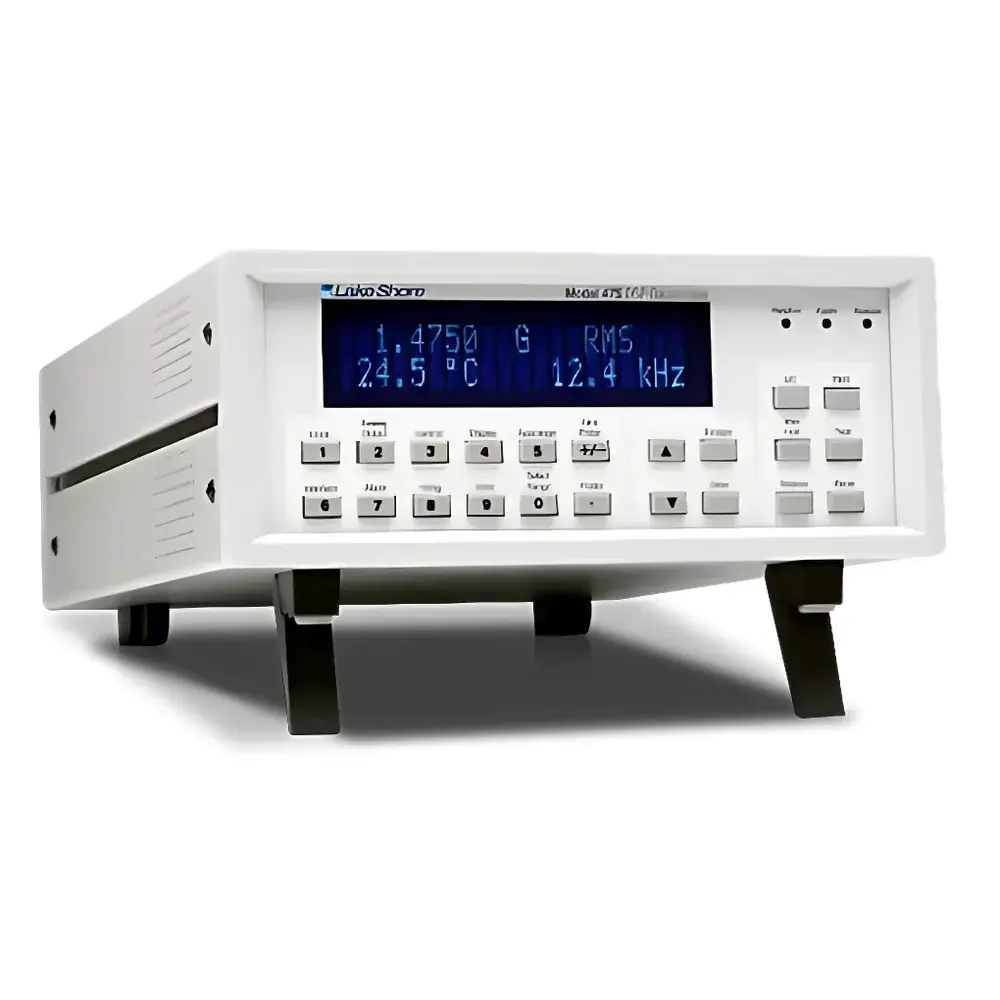
Lake Shore 475 DSP-Based Hall Effect Gaussmeter
| Brand | Lake Shore |
|---|---|
| Origin | USA |
| Model | 475 |
| Full-Scale Range | 35 mG to 350 kG |
| DC Resolution | 0.02 mG |
| Basic DC Accuracy | ±0.05% of reading ± 0.005% of range |
| Data Buffer | 1024 readings at up to 1000 samples/s |
Overview
The Lake Shore 475 DSP-Based Hall Effect Gaussmeter is a high-precision, digitally controlled magnetic field measurement instrument engineered for demanding DC and AC field characterization in research laboratories, materials development facilities, and industrial magnet system validation environments. Leveraging a dedicated digital signal processor (DSP), the 475 integrates over a decade of Lake Shore’s expertise in Hall-effect sensor physics, low-noise analog front-end design, and metrological traceability to deliver exceptional stability, repeatability, and functional versatility. Unlike conventional analog gaussmeters, the 475 performs real-time digital filtering, adaptive gain control, and on-the-fly temperature compensation—enabling consistent accuracy across wide thermal and dynamic operating conditions. Its core measurement principle relies on calibrated Hall-effect probes that convert magnetic flux density (B) into proportional voltage signals; these are digitized at high resolution and processed using proprietary algorithms to suppress noise, correct for probe nonlinearity, and compensate for thermal drift. Designed for integration into automated test systems, the 475 serves not only as a precision field meter but also as a closed-loop controller for electromagnet power supplies—making it a dual-role instrument in magnet commissioning, hysteresis loop mapping, and pulsed field diagnostics.
Key Features
- DSP-driven architecture enabling simultaneous high-speed sampling (up to 1000 S/s), real-time filtering, and embedded field control logic
- Ultra-wide DC range from 35 mG to 350 kG, with 0.02 mG resolution in the most sensitive ranges
- DC accuracy of ±0.05% of reading ± 0.005% of full scale, supported by NIST-traceable calibration protocols
- AC measurement capability from 1 Hz to 50 kHz (dependent on probe selection), with selectable narrowband (1–1 kHz) and broadband (50 Hz–20 kHz) modes
- 15 programmable bandpass filters and 3 low-pass filters for spectral isolation of harmonic or transient components
- Peak capture function with 20 µs minimum pulse width detection, critical for characterizing fast-rising pulsed fields
- Onboard 1024-point data buffer supporting burst-mode acquisition at full 1000 S/s—ten times faster than IEEE-488 transfer rates
- Hardware TTL trigger input/output for synchronized multi-instrument data acquisition and external event triggering
- Built-in PI control algorithm enabling direct feedback control of programmable magnet power supplies via analog voltage output (±10 V)
- Hot-swappable probe interface with automatic recognition, linearization, and temperature compensation per probe ID
Sample Compatibility & Compliance
The 475 is compatible with Lake Shore’s family of calibrated Hall-effect probes—including the high-field HST series (up to 350 kG) and high-sensitivity HSE series (optimized for sub-Gauss resolution)—all supplied with individual calibration certificates traceable to NIST standards. Probes are designed for use in cryogenic (4 K), ambient, and elevated-temperature environments, with optional shielding and fiber-optic isolation for EMI-prone settings. The instrument complies with IEC 61326-1 (EMC for laboratory equipment) and meets CE marking requirements. Its firmware architecture supports audit-ready operation under GLP and GMP frameworks: all calibrations, configuration changes, and measurement sessions can be logged with timestamps and user identifiers when interfaced with compliant data management software. While not FDA 21 CFR Part 11 certified out-of-the-box, the 475’s deterministic behavior, read-only firmware updates, and secure IEEE-488/GPIB communication protocol enable validation for regulated applications with appropriate SOPs.
Software & Data Management
The 475 communicates via IEEE-488 (GPIB), RS-232, and optional USB-to-GPIB adapters. Its native command set conforms to SCPI (Standard Commands for Programmable Instruments), ensuring compatibility with LabVIEW, MATLAB, Python (PyVISA), and custom C/C++ applications. Binary-mode IEEE-488 transmission reduces protocol overhead, sustaining 100 readings/second in continuous streaming—essential for real-time field stabilization or dynamic hysteresis sweeps. Internal memory stores 1024 buffered readings with time-stamped metadata; stored data is retrievable at lower rates for post-processing. Third-party software packages—including Lake Shore’s own MMS (Magnet Measurement Suite)—provide graphical plotting, statistical analysis, field map generation, and export to CSV, HDF5, or MATLAB .mat formats. All configurations (filter settings, trigger thresholds, scaling factors) are saved in non-volatile memory and survive power cycles, supporting repeatable setup across shifts or experiments.
Applications
- Characterization of permanent magnets, soft magnetic materials, and superconducting magnets under DC, AC, and pulsed excitation
- Closed-loop field stabilization in variable-temperature cryomagnets and superconducting solenoids
- Quality assurance testing of magnetic assemblies in aerospace, medical imaging (MRI shimming), and particle accelerator components
- Mapping spatial field uniformity and gradient profiles using motorized probe positioning stages
- Validation of magnetic shielding effectiveness and stray field leakage in EMI-sensitive instrumentation enclosures
- Time-resolved studies of magnetic domain dynamics and eddy current decay in conductive materials
- Calibration reference for secondary field sensors and Hall array systems
FAQ
Does the 475 support temperature compensation during AC measurements?
No—temperature compensation is applied only during DC measurements. AC accuracy specifications assume stable thermal conditions and do not include thermal drift correction.
Can the 475 control both bipolar and unipolar magnet power supplies?
Yes—the analog output supports ±10 V range and can be configured for either bipolar (symmetric) or unipolar (0–10 V) control modes via front-panel or remote command.
Is probe calibration data stored internally in the instrument?
Yes—each probe contains an EEPROM chip storing its unique calibration coefficients, linearity corrections, and temperature response curves, which the 475 reads automatically upon connection.
What is the maximum sustainable sampling rate when using IEEE-488 in ASCII mode?
Approximately 10–15 readings per second, depending on bus contention and controller latency; binary mode is required for rates above 50 readings/s.
Can the internal buffer be triggered externally without host computer involvement?
Yes—TTL-level hardware trigger input initiates buffered acquisition autonomously; no software polling or GPIB command required.



