
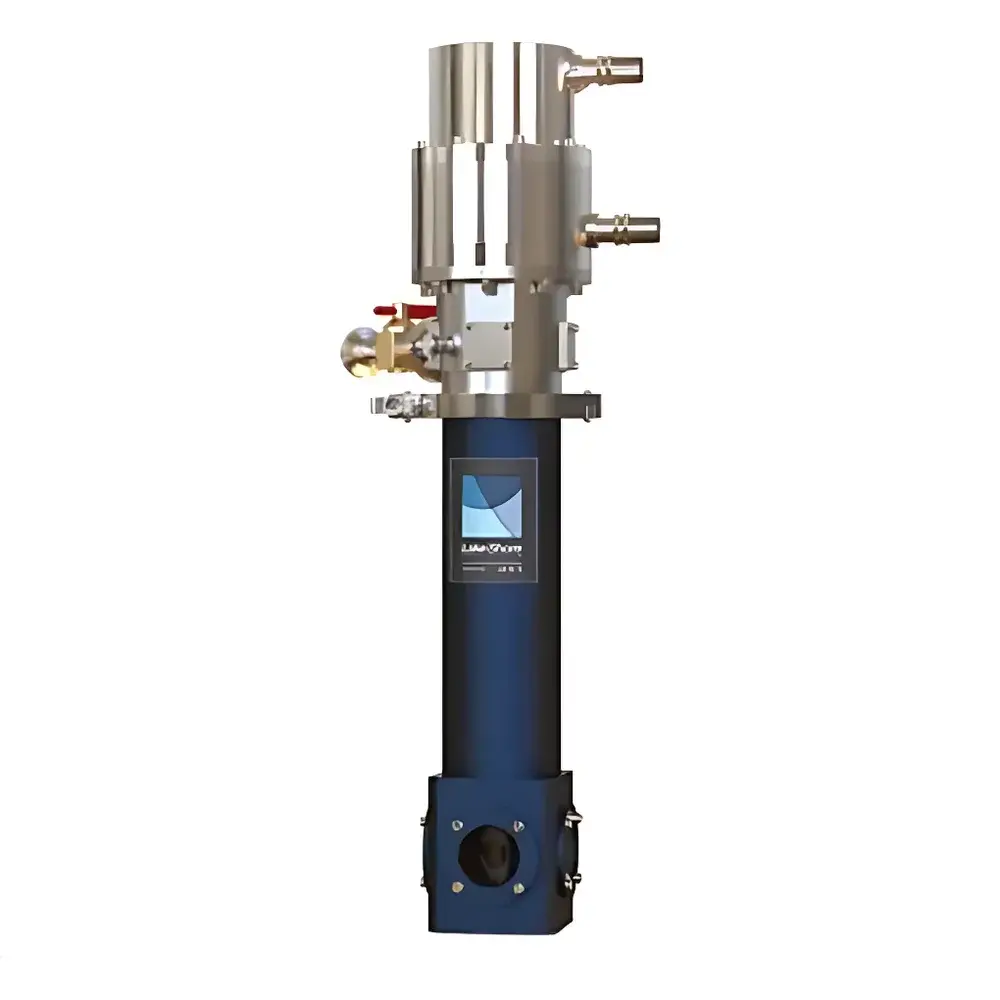
Lake Shore CCS-400 Optical High-Temperature Cryogenic Thermostat
| Brand | Lake Shore |
|---|---|
| Origin | USA |
| Model | CCS-400 |
| Cooling Type | Closed-Cycle Refrigeration |
| Temperature Range | <4 K to 500 K |
| Sample Environment | High Vacuum |
| Typical Temperature Stability | ±50 mK |
| Cool-down Time | 1.5–3 h |
| Optical Window | Yes (83–85 mm diameter) |
| Vibration Level | <40 nm (RMS) |
| Recommended Cryocooler Maintenance Interval | 13,000 h |
| Dimensions (H) | 61–89 cm |
| Weight | 16–30 kg |
Overview
The Lake Shore CCS-400 Optical High-Temperature Cryogenic Thermostat is a closed-cycle, helium-free cryogenic platform engineered for precision optical and electrical characterization of solid-state samples across an exceptionally broad thermal range—from below 4 K up to 500 K. Unlike liquid-helium-dependent systems, the CCS-400 integrates a high-reliability pulse-tube or Gifford-McMahon cryocooler, eliminating operational dependency on cryogens while maintaining sub-4 K base temperatures and stable high-temperature operation. Its all-metal, ultra-high-vacuum (UHV)-compatible construction ensures minimal thermal drift and low outgassing, supporting experiments requiring long-term thermal stability and contamination-sensitive environments. The sample stage resides in a dynamic vacuum space (<1×10⁻⁶ Torr typical), thermally isolated from the cryocooler cold head via low-conductance support structures and radiation shields—enabling precise, independent temperature control with active feedback regulation. Designed for integration into optical benchtop or vacuum chamber-based setups, the CCS-400 accommodates in situ spectroscopic, ellipsometric, photoluminescence, and magneto-optical measurements under controlled thermal conditions.
Key Features
- Helium-free closed-cycle refrigeration with no consumables or cryogen logistics
- Continuous, programmable temperature control from <4 K to 500 K with ±50 mK typical stability over 24-hour intervals
- Optimized UHV-compatible vacuum space (base pressure <1×10⁻⁶ Torr) with bake-out capability up to 150 °C
- Modular optical access: Standard 83–85 mm diameter window port with optional AR-coated fused silica, CaF₂, sapphire, or polyethylene windows covering spectral ranges from X-ray to THz
- Flexible electrical feedthrough options including DC, BNC, SMA, and triaxial configurations for low-noise transport, Hall effect, and four-probe resistivity measurements
- Interchangeable sample stages: Optical sample mounts with kinematic alignment, standard electrical stages with gold-plated copper contacts, four-terminal stages with guarded leads, and plug-and-play cartridge-style holders
- Cryocooler cold head position configurable at top or side—enabling vertical or horizontal optical paths without realignment
- Compact footprint (61–89 cm height; 16–30 kg) with vibration-damped mechanical design (<40 nm RMS displacement at sample position)
Sample Compatibility & Compliance
The CCS-400 supports conductive, non-magnetic, and thermally stable solid samples—including single crystals, thin films, 2D materials, quantum dots, and epitaxial heterostructures—mounted directly onto thermally anchored stages. All internal materials comply with ASTM E595 low-outgassing specifications for space-qualified hardware, and vacuum components meet ISO 10100 cleanroom compatibility standards. The system is fully compatible with GLP- and GMP-aligned laboratory workflows when integrated with validated temperature logging and audit-trail-capable controllers. Optional IEC 61000-4-3 EMC shielding and CE marking support deployment in regulated research facilities. While not inherently FDA 21 CFR Part 11 compliant, the CCS-400 interfaces seamlessly with third-party validated data acquisition platforms that provide electronic signature, change control, and secure user authentication layers.
Software & Data Management
Lake Shore’s proprietary CryoSoft™ software provides intuitive, scriptable control of temperature ramps, hold profiles, and multi-zone thermal zoning (when equipped with auxiliary heaters). Real-time monitoring includes dual-channel Pt-100 sensor readouts, cryocooler status telemetry (compressor oil pressure, cold head temperature, phase deviation), and vacuum gauge integration (optional Pirani or capacitance manometer). Data export supports CSV, HDF5, and TDMS formats with time-stamped metadata (including sensor calibration IDs, firmware versions, and environmental timestamps). For enterprise integration, the system exposes TCP/IP and Modbus TCP protocols, enabling interoperability with LabVIEW, Python (via PyVISA), MATLAB, and SCADA-based facility monitoring systems. All temperature setpoints and sensor calibrations are stored with NIST-traceable documentation per unit serial number.
Applications
- Temperature-dependent photoluminescence (PL) and cathodoluminescence (CL) spectroscopy of semiconductors and perovskites
- In situ Raman and FTIR measurements across phase transitions in correlated electron systems
- High-precision Hall effect and van der Pauw transport studies from quantum-limit regimes (<10 K) to high-temperature semiconductor behavior (up to 500 K)
- THz time-domain spectroscopy (THz-TDS) of superconducting gaps and phonon resonances
- Magneto-optical Kerr effect (MOKE) and Faraday rotation studies under variable temperature and field
- Calibration reference for IR detectors, bolometers, and single-photon avalanche diodes (SPADs)
- Material screening for quantum computing qubit substrates (e.g., Si/SiGe, GaAs, hBN) requiring low-vibration, low-RF-noise thermal environments
FAQ
Does the CCS-400 require liquid helium or other cryogens?
No—the CCS-400 operates exclusively with closed-cycle mechanical refrigeration and requires no liquid cryogens.
What vacuum level can the system achieve without additional pumping?
Using the standard integrated turbomolecular pump, base pressures below 1×10⁻⁶ Torr are routinely achieved after bake-out.
Can the CCS-400 be integrated into an existing optical table or UHV chamber?
Yes—flange configurations (CF-63, CF-100, or custom KF/ISO) and modular mounting brackets enable direct integration with third-party vacuum systems and optical enclosures.
Is remote operation supported over Ethernet or USB?
Yes—full bidirectional communication is supported via Ethernet (TCP/IP) and USB 2.0, with driver support for Windows, Linux, and macOS.
What is the recommended preventive maintenance interval for the cryocooler?
Lake Shore specifies a mean time between maintenance (MTBM) of 13,000 hours under continuous operation at nominal load conditions.



