
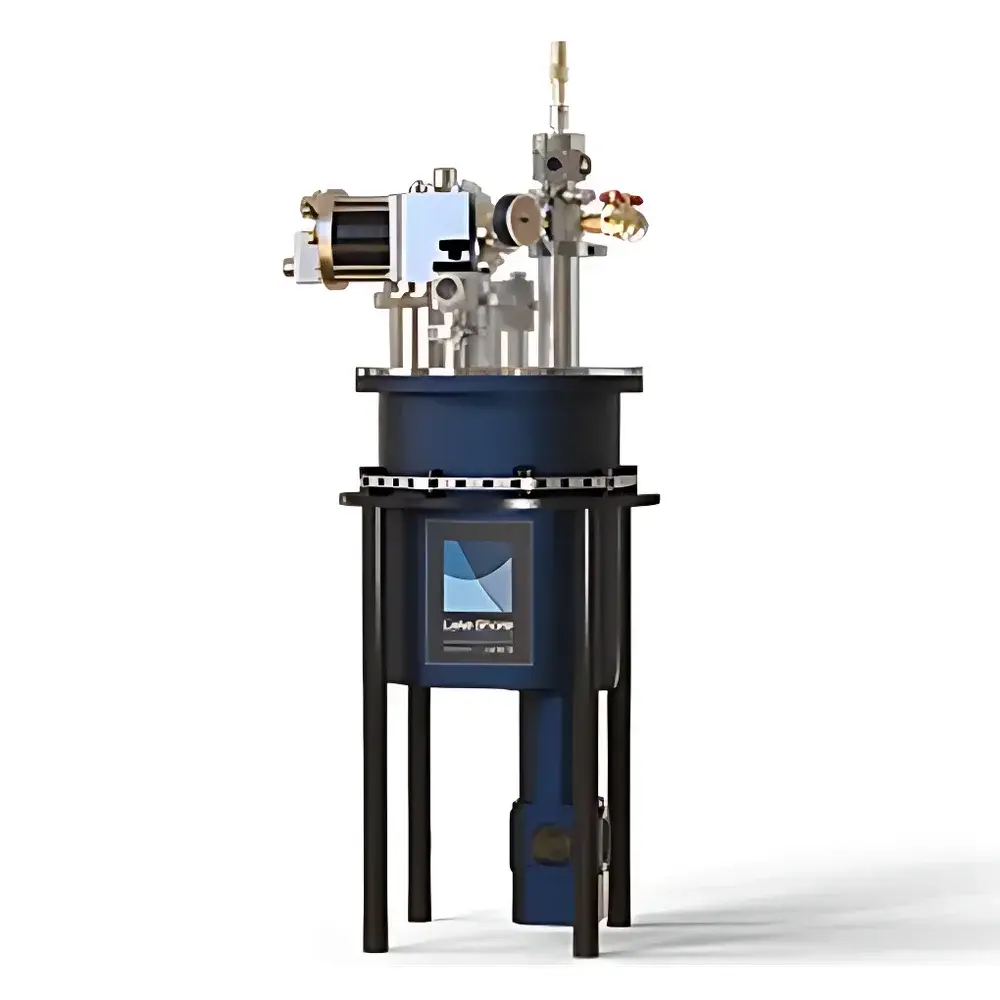
Lake Shore CCS-900 Top-Loading Cryogenic Thermostat
| Brand | Lake Shore |
|---|---|
| Origin | USA |
| Manufacturer Type | Authorized Distributor |
| Origin Category | Imported |
| Model | CCS-900 |
| Quotation | Upon Request |
| Cooling Type | Closed-Cycle Refrigeration |
| Temperature Range | <4 K to 800 K (2 K optional) |
| Typical Temperature Stability | ±50 mK |
| Sample Environment | Exchange Gas |
| Sample Types | Solid, Liquid, Powder |
| Sample Exchange Time | <10 min |
| Rotatable Sample Stage | Yes |
| Cool-down Time | 3–4 h |
| Cold Head Position | Top-Mounted |
| Optical Window | Standard (CCS-900), Optional (CCS-900-T) |
| Approximate Height | 114 cm (CCS-900), 114–168 cm (CCS-900-T) |
| Approximate Weight | 48 kg (CCS-900), 45–50 kg (CCS-900-T) |
| Sample Chamber Diameter | 38.1 mm |
| Customizable Chamber Dimensions | 28.6 mm, 38.1 mm, 60.3 mm |
| Window Block Diameter | 95.3 mm |
| Recommended Cryocooler Maintenance Interval | 13,000 h |
Overview
The Lake Shore CCS-900 Top-Loading Cryogenic Thermostat is a closed-cycle, helium-free cryogenic platform engineered for high-reproducibility low-temperature experimentation in physics, materials science, and quantum device characterization. Unlike traditional liquid-helium dewars, the CCS-900 employs a high-efficiency pulse-tube or Gifford-McMahon cryocooler integrated with an exchange gas thermal transfer system—enabling uniform, controllable cooling of samples immersed in helium or nitrogen exchange gas. This architecture eliminates dependency on liquid cryogens while maintaining stable base temperatures down to <4 K (with optional 2 K extension via enhanced cold stage configuration). Its top-loading geometry provides direct vertical access to the sample space, significantly reducing thermal perturbation during sample insertion and enabling rapid (<10 min) exchange without system warm-up. The thermostat is designed for integration into optical, magneto-optical, and electrical transport measurement setups—including confocal microscopy, Faraday/Kerr rotation, THz time-domain spectroscopy, and DC/AC resistivity mapping.
Key Features
- Helium-free operation using a closed-cycle cryocooler with >13,000 h mean time between maintenance intervals
- Exchange-gas thermal coupling ensures homogeneous temperature distribution across irregular, low-thermal-conductivity samples—including powders, thin films, viscous liquids, and bulk single crystals
- Wide operational temperature range: <4 K to 800 K (standard); 2 K capability available with upgraded cold stage and thermal anchoring
- Top-mounted cold head and vertically aligned sample chamber minimize conductive heat load and simplify alignment with external optics or magnets
- Rotatable sample stage supports azimuthal angular scans under cryogenic conditions without breaking vacuum or interrupting temperature stability
- Modular flange interface accommodates custom chamber depths (28.6 mm to 60.3 mm) for compatibility with superconducting magnets, optical cryostats, or synchrotron beamlines
Sample Compatibility & Compliance
The CCS-900 supports diverse sample geometries and measurement modalities. Its exchange-gas environment enables effective thermalization of thermally isolated specimens—such as insulating oxides, polymer composites, or nanostructured aerogels—that exhibit poor contact conduction. Standard configurations accept solid wafers, liquid cells (e.g., for NMR sample tubes), and loose powder samples mounted in quartz or sapphire holders. All variants comply with ISO 9001-certified manufacturing protocols and are compatible with GLP/GMP-compliant laboratories when configured with audit-trail-capable temperature controllers (e.g., Lake Shore Model 336 with 21 CFR Part 11 firmware). Vacuum integrity meets ASTM E595 outgassing specifications for ultra-high-vacuum (UHV)-compatible variants (≤1×10⁻⁸ Torr base pressure with turbomolecular pumping).
Software & Data Management
Temperature control is managed via Lake Shore’s proprietary CryoSoft™ software suite, supporting real-time PID optimization, multi-zone ramp/soak profiles, and synchronized data logging from up to 16 analog/digital inputs (including diode, RTD, and Cernox® sensor channels). The system integrates natively with LabVIEW™, Python (via PyVISA), and MATLAB® through SCPI-compliant Ethernet or USB interfaces. All temperature setpoints, sensor readings, and alarm events are timestamped and exportable in CSV or HDF5 format. For regulated environments, optional firmware enables electronic signatures, user-level access control, and full audit trail generation per FDA 21 CFR Part 11 requirements.
Applications
- Quantum transport measurements: Hall effect, Shubnikov–de Haas oscillations, and quantum Hall regime studies at sub-4 K
- Magneto-optical spectroscopy: Faraday rotation, magnetic circular dichroism (MCD), and Zeeman splitting analysis under applied fields up to 12 T (with magnet-compatible chamber)
- THz and IR transmission/reflection: Enabled by customizable window blocks (95.3 mm diameter) with AR-coated substrates spanning X-ray to THz bands (CaF₂, Si, Ge, diamond, polyethylene)
- Electrical characterization: Four-probe DC resistance, low-frequency AC impedance, and noise spectroscopy using shielded feedthroughs (BNC, SMA, triaxial, and filtered DC)
- In-situ structural studies: XRD, Raman, and photoluminescence of phase-transition materials (e.g., VO₂, NiTi, multiferroics) across 4–800 K
FAQ
What cooling technology does the CCS-900 use?
It utilizes a closed-cycle pulse-tube or Gifford-McMahon cryocooler, eliminating the need for liquid helium.
Can the CCS-900 achieve temperatures below 4 K?
Yes—optional configurations extend the base temperature to ≤2 K via optimized cold stage design and enhanced thermal anchoring.
Is the sample chamber vacuum-compatible?
Standard models operate under high vacuum (10⁻⁶ Torr); UHV-compatible versions (10⁻⁹ Torr) are available with metal-sealed CF flanges and low-outgassing materials.
How is temperature uniformity maintained across irregular samples?
Through controlled exchange gas flow (He or N₂) that establishes convective thermal equilibrium within the sample chamber.
Are custom electrical or optical interfaces supported?
Yes—Lake Shore offers application-specific feedthroughs, window coatings, and sample holder designs under NDA-based engineering collaboration.



