
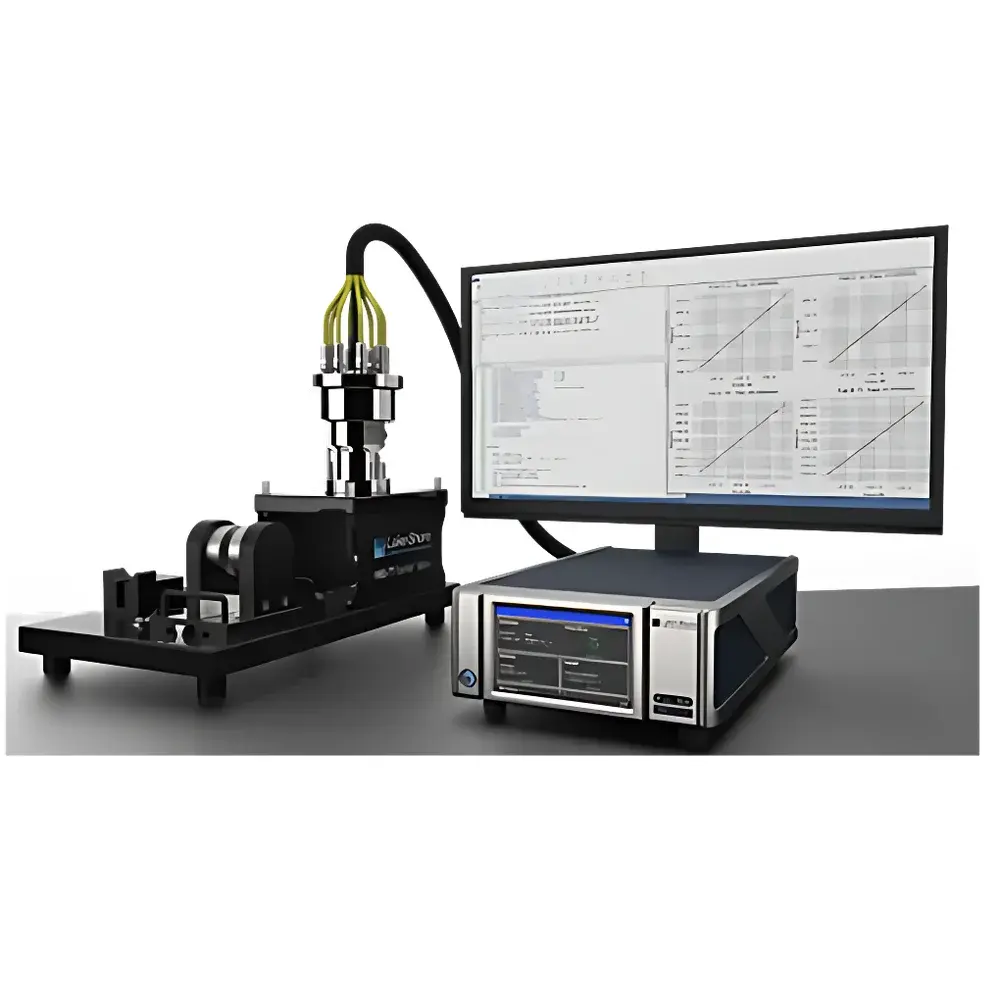
Lake Shore FastHall Station Desktop Hall Effect Measurement System
| Brand | Lake Shore |
|---|---|
| Origin | USA |
| Manufacturer Status | Authorized Distributor |
| Product Origin | Imported |
| Model | FastHall Station |
| Pricing | Upon Request |
| Magnetic Field | 1 T (RT), 0.75 T (77 K) |
| Temperature Options | Room Temperature & Optional Liquid Nitrogen Cooling (77 K) |
| Resistance Range | 10 mΩ to 1 GΩ |
| Mobility Range | 0.01–10⁶ cm²/V·s |
| Resistivity Range | 1×10⁻⁵ to 10⁵ Ω·cm (typ.) |
| Carrier Concentration | 8×10² to 8×10²³ cm⁻³ (typ.) |
| Measurement Speed | <10 s per sample (typ.) |
| Sample Formats | Solder card (10×10×3 mm), Pin card (10×10×2 mm) |
| Hall Method | FastHall™ (field-reversal-free) and Van der Pauw / Hall bar configurations |
Overview
The Lake Shore FastHall Station Desktop Hall Effect Measurement System is a fully integrated, benchtop-ready solution engineered for rapid, high-fidelity characterization of electrical transport properties in semiconductor, thermoelectric, and novel electronic materials. Built around the core M91 FastHall™ measurement engine, the system implements a proprietary current-source–voltage-measurement architecture that eliminates the need for magnetic field reversal—enabling stable, drift-resistant Hall coefficient extraction under static 1 T permanent magnet fields. This design fundamentally improves measurement reproducibility for low-mobility and high-resistivity samples where conventional field-sweep or lock-in techniques suffer from thermal EMF drift, contact resistance instability, or signal-to-noise degradation. The system operates natively at room temperature and supports optional liquid nitrogen cooling (77 K) via a dedicated cryogenic insert, allowing users to probe temperature-dependent carrier scattering mechanisms without requiring complex cryostat integration.
Key Features
- FastHall™ methodology: Single-field, non-reversing Hall measurement delivering <10 s per sample acquisition time with full parameter extraction (Hall coefficient, mobility, resistivity, carrier concentration)
- Benchtop form factor: Compact footprint (≤60 cm × 45 cm × 35 cm) with integrated 1 T NdFeB permanent magnet, precision XYZ-adjustable sample stage, and calibrated current/voltage electronics
- Wide dynamic range: Supports resistances from 10 mΩ to 1 GΩ and carrier mobilities spanning 0.01–10⁶ cm²/V·s—optimized for oxides, polymers, amorphous semiconductors, and heavily doped wide-bandgap materials
- Dual-sample configuration support: Native compatibility with Van der Pauw (four-point square geometry) and Hall bar (six-contact linear geometry) layouts using standardized solder- or pin-based carriers (max 10×10×3 mm)
- Modular thermal extension: Optional liquid nitrogen cold finger enables single-point 77 K measurements with field reduced to 0.75 T—ideal for preliminary low-temperature screening prior to full cryostat deployment
Sample Compatibility & Compliance
The FastHall Station accommodates standard semiconductor wafer fragments, thin-film coupons, pressed pellets, and epitaxial layers mounted on industry-standard solder cards (10×10×3 mm) or pin cards (10×10×2 mm). Its low-noise, guarded current sourcing and 6½-digit nanovolt resolution ensure compliance with ASTM F76 (Standard Test Methods for Measuring Resistivity and Hall Coefficient of Semiconductor Materials) and ISO/IEC 17025 traceability requirements when operated within defined environmental conditions (23±2 °C, <50% RH). All hardware and firmware are designed to meet CE electromagnetic compatibility (EMC) directives and UL 61010-1 safety standards for laboratory instrumentation. While not FDA-certified as a medical device, its data integrity architecture—including timestamped raw data logging, user-access-controlled measurement protocols, and audit-trail-enabled software—supports GLP and GMP-aligned workflows in R&D and process development environments.
Software & Data Management
Controlled via Lake Shore’s proprietary CryoSoft™ v5.x platform (Windows 10/11 compatible), the FastHall Station provides intuitive instrument setup, real-time visualization of I–V sweeps and Hall voltage transients, and automated parameter fitting using least-squares minimization of the standard Hall transport equations. All measurement metadata—including applied current, field strength, contact configuration, ambient temperature, and operator ID—are embedded into HDF5-formatted output files (.h5), ensuring FAIR (Findable, Accessible, Interoperable, Reusable) data principles. Export options include CSV, MATLAB .mat, and PDF reports compliant with internal lab SOPs. Software supports 21 CFR Part 11 readiness through optional electronic signature modules, role-based access control, and immutable audit logs—facilitating regulatory submissions in materials qualification pipelines.
Applications
- Characterization of low-mobility organic semiconductors (e.g., pentacene, P3HT) and perovskite thin films for flexible electronics
- Quality assurance of thermoelectric oxides (e.g., SrTiO₃, NaCo₂O₄) where carrier density tuning dictates ZT optimization
- Rapid screening of ion-gated or electrolyte-gated transistors to extract effective carrier concentrations at accumulation regimes
- Process development feedback for ALD/CVD-deposited TCOs (e.g., ITO, AZO) across annealing and doping gradients
- Fundamental studies of variable-range hopping conduction in disordered chalcogenide glasses and amorphous silicon
FAQ
Does the FastHall Station require external power supplies or magnet controllers?
No—the system integrates a regulated DC current source (up to ±100 mA), low-noise voltage measurement circuitry, and a self-contained 1 T permanent magnet assembly. No external magnet power supply or water cooling is needed.
Can I perform temperature-dependent Hall measurements beyond 77 K?
The base system operates at ambient temperature; the optional liquid nitrogen module provides a single 77 K data point. For continuous variable-temperature measurements (4–300 K), integration with Lake Shore’s TTPX or ACMS-II cryogenic platforms is supported via digital interface.
Is calibration traceable to NIST standards?
Yes—current source accuracy is verified against NIST-traceable shunt resistors; voltage measurement chain is calibrated using Fluke 8508A reference standards. Full calibration certificates are provided with each system shipment.
What sample contact configurations does the software auto-recognize?
CryoSoft automatically detects Van der Pauw (standard four-terminal square) and Hall bar (six-terminal linear) geometries based on user-defined contact numbering and performs appropriate tensor inversion algorithms without manual coefficient input.
How is data security handled during multi-user lab deployment?
CryoSoft supports Windows Active Directory integration, encrypted local database storage, and configurable export restrictions—ensuring alignment with institutional IT security policies and ISO 27001 frameworks.





