Lake Shore Hall Effect Sensors
| Brand | Lake Shore |
|---|---|
| Origin | USA |
| Manufacturer Status | Authorized Distributor |
| Product Category | Imported |
| Model | Hall Effect Sensor |
| Pricing | Upon Request |
Overview
Lake Shore Hall effect sensors are precision solid-state magnetic field transducers engineered for high-fidelity, quantitative measurement of magnetic flux density (B) in demanding scientific and industrial environments. Based on the quantum-mechanical Hall effect—where a transverse voltage (VH) develops across a current-carrying conductor under orthogonal magnetic field exposure—these sensors deliver a linear, temperature-dependent output voltage proportional to B. Unlike simple proximity switches, Lake Shore’s offerings are metrologically traceable devices designed for calibration-grade field mapping, cryogenic magnet characterization, and in-situ magnetic diagnostics. They operate across extreme thermal regimes—from sub-kelvin (1 K) to 402 K—and maintain stable performance under vacuum, high-radiation, or ultra-low-noise conditions typical of quantum materials labs, fusion diagnostics, and space-qualified instrumentation.
Key Features
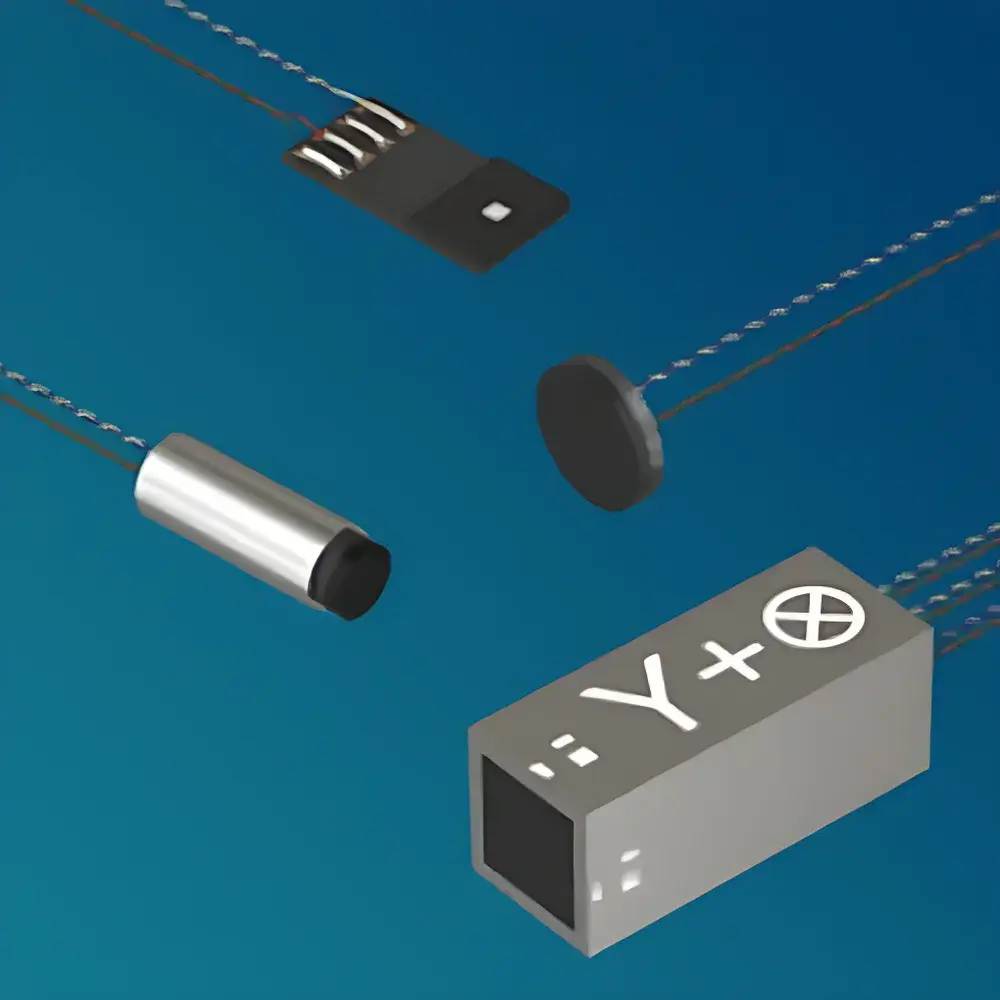
- Multi-material platform: Four distinct sensor families—2DEG InAs, bulk-stable InAs, bulk-sensitive InAs, and GaAs thin-film—each optimized for specific trade-offs among sensitivity, temperature stability, linearity, and planar Hall immunity.
- Configurable geometry: Available in single-axis (axial or transverse) and triaxial configurations with minimal active area (< 0.1 mm²), enabling high spatial resolution mapping in confined geometries such as superconducting cavities or micro-magnet arrays.
- Cryogenic & harsh-environment rated: Certified operation from 1 K (for low-temperature variants currently in development) up to 125 °C; hermetically sealed packages withstand UHV (<10−9 Torr), neutron/gamma irradiation (up to 106 rad), and thermal cycling without hysteresis or drift.
- Four-terminal architecture: Independent current drive (IC) and Hall voltage (VH) terminals eliminate lead resistance errors and support precise current sourcing (e.g., Lake Shore Model 121 Current Source) with programmable fixed-output settings (1 mA or 100 mA).
- Low intrinsic offset: Best-in-class equivalent field offsets down to ±0.5 mT (±25 µV), critical for zero-field nulling in closed-loop magnet control systems and background-subtracted field gradient measurements.
Sample Compatibility & Compliance
Lake Shore Hall sensors integrate seamlessly into both custom and turnkey magnetic measurement systems. They are fully compatible with Lake Shore F71/F41 Teslameters (with full factory calibration, NIST-traceable temperature compensation, and plug-and-play probe emulation) and support legacy integration with Models 425/475 Gaussmeters via HMCBL interface cables—though linearization and thermal correction must be applied externally in those configurations. All sensors comply with IEC 61000-4-2/3/4 for electrostatic discharge and radiated immunity, and meet ASTM D7817-22 requirements for magnetic field sensor verification in materials testing. For GLP/GMP-regulated environments, raw sensor outputs satisfy FDA 21 CFR Part 11 audit trail prerequisites when paired with compliant data acquisition firmware (e.g., Lake Shore CryoSoft v9.2+ with timestamped calibration metadata).
Software & Data Management
Sensor-specific calibration coefficients—including sensitivity (mV/T), temperature coefficient (ppm/°C), input resistance, and offset—are stored in embedded EEPROM or delivered in ASCII-formatted .cal files. Lake Shore’s proprietary CryoSoft software automatically loads these parameters during probe initialization, enabling real-time compensated field computation with uncertainty propagation per ISO/IEC 17025:2017 Annex A. Third-party integration is supported via SCPI-compliant USB/VISA and TCP/IP interfaces; Python, LabVIEW, and MATLAB drivers include built-in polynomial temperature correction routines aligned with ITS-90 thermometric standards. Raw voltage data streams at up to 10 kHz (depending on readout instrument), supporting dynamic field profiling in pulsed magnet applications.
Applications
- Magnetic field mapping of superconducting magnets (dipole, quadrupole, undulator) in accelerator physics facilities
- In-situ characterization of magnetic phase transitions in quantum materials (e.g., skyrmion lattices, spin ices) below 4 K
- Calibration reference for NMR shimming coils and MRI fringe field surveys
- Non-contact position sensing in cryogenic motion stages and MEMS-based inertial navigation units
- Spacecraft attitude determination via Earth’s magnetic field vector reconstruction (tri-axial GaAs variants)
- Quality assurance of permanent magnet assemblies in EV motor manufacturing lines
FAQ
Do Lake Shore Hall sensors provide galvanic isolation between drive and sense circuits?
No. These are four-terminal, non-isolated devices. The input impedance between current and voltage terminals is typically on the order of the sensor’s input resistance (e.g., ~800 Ω for 2DEG InAs). Therefore, the current source must be electrically isolated from downstream voltmeters or amplifiers to prevent ground-loop-induced errors.
Can I use a Lake Shore Hall sensor with non-Lake Shore readout electronics?
Yes—provided the external system supports stable current sourcing (±0.01% regulation), high-input-impedance voltage measurement (>10 GΩ), and optional temperature compensation using published coefficients. Calibration certificates include full uncertainty budgets referenced to NIST SRM 2550.
What is the difference between “planar Hall effect” and standard Hall response?
Planar Hall effect arises when the magnetic field lies within the sensor plane, generating spurious voltage components orthogonal to the intended measurement axis. Bulk InAs sensors exhibit significant planar Hall artifacts, limiting them to known-field-direction applications; 2DEG InAs and GaAs thin-film variants suppress this effect by >20 dB, enabling true vector field reconstruction.
Are calibration reports NIST-traceable?
Yes. Every sensor ships with a certificate of calibration performed at Lake Shore’s A2LA-accredited laboratory (ISO/IEC 17025:2017), including traceability to NIST Standard Reference Material 2550 and uncertainty analysis per GUM (JCGM 100:2008).