
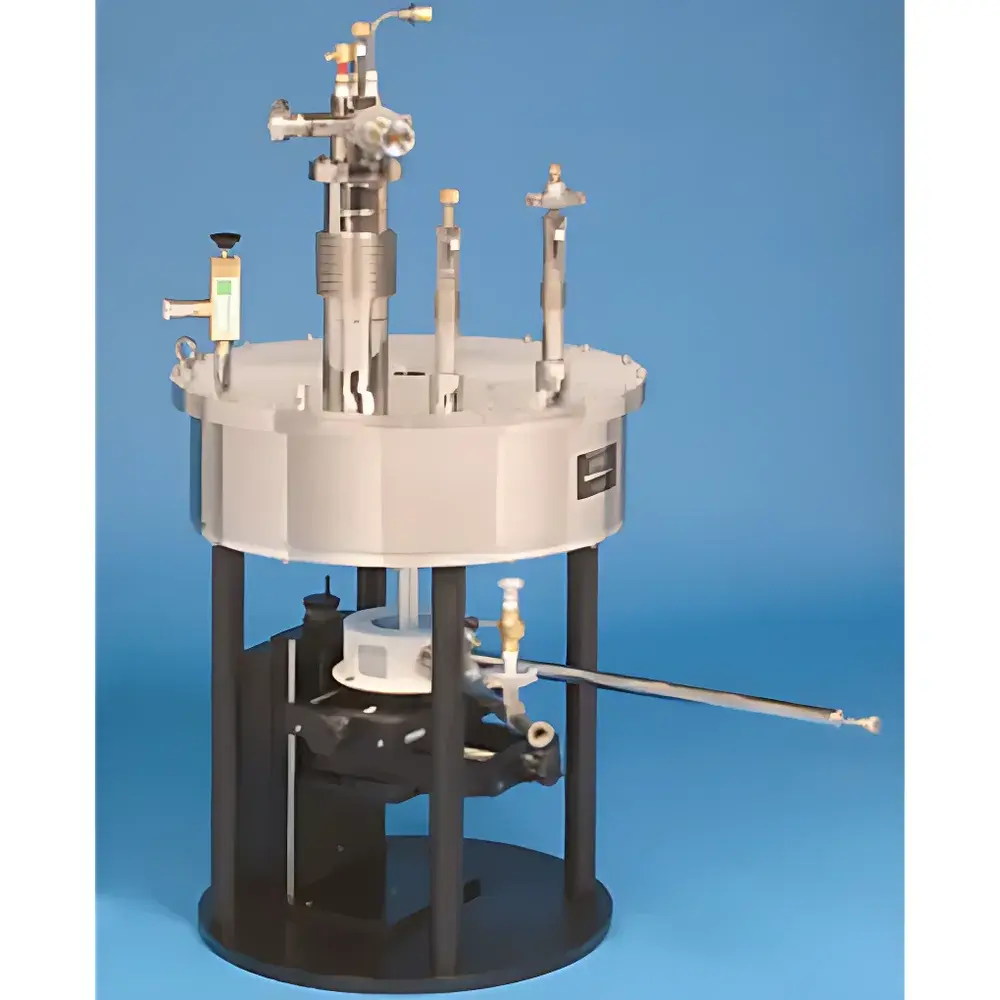
Lake Shore Microscopy Cryogenic Optical Superconducting Magnet System
| Brand | Lake Shore |
|---|---|
| Origin | USA |
| Manufacturer Type | Authorized Distributor |
| Product Origin | Imported |
| Model | Microscopy |
| Price | Upon Request |
| Magnetic Field | 0–7 T (Vertical Bore) |
| Bore Diameter | 42 mm (Room-Temperature Bore) |
| Temperature Range | 3.5 K to 325 K (420 K Optional) |
| Vacuum Environment | UHV-Compatible |
| Optical Access | Multiple Collinear & Off-Axis Ports |
| Sample Diameter Capacity | Up to 16 mm |
| Motion Control | High-Precision Motorized X-Y-Z Translation Stage |
| Compatible Cryostat | ST-500 High-Stability Microscope Cryostat |
| Primary Measurement Modalities | Micro-Raman, Photoluminescence (PL), Magneto-Optical Kerr Effect (MOKE) |
Overview
The Lake Shore Microscopy Cryogenic Optical Superconducting Magnet System is an integrated platform engineered for high-resolution magneto-optical characterization under precisely controlled cryogenic and high-field conditions. Built around a 7 T vertical-bore superconducting magnet and fully compatible with the ST-500 high-stability microscope cryostat, this system enables simultaneous application of strong magnetic fields (0–7 T) and variable-temperature operation from 3.5 K up to 325 K (with 420 K optional). Its design adheres to fundamental requirements for quantum materials research, including low-vibration mechanical architecture, UHV-compatible vacuum envelope, and multi-axis optical access aligned with the magnetic field axis. The system operates on the principle of magneto-optical spectroscopy—where polarization-resolved light-matter interactions (e.g., Kerr rotation, Zeeman splitting, Raman phonon shifts) are quantified as functions of both temperature and applied field—providing direct insight into spin ordering, orbital coupling, excitonic behavior, and topological electronic states.
Key Features
- 7 T vertical-field superconducting magnet with persistent mode operation and field homogeneity < ±0.1% over 10 mm DSV
- 42 mm room-temperature bore diameter, optimized for integration with standard optical microscopy components and fiber-coupled spectrometers
- ST-500 cryostat platform featuring active vibration damping, <5 nm RMS positional stability at base temperature, and dual-stage cooling (He-4/He-3 or pulse-tube options)
- Motorized, UHV-compatible XYZ translation stage with ≤100 nm step resolution and closed-loop position feedback
- Multi-port optical access: two collinear axial ports (NA ≥ 0.5), four radial ports (f/2.8), and adjustable kinematic mounts for polarization optics
- Sample environment supports diameters up to 16 mm and thicknesses ≤2 mm; accommodates standard sample holders (e.g., copper cold fingers, quartz windows, electrical feedthroughs)
- Integrated thermal anchoring and magnetic shielding ensure minimal field-induced heating and stray field interference with adjacent instrumentation
Sample Compatibility & Compliance
This system is routinely deployed in laboratories conducting GLP-aligned materials qualification and peer-reviewed condensed matter physics research. It supports samples ranging from exfoliated 2D heterostructures on Si/SiO₂ substrates to bulk single crystals (e.g., CrI₃, Fe₃GeTe₂, EuS) and thin-film heteroepitaxial stacks. All vacuum components meet ASTM E595 outgassing specifications for UHV applications (<1 × 10⁻⁹ Torr base pressure achievable with ion pump + Ti sublimation). Mechanical interfaces conform to ISO 3511-1 flange standards (CF-63 and CF-100), and electrical feedthroughs comply with MIL-STD-202G for hermeticity and thermal cycling endurance. Full traceability documentation—including calibration certificates for temperature sensors (Cernox® CX-1050, calibrated to NIST SRM 1750), field mapping reports, and vacuum leak test logs—is provided upon delivery.
Software & Data Management
System control is unified through Lake Shore’s proprietary CryoSoft™ v4.2 platform, which provides synchronized orchestration of magnet ramping, cryostat temperature setpoints, stage positioning, and external spectrometer triggering (via TTL/USB/Ethernet). All instrument parameters—including real-time field (±0.01 T), temperature (±2 mK), stage coordinates (±50 nm), and vacuum pressure (±5 × 10⁻¹¹ Torr)—are logged with timestamped metadata in HDF5 format. Data export supports direct ingestion into Python-based analysis pipelines (e.g., SciPy, Matplotlib, xarray) and MATLAB. Audit trails comply with FDA 21 CFR Part 11 requirements, including user authentication, electronic signatures, and immutable log archiving. Optional integration with LabArchives ELN enables automated metadata tagging and experiment reproducibility tracking.
Applications
- Mapping magnetic domain evolution in van der Waals magnets via polar MOKE microscopy
- Temperature- and field-dependent Raman phonon softening in multiferroics (e.g., BiFeO₃)
- Zeeman-splitting analysis of excitonic resonances in transition metal dichalcogenides (TMDs)
- In situ magneto-photoluminescence of perovskite quantum dots under 7 T fields
- Probing spin-lattice relaxation dynamics using time-resolved Kerr rotation spectroscopy
- Correlating anomalous Hall conductivity with Berry curvature signatures observed in ARPES-compatible geometries
FAQ
What is the minimum attainable temperature when operating at full 7 T field?
The system maintains base temperature of ≤3.5 K at 7 T, verified by independent Cernox sensor calibration under field-cooled conditions.
Can the system be upgraded to include He-3 refrigeration or dilution refrigerator compatibility?
Yes—ST-500 cryostat variants support He-3 insert integration (down to 0.3 K) and can be retrofitted with custom wiring harnesses for dilution unit interfacing.
Is polarization-resolved detection supported natively?
Yes—the optical train includes motorized half-wave and quarter-wave plates, Glan–Taylor polarizers, and a rotating analyzer mount, all software-synchronized with field and temperature sweeps.
How is magnetic field homogeneity characterized and validated?
Each magnet undergoes full 3D field mapping pre-shipment; a certified report detailing homogeneity over 10 mm DSV and field drift (<0.001 T/h in persistent mode) is included.
Are custom sample probes or electrical transport measurement capabilities available?
Lake Shore offers OEM-integrated DC/AC transport modules (up to 4-wire, 10 nV resolution) and custom probe designs—including RF/microwave waveguides and THz photoconductive antennas—for multimodal correlative studies.



