
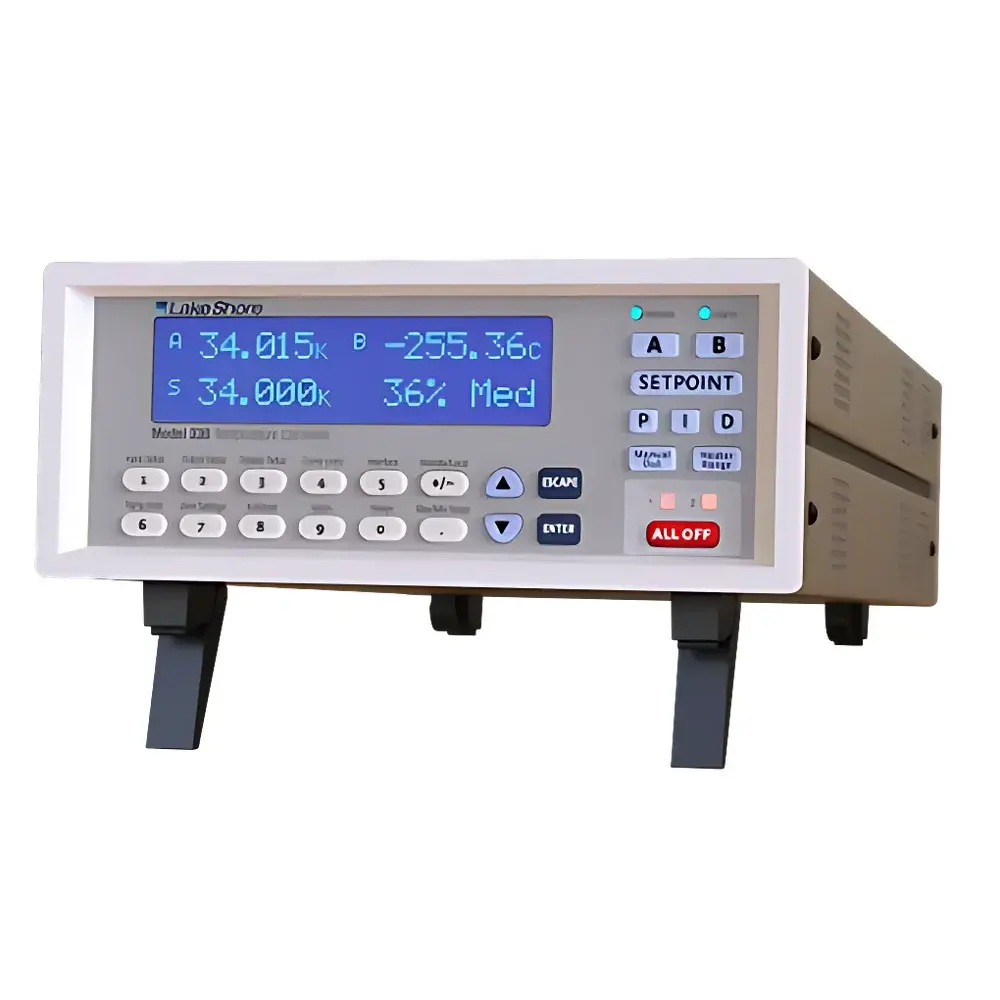
Lake Shore Model 335 Temperature Controller
| Brand | Lake Shore |
|---|---|
| Origin | USA |
| Model | 335 |
| Temperature Range | 0.3 K to 1505 K |
| Sensor Inputs | 2 standard (expandable to 4 with optional thermocouple card) |
| Control Outputs | 2 independent PID channels |
| Heater Power | 75 W total (configurable as 50 W + 25 W or 75 W + 1 W) |
| Interface | Ethernet, USB, IEEE-488 (GPIB) |
| Analog Output | ±10 V |
| Compliance | GLP/GMP-ready with audit-trail-capable logging via software |
Overview
The Lake Shore Model 335 Temperature Controller is a high-precision, dual-loop digital temperature regulation system engineered for demanding cryogenic and high-temperature applications in physics laboratories, materials science research, and quantum device characterization. Operating on closed-loop digital PID control architecture, the Model 335 delivers stable, low-noise thermal regulation across an unprecedented range—from 300 mK (achieved using calibrated NTC sensors such as Cernox® or Rox™) up to 1505 K—by intelligently managing sensor input switching via its Zone-based auto-ranging algorithm. Its design centers on metrological integrity: 24-bit analog-to-digital conversion, galvanically isolated sensor inputs, current-reversal compensation for thermistor offset elimination, and sub-millikelvin measurement resolution ensure traceable, reproducible thermal control under ultra-low-vibration and EMI-sensitive conditions typical of dilution refrigerator inserts, superconducting magnet systems, and scanning probe microscopy platforms.
Key Features
- Dual independent PID control loops with fully configurable P/I/D parameters, manual output override, and ramp-rate programming (0.1 K/min to 100 K/min)
- Two standard sensor input channels supporting diodes (e.g., DT-670), RTDs (100 Ω/1000 Ω Pt, Ge, doped glass), and thermistors (Cernox®, Rox™); expandable to four inputs with optional 3060 thermocouple interface card
- Configurable heater outputs: Channel 1 delivers up to 75 W (50 W @ 125 Ω or 75 W @ 50 Ω); Channel 2 provides either 25 W (25 W @ 25 Ω) or 1 W (1 W @ 100 Ω) in current- or voltage-source mode
- Zone control with 10 user-defined temperature segments—each with dedicated PID coefficients, heater range, and control channel assignment—enabling seamless handoff between sensor types across the full 0.3 K–1505 K span
- Current-reversal excitation for resistive sensors eliminates thermoelectric EMF errors; SoftCal™ correction improves accuracy of DT470 diodes (±0.25 K from 30 K–375 K) and Pt RTDs (±0.25 K from 70 K–325 K)
- Real-time filtering (2–64 sample averaging), auto-scaling of resistance ranges, and 39-user-loadable 200-point calibration curves for non-standard sensors
- Vacuum-fluorescent front panel display (2 × 20 characters) with selectable units (K, °C, V, mV, Ω), min/max tracking, and 2 Hz update rate
Sample Compatibility & Compliance
The Model 335 is routinely deployed in ISO/IEC 17025-accredited laboratories and supports compliance-critical workflows through hardware-level safeguards and software-integrated traceability. All sensor inputs are optically isolated from chassis ground and power circuits, minimizing common-mode noise in multi-instrument cryostat environments. Built-in safety limits—including programmable temperature ceilings, automatic heater shutdown on power-up or sensor fault, and short-circuit protection—meet IEC 61010-1 requirements for laboratory equipment. When paired with Lake Shore’s CryoSoft™ or third-party SCADA systems compliant with FDA 21 CFR Part 11, the controller enables electronic signatures, audit trails, and secure data archiving—essential for GxP-regulated material qualification and process validation in biophysics and nanofabrication facilities.
Software & Data Management
Native communication is supported over Ethernet (TCP/IP), USB (virtual COM port), and IEEE-488 (GPIB), enabling integration into LabVIEW, Python (PyVISA), MATLAB, and EPICS-based control frameworks. The included CryoSoft™ software provides real-time graphing, scriptable ramp-hold sequences, automated calibration curve generation, and CSV/TDMS export with timestamped metadata. For enterprise deployment, the Model 335 supports Modbus TCP mapping of all registers—facilitating centralized monitoring in industrial-scale quantum computing infrastructure. All analog outputs (±10 V), relay states, and alarm flags are accessible via SCPI commands, allowing synchronized triggering of auxiliary systems (e.g., magnetic field sweeps, laser modulation) without external logic controllers.
Applications
- Cryogenic characterization of superconductors, topological insulators, and 2D materials in dilution refrigerators and adiabatic demagnetization cryostats
- Thermal stabilization of quantum dot devices, SQUIDs, and single-photon detectors requiring sub-10 mK stability over 24+ hours
- High-temperature annealing and phase-transition studies of ferroelectrics and multiferroics up to 1500 K in vacuum or controlled-atmosphere furnaces
- In-situ temperature calibration of radiation thermometers and blackbody sources per ASTM E2847 and ISO 18434-1
- Multi-zone thermal profiling in semiconductor wafer probing stations and MEMS packaging test chambers
- GLP-compliant stability testing of protein crystallization trays and cryopreserved cell lines
FAQ
What sensor types are natively supported without add-on cards?
The Model 335 supports silicon diodes (DT-470, DT-670), platinum RTDs (100 Ω, 1000 Ω), germanium, doped-glass thermistors, Cernox®, and Rox™ sensors on its two standard inputs. Thermocouples require the optional 3060 thermocouple interface card.
Can the Model 335 operate autonomously without a computer connection?
Yes—the front panel enables full configuration, setpoint entry, PID tuning, and real-time monitoring. Network or USB connectivity is required only for data logging, remote scripting, or integration with higher-level control systems.
How does Zone control eliminate sensor discontinuities during wide-range sweeps?
Zone control divides the full temperature span into up to 10 contiguous segments. At each segment boundary, the controller automatically switches active sensor input and loads pre-configured PID parameters optimized for that sensor’s sensitivity and noise profile—ensuring continuous, hysteresis-free regulation without manual intervention.
Is the ±10 V analog output referenced to earth ground or chassis ground?
The analog output is referenced to chassis ground, which is connected to the instrument’s safety earth terminal. For differential measurements, users must employ externally isolated data acquisition systems.
What is the typical temperature stability achievable at 4 K using a Cernox® sensor?
When configured with appropriate filtering (e.g., 16-sample moving average) and operated in low-noise lab environments, the Model 335 achieves ≤ ±1 mK stability over 1-hour periods at 4 K—limited primarily by sensor intrinsic noise and thermal anchoring quality, not controller electronics.




