
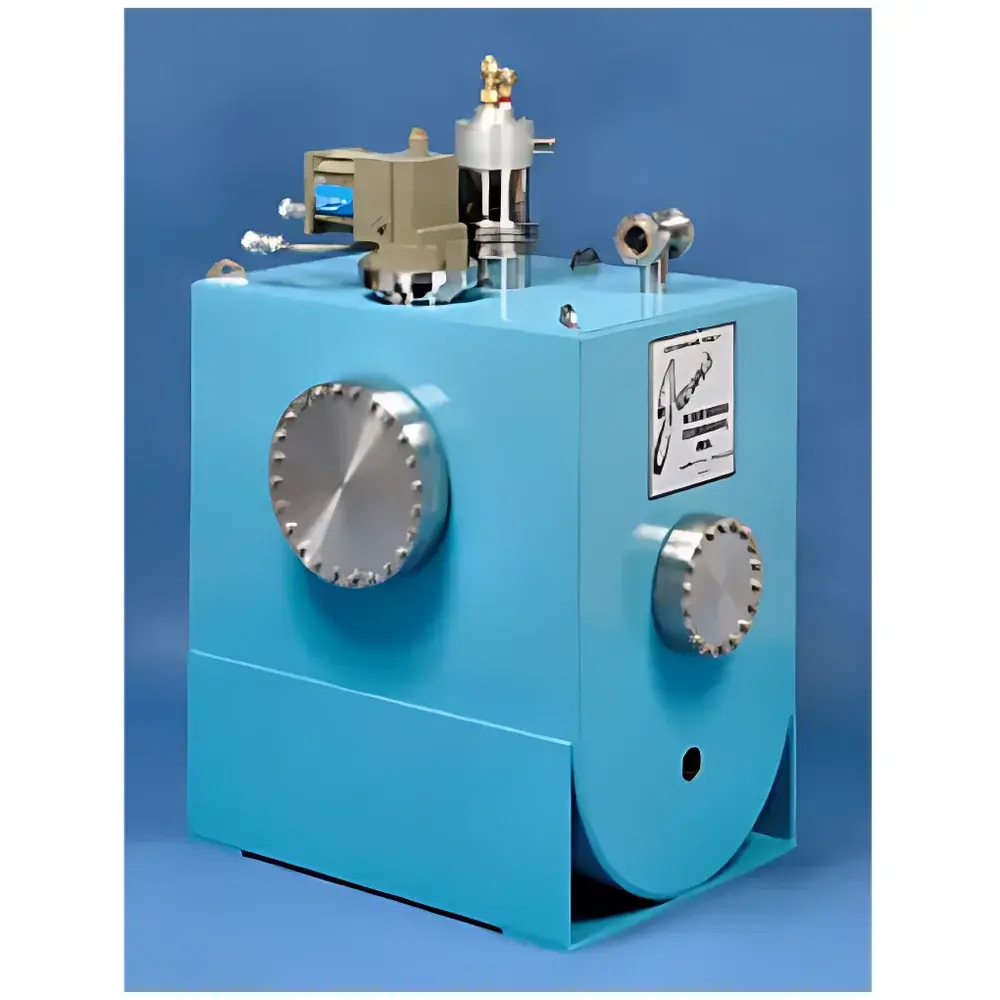
Lake Shore Room Temperature Bore Superconducting Magnet System
| Brand | Lake Shore |
|---|---|
| Origin | USA |
| Manufacturer Type | Authorized Distributor |
| Product Origin | Imported |
| Model | Room Temperature Bore Superconducting Magnet |
| Magnetic Field Range | 6–14 T |
| Bore Temperature | Ambient (300 K) |
| Sample Environment Options | Ambient Atmosphere, Vacuum, Ultra-High Vacuum (UHV), Cryogenic Insert Compatible (1.5 K – 800 K) |
| Optical Access | Optional Viewports |
| Bore Diameter | Customizable |
Overview
The Lake Shore Room Temperature Bore Superconducting Magnet System is a high-field, compact magnet platform engineered for precision magnetic property characterization under controlled thermal and environmental conditions. Unlike conventional cryogen-cooled superconducting magnets with cold bores, this system features a warm-bore architecture—maintaining the magnet’s central aperture at ambient temperature (≈300 K) while delivering stable, persistent magnetic fields from 6 T to 14 T. This design enables direct integration with externally cooled cryostats, allowing users to insert custom low-temperature probes—including continuous-flow cryostats, sorption-based cryocoolers, or dilution refrigerators—through the bottom of the bore and position them precisely within the homogeneous field region. The warm-bore configuration eliminates thermal stress on optical components and simplifies alignment in magneto-optical experiments, making it especially suitable for magneto-photoluminescence (mPL), Faraday/Kerr rotation spectroscopy, scanning probe microscopy (SPM), and transport measurements requiring simultaneous optical access and high magnetic fields.
Key Features
- Stable, persistent magnetic field generation from 6 T to 14 T with field homogeneity better than ±0.1% over a 10 mm DSV (Diameter Spherical Volume)
- Ambient-temperature bore (300 K) minimizes thermal gradients and enables rapid sample exchange without magnet quench risk
- Customizable bore diameter to accommodate diverse cryostat footprints and optical path requirements
- Integrated mechanical interface for seamless coupling with commercial and custom low-temperature systems (1.5 K – 800 K operational range)
- Optional high-transmission optical viewports (UV-VIS-NIR or IR-grade fused silica, CaF₂, or sapphire) installed radially or axially
- UHV-compatible flange options (CF, ISO-KF) supporting base pressures down to 1×10⁻¹⁰ mbar when paired with appropriate pumping and sealing protocols
- Field control via Lake Shore Model 643 or 648 programmable current supply with analog/digital I/O and IEEE-488 (GPIB) or Ethernet interfaces
Sample Compatibility & Compliance
The system supports a broad spectrum of sample environments without compromising field stability or measurement fidelity. Users may operate samples under ambient atmosphere, mechanical pump-grade vacuum (~10⁻³ mbar), high vacuum (10⁻⁶ mbar), or ultra-high vacuum (≤10⁻¹⁰ mbar), contingent upon chamber selection and pumping configuration. When integrated with certified cryogenic inserts, the platform complies with ASTM E2937 (Standard Practice for Low-Temperature Magnetic Property Measurements) and supports GLP-compliant workflows through audit-trail-enabled field logging. All electrical feedthroughs meet IEC 61000-4-3 immunity standards, and vacuum components conform to ASME BPVC Section VIII and ISO 16063-21 for vibration-sensitive metrology applications.
Software & Data Management
Lake Shore’s M81 Magnet Control Software provides intuitive field ramping, hold, sweep, and persistent mode operation with real-time field monitoring and interlock management. Data acquisition integrates natively with third-party platforms including LabVIEW, Python (via PyVISA), and MATLAB, enabling synchronized capture of magnetic field, temperature, and detector signals. Full compliance with FDA 21 CFR Part 11 is achievable through optional electronic signature modules and time-stamped, encrypted data logs—critical for regulated R&D environments in semiconductor materials development and quantum device qualification.
Applications
- Quantum transport studies (e.g., quantum Hall effect, Shubnikov–de Haas oscillations) using Hall bar or Corbino disk geometries
- Magneto-optical spectroscopy of 2D materials (MoS₂, WSe₂), perovskites, and topological insulators
- AC/DC magnetization hysteresis loop analysis (M–H curves) under variable temperature and field
- In situ magnetic force microscopy (MFM) and spin-polarized scanning tunneling microscopy (SP-STM)
- Calibration of Hall sensors, fluxgate magnetometers, and SQUID reference standards
- Development and validation of magnetic thin-film deposition processes under field-assisted growth conditions
FAQ
Can this magnet be operated without a cryostat?
Yes—the system functions as a standalone high-field source at ambient temperature; cryogenic integration is optional and application-dependent.
What is the typical field stability during long-term holds?
With proper persistent-mode operation and thermal stabilization, field drift is typically ≤10 ppm/hour after initial settling.
Is remote operation supported?
Yes—Ethernet and GPIB interfaces enable full command-and-control via SCPI protocol, supporting integration into automated test benches.
Are there restrictions on maximum sample size or weight?
Maximum allowable sample + probe mass is determined by the selected cryostat’s suspension mechanism and must remain within the magnet’s specified axial load limit (consult mechanical drawings for model-specific values).
Does Lake Shore provide field mapping services?
Yes—comprehensive 3D field mapping (including gradient and homogeneity analysis) is available upon request, delivered with NIST-traceable calibration documentation.



