
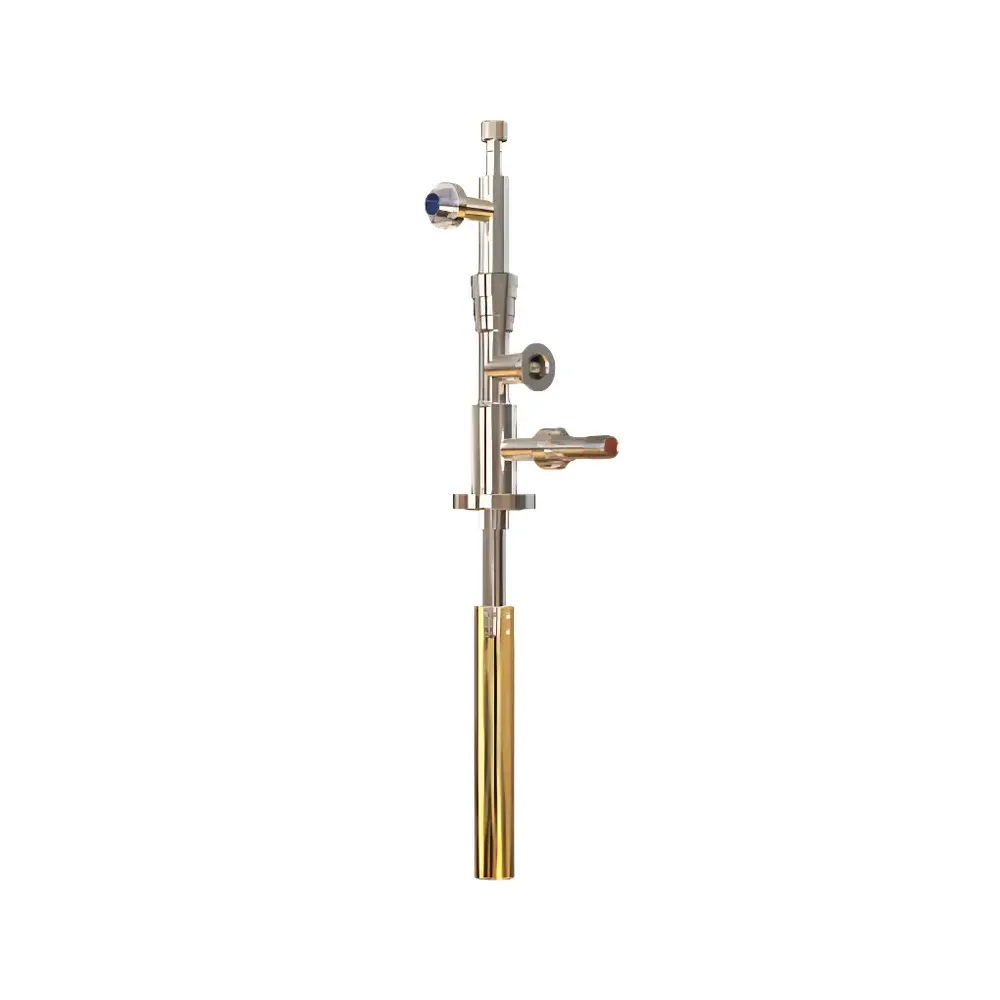
Lake Shore ST-400 Ultra-High Vacuum Cryogenic Thermostat
| Brand | Lake Shore |
|---|---|
| Origin | USA |
| Model | ST-400 |
| Cooling Method | Liquid Helium (with optional RGC helium recirculator) |
| Temperature Range | 2 K to 500 K (ST-400) |
| Base Pressure | ≤1×10⁻¹¹ Torr |
| Temperature Stability | ±50 mK |
| Cool-down Time to 5 K | ≤15 min |
| Sample Environment | High-vacuum or ultra-high vacuum (UHV) chamber |
| Sample Mounting | Customizable sample holders (optical, DC, 4-probe, plug-in) |
| Optical Window Options | X-ray to THz spectral range |
| Electrical Feedthroughs | DC, BNC, SMA, triaxial |
| Initial LN₂ Consumption @ 80 K | 0.1 L/h |
| Liquid Helium Consumption @ 5 K | 0.6 L/h |
| System Mass (excl. transfer lines) | ~4.6 kg |
| Required Initial Pump-down | ~10⁻³ Torr |
Overview
The Lake Shore ST-400 Ultra-High Vacuum Cryogenic Thermostat is a precision-engineered continuous-flow cryostat designed for integration into ultra-high vacuum (UHV) systems operating down to 1×10⁻¹¹ Torr. It employs liquid helium as the primary cryogen delivered via low-heat-leak transfer lines to achieve base temperatures below 4.2 K—typically reaching 2 K with high thermal stability. The ST-400 utilizes a closed-cycle architecture where the cold head and temperature-sensing elements are isolated from the UHV environment; only the sample stage and thermal link enter the vacuum chamber, eliminating the need to bake out or vent the entire system when installing or servicing internal components. Its vertical vacuum port orientation and ConFlat® flange compatibility (CF-35, CF-63, CF-100, etc.) enable seamless integration with standard UHV chambers, load locks, and beamline end stations. Optional integration with the Lake Shore RGC series helium recirculation refrigerators allows fully cryogen-free operation across the full 2–500 K (or 2–800 K for ST-400-H) range—ideal for long-duration transport, magnetotransport, quantum sensing, and spectroscopic experiments requiring minimal operational overhead and consistent thermal history.
Key Features
- UHV-compatible mechanical design with non-outgassing materials (oxygen-free copper, stainless steel 304/316, ceramic insulators) meeting ASTM E595 and ISO 15070 low-total-mass-loss specifications
- Temperature control accuracy of ±50 mK over the full 2–500 K range using Lake Shore Model 335 temperature controller with dual-sensor feedback (silicon diode + Cernox™)
- Modular sample stage architecture supporting interchangeable mounts: optical alignment stages, DC four-terminal platforms, RF-compatible SMA feedthrough arrays, and plug-in carriers for rapid sample exchange without breaking vacuum
- Optical access via customizable windows spanning X-ray (beryllium), UV-VIS (quartz, sapphire), IR (KBr, ZnSe), and THz (high-resistivity silicon) spectral bands—each window sealed with metal gaskets and rated for UHV service
- Electrical feedthrough options include shielded DC leads, 50 Ω BNC, 75 Ω SMA, and triaxial configurations with leakage current <1 fA at 4 K, compliant with low-noise metrology requirements
- Rapid cooldown profile: ≤15 minutes from 300 K to 5 K under standard liquid helium flow conditions (0.6 L/h at 5 K)
Sample Compatibility & Compliance
The ST-400 accommodates solid-state samples with high thermal conductivity—including single crystals, thin films on insulating substrates, epitaxial heterostructures, and nanoscale devices—mounted directly to the copper cold finger or via low-thermal-resistance interface materials (e.g., Apiezon N grease, indium foil). All internal wetted surfaces conform to ASTM F2781 (UHV cleaning standards), and surface treatments meet NASA-STD-6002 outgassing limits. The system supports GLP/GMP-aligned experimental workflows through traceable calibration certificates (NIST-traceable sensor calibrations available), and its electrical architecture complies with IEC 61000-4-5 surge immunity and IEC 61326-1 for laboratory measurement equipment. When operated with the RGC recirculator, it satisfies USP analytical instrument qualification (AIQ) criteria for sustained thermal performance verification.
Software & Data Management
Control and monitoring are enabled via Lake Shore’s CrossBridge™ software suite, which provides real-time PID parameter tuning, multi-zone thermal profiling, and automated ramp-hold-cooldown sequences. All temperature setpoints, sensor readings, heater power outputs, and vacuum interlock statuses are logged with timestamped metadata in HDF5 format—ensuring auditability and compatibility with Python-based analysis pipelines (e.g., SciPy, Pandas). CrossBridge supports 21 CFR Part 11-compliant user access controls, electronic signatures, and change-history tracking when deployed on validated Windows environments. Third-party integration is facilitated through TCP/IP and LabVIEW™ drivers, enabling synchronization with lock-in amplifiers, SQUID magnetometers, or synchrotron timing systems.
Applications
- Quantum transport measurements (Hall effect, Shubnikov–de Haas oscillations, quantum Hall regimes) under high magnetic fields and sub-5-K conditions
- Low-temperature scanning probe microscopy (STM, AFM) requiring vibration-isolated, UHV-compatible thermal anchoring
- Far-infrared and THz spectroscopy of phonon-polaritons, magnons, and topological edge modes
- Single-photon detector characterization (SNSPDs, TES) demanding sub-100-mK stability and electromagnetic shielding
- In situ annealing and defect engineering studies using integrated resistive heating (up to 800 K in ST-400-H variant) under controlled partial pressures
FAQ
Can the ST-400 be operated without liquid helium?
Yes—when paired with an RGC helium recirculation refrigerator, the ST-400 achieves continuous, cryogen-free operation from 2 K to 500 K (or 800 K for the ST-400-H version), eliminating dependence on liquid helium supply chains.
What vacuum pumps are recommended for achieving 1×10⁻¹¹ Torr?
A combination of turbomolecular pumping (≥800 L/s) backed by a dry scroll pump, followed by activation of a non-evaporable getter (NEG) pump and cryopanels at 10 K, is required to reach and maintain base pressure.
Is the ST-400 compatible with magnetic fields above 9 T?
Yes—the ST-400 platform is non-magnetic (Cu, SS316, Ti alloys) and has been successfully deployed in 12-T superconducting magnets; custom radiation shields and thermal anchoring paths can be optimized for high-field thermal load management.
How is temperature uniformity across the sample verified?
Uniformity is characterized using calibrated multi-point sensor mapping (±0.1 K resolution) and confirmed per ASTM E220 methodology; typical radial gradients across a 10-mm-diameter sample area are <±20 mK at 4.2 K.
Does Lake Shore provide installation support and UHV bakeout protocols?
Yes—comprehensive commissioning includes on-site UHV leak checking, bakeout supervision (up to 150 °C), residual gas analysis (RGA) validation, and operator training aligned with ISO/IEC 17025 laboratory competence requirements.



