
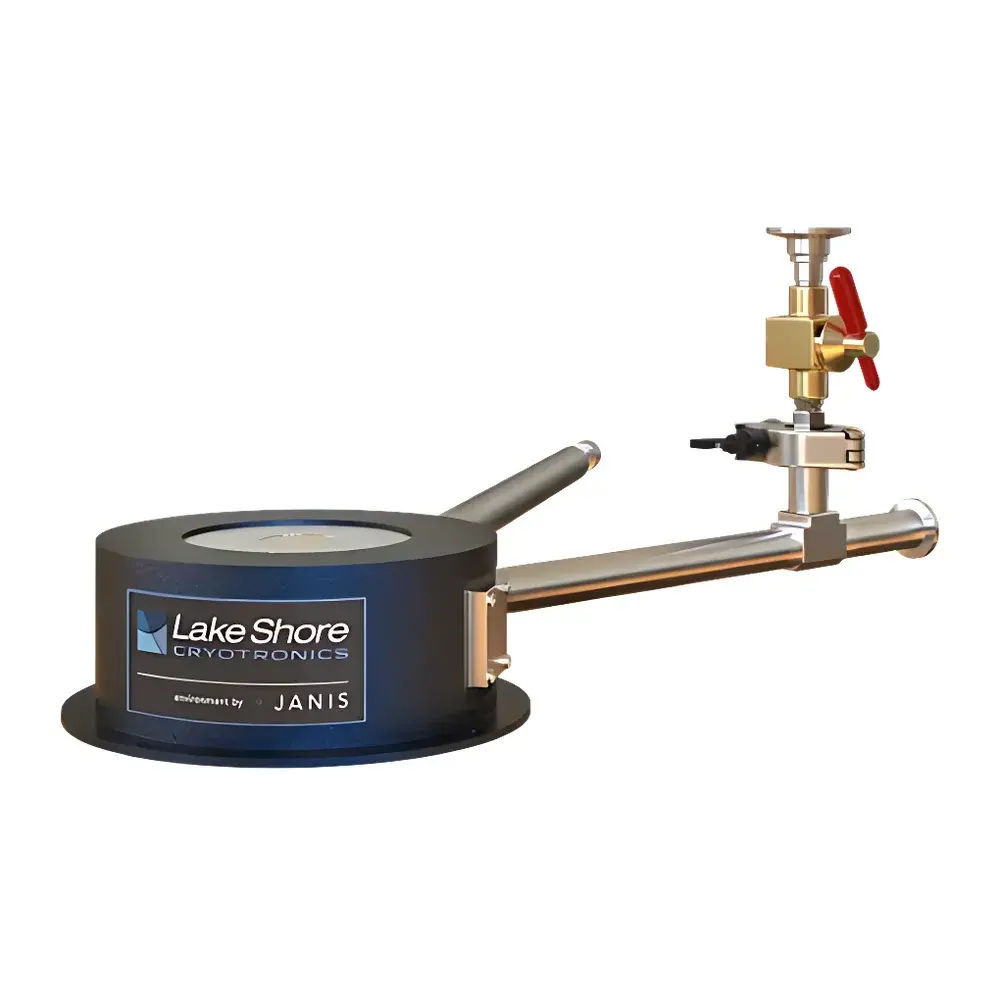
Lake Shore ST-500 Low-Vibration Microscopic Cryogenic Thermostat
| Brand | Lake Shore |
|---|---|
| Origin | USA |
| Model | ST-500 |
| Temperature Range | 3.5 K to 475 K |
| Sample Environment | High Vacuum (1×10⁻⁵ Torr typical) |
| Vibration Level | ±15 nm RMS |
| Working Distance | As low as 1 mm |
| Cool-down Time | ~30 min to 5 K |
| Thermal Stability | ±50 mK |
| Optional Vacuum Extensions | LGV Large Vacuum Shroud, Superconducting Magnet & Electromagnet Integration Kits |
| Optical Window Options | X-ray to THz transmission range |
| Electrical Feedthrough Options | DC, BNC, SMA, Triaxial |
Overview
The Lake Shore ST-500 Low-Vibration Microscopic Cryogenic Thermostat is an engineered solution for high-resolution optical microscopy under precisely controlled cryogenic conditions. Designed specifically for micro-Raman spectroscopy, micro-photoluminescence (micro-PL), cathodoluminescence, and other near-field optical techniques, the ST-500 integrates ultra-low mechanical vibration performance with sub-millimeter working distance and vacuum-compatible sample environments. Its operation relies on continuous-flow cryogenics—either liquid helium or helium gas recirculation via compatible RGC systems—enabling stable, long-duration experiments without liquid helium dependency when paired with a closed-cycle refrigerator. The thermostat’s core architecture minimizes thermal drift and acoustic coupling, achieving ±15 nm RMS vibration amplitude at base temperature, critical for diffraction-limited imaging and nanoscale spectral mapping. With a minimum objective-to-sample working distance of just 1 mm, the ST-500 maintains compatibility with high-numerical-aperture (NA) microscope objectives while preserving optical throughput and alignment stability.
Key Features
- Temperature range from 3.5 K to 475 K (ST-500) or 6 K to 475 K (ST-500-C variant), with thermal stability better than ±50 mK over extended measurement periods
- Ultra-low vibration platform: <12 nm RMS typical vibration magnitude; <2 nm/min positional drift averaged over 2 hours at 4 K
- Vacuum sample environment maintained at ≤1×10⁻⁵ Torr during operation, supported by initial pump-down to ~1×10⁻⁴ Torr
- Top-access sample loading: enables rapid exchange without dismounting the thermostat from the microscope stage or breaking vacuum in auxiliary chambers
- Modular vacuum extension options—including LGV (Large Vacuum Shroud) and custom bore adapters—for integration into superconducting magnet bores (e.g., 10–16 mm ID) or electromagnet pole gaps
- Flexible optical path configuration: transmission geometry support with interchangeable window materials spanning X-ray, UV–Vis–NIR, mid-IR, and THz spectral ranges
- Electrical interfacing versatility: standardized feedthroughs for DC, BNC, SMA, and triaxial connections; optional four-probe, plug-in, and optically transparent electrical sample stages
Sample Compatibility & Compliance
The ST-500 accommodates solid, thermally conductive samples—including single crystals, thin films, 2D materials, semiconductor wafers up to 150 mm diameter (with LGV option), and multi-sample arrays. All sample stages are machined from high-purity oxygen-free copper or aluminum alloys to ensure uniform thermal anchoring and minimal thermal lag. The system complies with standard laboratory vacuum safety practices per ASTM E509 and ISO 27893 for cryogenic vacuum equipment. When configured with RGC-compatible interfaces and digital temperature controllers (e.g., Lake Shore Model 336 or 350), the ST-500 supports audit-ready temperature logging aligned with GLP/GMP documentation requirements. While not inherently FDA 21 CFR Part 11 compliant, its digital I/O and Ethernet-enabled controllers permit integration into validated data acquisition workflows with appropriate software-level validation protocols.
Software & Data Management
Lake Shore’s CrossBridge™ software provides native control of ST-500 temperature ramping, hold profiles, and real-time monitoring of sensor outputs (Cernox™, RuO₂, or diode-based). It supports synchronized triggering with external instruments—including spectrometers, lock-in amplifiers, and AFM controllers—via TTL, analog voltage, or TCP/IP commands. Data export conforms to HDF5 and CSV formats for interoperability with Python (NumPy/Pandas), MATLAB, and Igor Pro. All temperature setpoints, sensor readings, and timestamped event logs are stored with metadata including vacuum pressure, cooling power, and system status flags—facilitating traceable experiment replication and regulatory review.
Applications
- Micro-Raman and micro-PL characterization of quantum dots, transition metal dichalcogenides (TMDs), and perovskite semiconductors across phase transitions
- Low-temperature cathodoluminescence mapping of plasmonic nanostructures and photonic crystals
- In-situ magneto-optical studies under high magnetic fields (up to 12 T) using integrated magnet-compatible variants
- THz time-domain spectroscopy (THz-TDS) of correlated electron systems requiring sub-10 K stability and minimal vibrational noise
- Quantum transport measurements combined with optical excitation, enabled by multi-port electrical + optical access
- Long-duration photostability testing of novel luminescent materials under cryogenic aging conditions
FAQ
Can the ST-500 operate without liquid helium?
Yes—when coupled with a Lake Shore RGC series helium recirculation refrigerator, the ST-500 achieves fully cryogen-free operation from 3.5 K to 475 K.
What is the maximum sample size supported in standard configuration?
Standard mounting accommodates samples up to 25 mm in diameter; the LGV shroud option extends capacity to 150 mm wafers or multiple smaller specimens.
Is the ST-500 compatible with inverted microscopes?
Yes—the modular design allows vertical, horizontal, or inverted orientation; optical path alignment is preserved via kinematic mounting and adjustable tilt compensation.
How is temperature calibrated and verified?
Each unit ships with NIST-traceable calibration certificates for primary sensors; in situ verification is performed using Lake Shore’s certified reference standards and cross-sensor redundancy protocols.
Are custom window materials available beyond standard fused silica or CaF₂?
Yes—custom windows including sapphire, diamond, polyethylene (for THz), and silicon nitride membranes can be specified during ordering to match spectral and mechanical requirements.



