
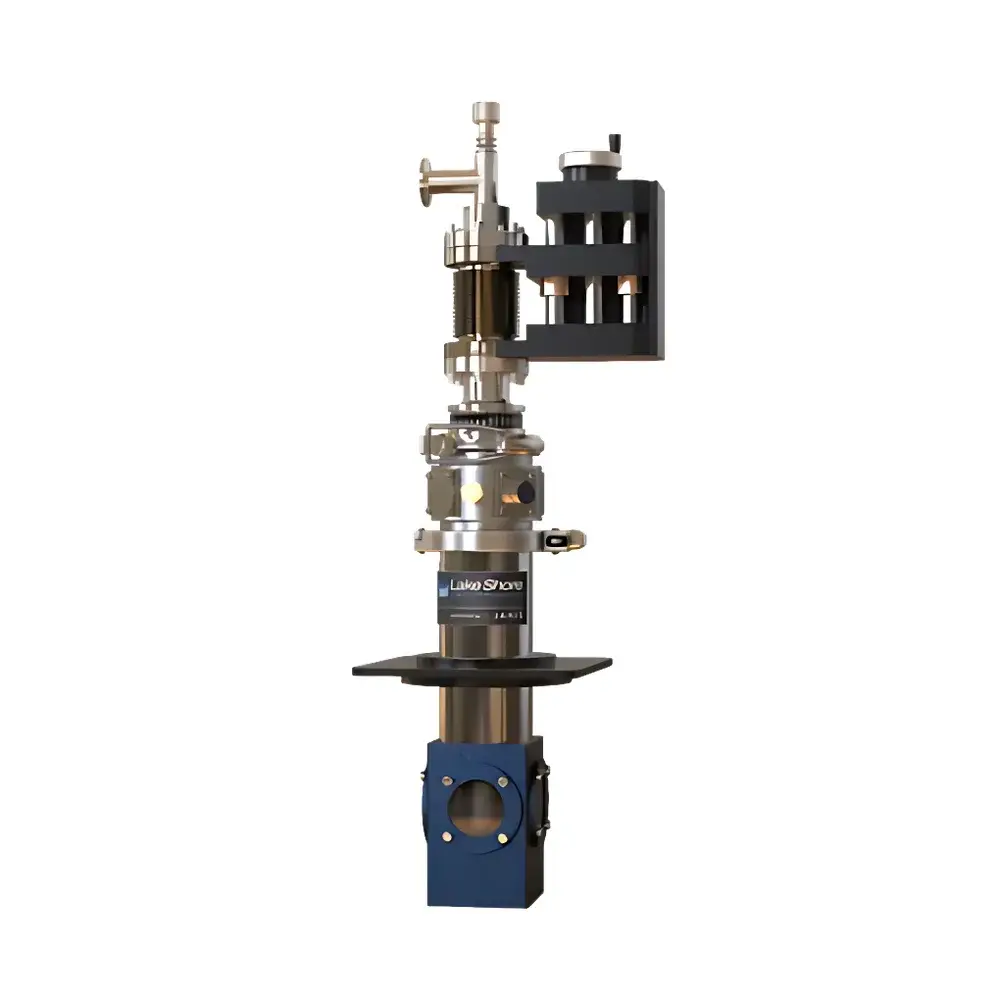
Lake Shore STVP-FTIR / ST-FTIR / VPF-FTIR Cryogenic Thermostat for FTIR Spectroscopy
| Brand | Lake Shore |
|---|---|
| Origin | USA |
| Manufacturer Status | Authorized Distributor |
| Origin Category | Imported |
| Model | STVP-FTIR / ST-FTIR / VPF-FTIR |
| Quotation | Upon Request |
| Temperature Range | 2 K to 500 K (STVP/ST), 65 K to 500 K (VPF) |
| Cooling Method | Liquid Helium (STVP/ST), Liquid Nitrogen (VPF) |
| Sample Environment | Flowing Vapor (STVP), High Vacuum (ST, VPF) |
| Temperature Stability | ±50 mK |
| Cool-down Time | ≤15 min to 5 K (STVP/ST), ≤15 min to 77 K (VPF) |
| Optical Access | Four Configurable Windows |
| Window Material Options | CaF₂, BaF₂, Sapphire, Polyethylene, Mylar, Silicon, Germanium (covering Far-IR to X-ray) |
| Translation Stage Travel | 51 mm |
| Sample Holder | 3-Position Rotatable Mount |
| Mounting Interface | Standard ISO-KF or CF Flange |
| Compatibility | Commercial FTIR Spectrometers (Bruker, Thermo Fisher, PerkinElmer, Nicolet) |
| Optional Accessories | Electrical Feedthroughs (DC, BNC, SMA, Triaxial), Custom Sample Stages (4-Probe, Plug-in, Optical), Vacuum-Compatible Thermometry (Cernox®, RuO₂, Diode) |
Overview
The Lake Shore STVP-FTIR, ST-FTIR, and VPF-FTIR cryogenic thermostats are purpose-engineered optical cryostats designed for integration with commercial Fourier Transform Infrared (FTIR) spectrometers. These systems operate on well-established cryogenic principles—utilizing either liquid helium (STVP, ST) or liquid nitrogen (VPF) as the primary coolant—and deliver precise, stable, and reproducible temperature control across broad operational ranges (2–500 K). The STVP series employs a flowing-helium vapor bath configuration, enabling high thermal uniformity and rapid thermal equilibration; the ST and VPF models operate under high vacuum (<10⁻⁵ Torr), minimizing conductive and convective heat loads to maximize measurement fidelity in low-noise spectroscopic applications. Each model integrates a motorized linear translation stage (51 mm travel) and a three-position rotatable sample mount—both critical for repeatable alignment of solid, powder, or thermally conductive samples within the IR beam path. The modular flange interface supports direct mounting to standard FTIR sample compartments, including evacuated and purged configurations, while four independently configurable optical ports accommodate transmission, reflection, or ATR geometries.
Key Features
- Temperature range spanning 2 K to 500 K (STVP/ST) or 65 K to 500 K (VPF), with stability better than ±50 mK over extended acquisition periods
- Optimized thermal architecture: STVP uses flowing-helium vapor for fast cooldown (≤15 min to 5 K); ST and VPF rely on high-vacuum isolation for minimal background radiation and long hold times
- Integrated 51 mm linear translation stage with micrometer-level repeatability for precise sample positioning relative to the IR beam
- Three-position rotatable sample holder—enabling sequential measurement of multiple specimens or angular-dependent spectral acquisition without breaking vacuum
- Four optical access windows with standardized threading (e.g., CF-35 or ISO-KF40), supporting interchangeable window materials (CaF₂ for UV–mid-IR, polyethylene for far-IR, silicon/germanium for THz, beryllium for X-ray)
- Direct compatibility with RGC-series closed-cycle helium refrigerators—enabling fully cryogen-free operation for STVP and ST models across the full temperature range
- Compact, lightweight design: STVP (~7 kg), ST (~10 kg), VPF (~3.3 kg)—optimized for benchtop integration without structural reinforcement
Sample Compatibility & Compliance
These thermostats accommodate a wide variety of sample forms—including single crystals, thin films, pressed pellets, powders, and small-volume liquids—provided they exhibit adequate thermal conductivity for efficient coupling to the cold finger or sample stage. All models meet vacuum integrity standards per ASTM E595 for outgassing compliance in ultra-high-vacuum environments. The ST and VPF variants achieve base pressures below 10⁻⁵ Torr after bake-out, satisfying requirements for low-background IR measurements per ISO 17025-accredited laboratories. Electrical feedthrough options (DC, BNC, SMA, triaxial) conform to IEC 61000-4-2 for electrostatic discharge immunity and support four-probe resistivity, Hall effect, or dielectric spectroscopy experiments alongside FTIR. Mechanical interfaces comply with ISO 3567 (vacuum flange dimensions) and SEMI F22 (cleanroom-compatible hardware specifications).
Software & Data Management
Lake Shore’s CrossBridge™ software platform provides full remote control of temperature setpoint, ramp rate, hold duration, and stage positioning via Ethernet or USB. The system logs timestamped temperature, pressure, and stage position data at user-defined intervals (down to 100 ms resolution), generating CSV- and HDF5-formatted output compatible with MATLAB, Python (NumPy/Pandas), and LabVIEW. All thermal and positional parameters are traceable through built-in audit trails compliant with FDA 21 CFR Part 11 requirements—including electronic signatures, change history, and role-based access control. When operated with an RGC refrigerator, CrossBridge automatically synchronizes compressor status, cold-head temperature, and helium pressure telemetry—enabling predictive maintenance and uninterrupted multi-day experiments without manual intervention.
Applications
- Low-temperature vibrational spectroscopy of phonon modes in quantum materials (e.g., topological insulators, 2D transition metal dichalcogenides)
- Temperature-dependent analysis of hydrogen-bonding networks in pharmaceutical hydrates and amorphous dispersions (per USP and ICH Q5C guidelines)
- In situ studies of catalytic surface intermediates under controlled thermal and gaseous environments
- Far-IR characterization of collective excitations in superconductors and magnetic insulators
- THz time-domain spectroscopy of carrier dynamics in semiconductor heterostructures
- Correlative cryo-FTIR and cryo-EDS on frozen-hydrated biological specimens
FAQ
Can these thermostats be used with non-Lake Shore FTIR systems?
Yes. Standard ISO-KF and CF flanges ensure mechanical compatibility with Bruker Tensor, Thermo Fisher Nicolet iS50, PerkinElmer Frontier, and other major FTIR platforms. Optical alignment is verified using integrated laser boresighting tools.
Is vacuum pumping required for all models?
The ST and VPF models require high vacuum (<10⁻⁵ Torr) for optimal performance; the STVP operates in flowing-helium vapor and does not require vacuum but may be optionally enclosed for environmental isolation.
What window materials are recommended for far-IR (20–500 cm⁻¹) measurements?
Polyethylene (PE) and Mylar are standard for broadband far-IR transmission; for higher laser damage thresholds, high-resistivity silicon (HR-Si) or diamond windows may be specified.
How is temperature calibrated and certified?
Each unit ships with NIST-traceable calibration certificates for Cernox® sensors (2–400 K) and silicon diodes (1.4–300 K), validated per ISO/IEC 17025:2017 by Lake Shore’s A2LA-accredited metrology lab.
Can electrical transport measurements be performed simultaneously with FTIR?
Yes. Multi-channel DC and AC feedthroughs support simultaneous resistivity, Hall, and dielectric loss measurements without compromising optical access or thermal stability.



