
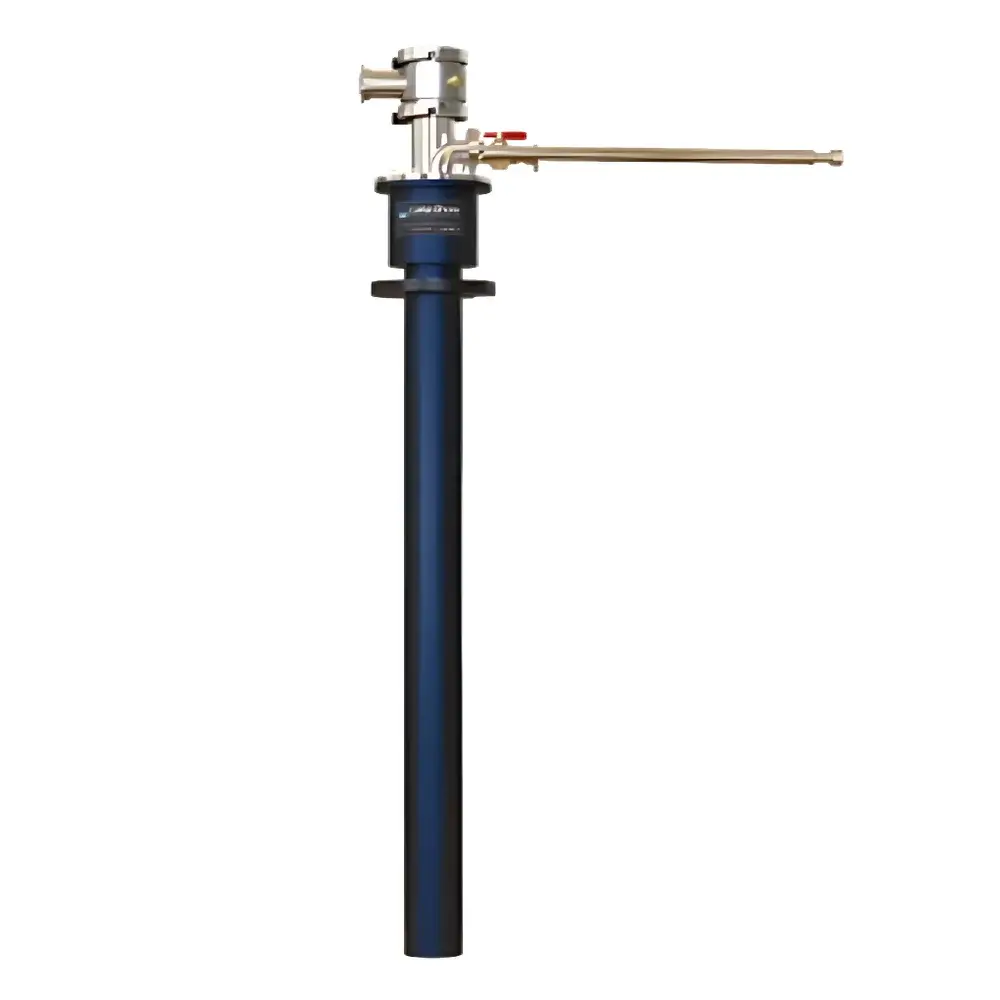
Lake Shore STVP-NMR Continuous-Flow Cryogenic Thermostat
| Brand | Lake Shore |
|---|---|
| Origin | USA |
| Manufacturer Status | Authorized Distributor |
| Origin Category | Imported |
| Model | STVP-NMR |
| Pricing | Upon Request |
| Temperature Range | <2 K (1.5 K in single-point mode) to 325 K (420 K optional) |
| Typical Temperature Stability | ±50 mK |
| Sample Environment | Continuous-flow helium vapor |
| Cooling Method | Liquid Helium |
| Cool-down Time | 30 min to 5 K |
| Sample Chamber Internal Diameter | 55 mm |
| Installation Orientation | Vertical (required below 4.5 K) |
| Liquid Helium Consumption | 0.5 L (from RT to 4.2 K) |
| Approx. Weight (unit only) | 7 kg |
| Approx. Shipping Weight | 79 kg |
| Approx. Shipping Dimensions | 1905 × 990.6 × 431.8 mm |
| Compatibility | Optimized for 89 mm bore NMR magnets, customizable for other bores |
Overview
The Lake Shore STVP-NMR Continuous-Flow Cryogenic Thermostat is a precision-engineered cryogenic sample environment system designed specifically for high-field nuclear magnetic resonance (NMR) spectroscopy and related low-temperature magnetic resonance applications. It operates on the continuous-flow principle, delivering temperature-controlled helium vapor directly to the sample region via an efficient liquid helium transfer line. Unlike bath or closed-cycle systems, the STVP-NMR maintains the sample in a dynamic, laminar flow of cold helium gas—ensuring rapid thermal equilibration, minimal thermal gradients, and high reproducibility across repeated temperature sweeps. Its compact 55 mm internal bore and minimal radial footprint allow seamless integration into standard 89 mm bore superconducting NMR magnets without obstructing shimming coils, RF probes, or field homogeneity. The system supports operation from sub-2 K (achieving 1.5 K in single-point mode) up to 325 K (extendable to 420 K with optional heater configuration), making it suitable for quantum material characterization, spin dynamics studies, and variable-temperature NMR of paramagnetic species.
Key Features
- Continuous-flow helium vapor cooling architecture enabling precise, stable, and responsive temperature control across a broad range (1.5 K – 420 K)
- Top-loading sample insertion design for rapid sample exchange without magnet disassembly or cryostat venting
- Optimized mechanical integration for 89 mm bore NMR magnets; custom configurations available for alternative bore sizes
- Compatible with RGC-series helium recirculation refrigerators for fully cryogen-free operation—eliminating liquid helium dependency during extended experiments
- Modular sample stage interface accommodating multiple probe types: optical, electrical (DC/BNC/SMA/triaxial), and multi-probe configurations including four-terminal and plug-in holders
- Sub-50 mK temperature stability under steady-state conditions, verified via calibrated carbon-glass sensor and PID-controlled vapor pressure regulation
- Vertical orientation requirement below 4.5 K ensures optimal helium phase separation and vapor flow uniformity
Sample Compatibility & Compliance
The STVP-NMR accommodates a wide variety of sample forms—including powders, single crystals, thin films, liquids, and frozen solutions—mounted in user-supplied NMR sample tubes or custom holders inserted into the 55 mm-diameter sample chamber. Optical variants are available with bottom-mounted windows fabricated from fused silica, CaF₂, or sapphire to support transmission measurements from X-ray through THz spectral regions. Electrical variants integrate feedthroughs compliant with vacuum integrity standards (≤1×10⁻⁹ mbar leak rate) and include shielded DC, BNC, SMA, and triaxial connectors rated for operation down to 1.5 K. All configurations meet ISO 9001-certified manufacturing protocols and adhere to IEC 61000-6-3 EMC emission limits. When operated with RGC recirculators, the system supports GLP/GMP-aligned workflows requiring audit trails, calibration logs, and instrument interlock verification per FDA 21 CFR Part 11 guidelines.
Software & Data Management
Temperature setpoint, ramp rate, hold time, and sensor readback are managed via Lake Shore’s proprietary CryoSoft™ software suite, compatible with Windows-based host PCs and supporting TCP/IP and USB 2.0 communication. The software provides real-time plotting, automated temperature sweeps, script-driven multi-step protocols, and export to CSV/Excel formats. Integrated data logging records timestamped values from up to eight independent sensors (including primary sample-stage thermometry and secondary vapor-line monitoring). Optional LabVIEW™ drivers and Python API enable integration into custom automation frameworks for high-throughput NMR screening or synchrotron-coupled experiments. All firmware updates and calibration coefficients are digitally signed and version-tracked to ensure traceability in regulated environments.
Applications
- Variable-temperature solid-state NMR of quantum spin liquids and frustrated magnets
- In-situ EPR/NMR correlation studies under ultra-low-field conditions
- THz spectroscopy of phonon–magnon coupling in antiferromagnetic insulators
- Transport property mapping (resistivity, Hall effect, thermopower) at millikelvin temperatures
- Low-T NMR of hyperpolarized nuclei (¹²⁹Xe, ¹³C) in porous media and biological matrices
- Calibration reference for primary thermometry standards (e.g., RuO₂, Cernox™, RhFe) below 4 K
FAQ
What is the minimum base temperature achievable with the STVP-NMR in continuous-flow mode?
The system achieves 1.5 K in single-point mode using optimized vapor pressure control and high-efficiency heat sinking; typical continuous-flow operation starts at <2 K with stable regulation above that threshold.
Can the STVP-NMR be used with magnets having bore diameters other than 89 mm?
Yes—Lake Shore offers custom mechanical adapters and revised cold-finger geometries for 52 mm, 100 mm, and 120 mm bore systems upon request and engineering review.
Is vacuum compatibility maintained during optical window installation?
All optical window variants are sealed using indium wire gaskets and qualified to maintain ≤1×10⁻⁹ mbar base pressure over 10⁴ thermal cycles between 300 K and 4 K.
How does the RGC integration eliminate liquid helium consumption?
The RGC helium recirculator captures, purifies, recondenses, and re-delivers helium vapor—closing the refrigeration loop and reducing net helium loss to trace purge flows only.
What electrical noise specifications apply to the triaxial feedthroughs at 2 K?
Triaxial connectors exhibit 120 dB common-mode rejection ratio (CMRR) at 1 kHz when properly grounded and shielded per Lake Shore’s installation manual.



