
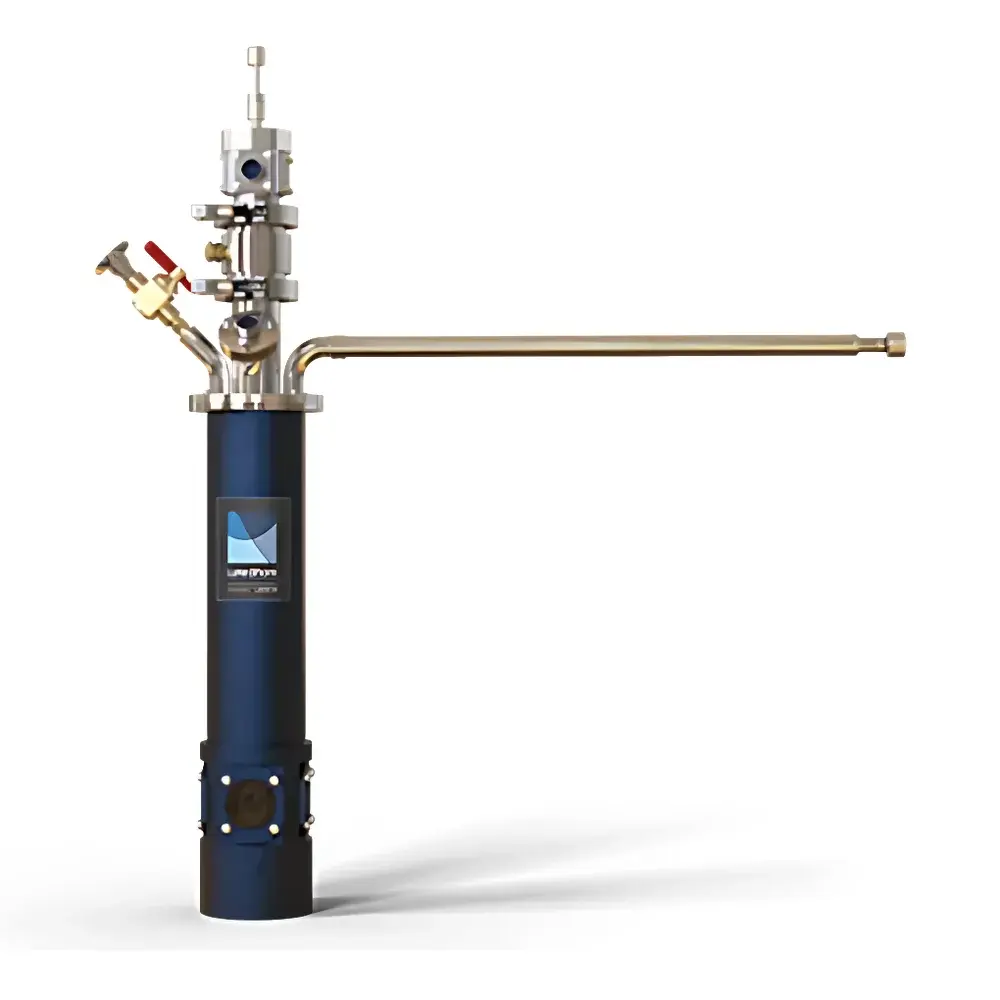
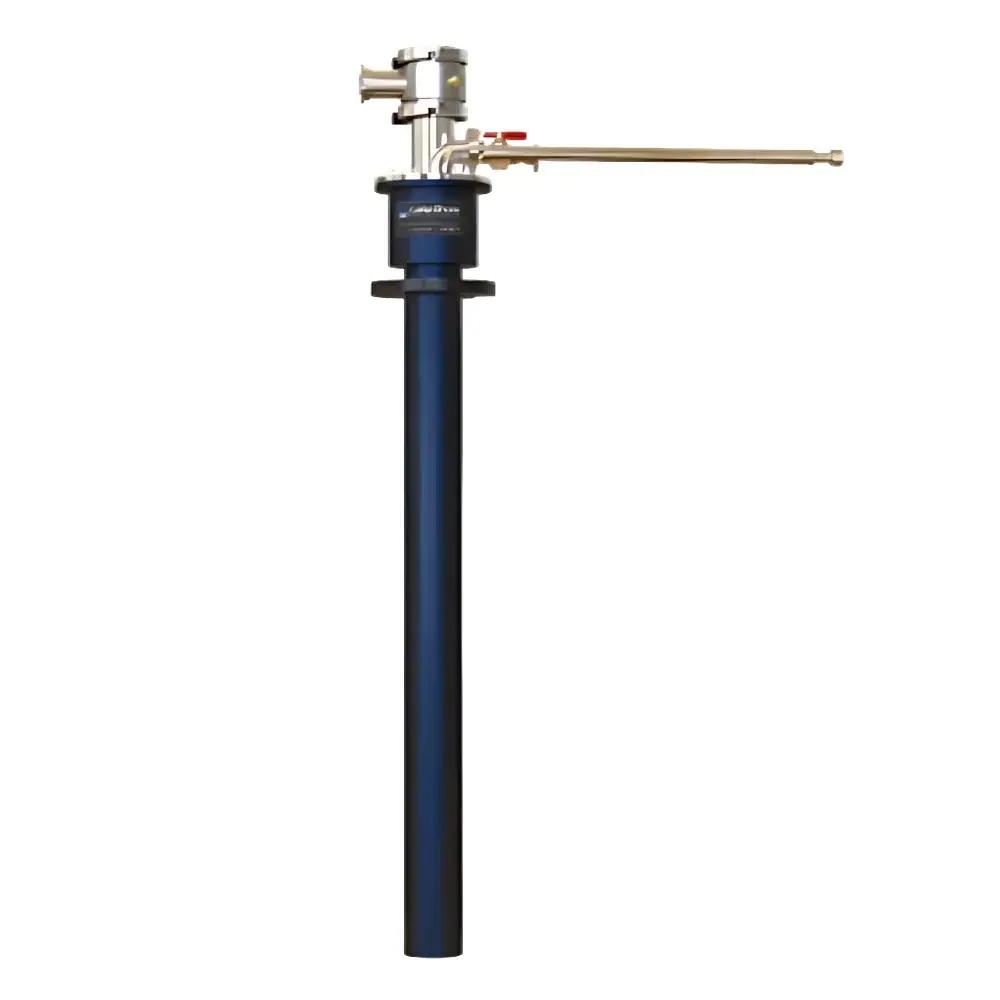
Lake Shore STVP Series Continuous-Flow Cryogenic Thermostat
| Brand | Lake Shore |
|---|---|
| Origin | USA |
| Manufacturer Status | Authorized Distributor |
| Origin Category | Imported |
| Model | STVP Series |
| Pricing | Upon Request |
Overview
The Lake Shore STVP Series Continuous-Flow Cryogenic Thermostat is a precision-engineered, top-loading cryostat designed for high-stability, wide-range temperature control of samples under continuous-flow cooling. Based on the Janis-designed gas-flow cryostat architecture, it cools specimens by directing temperature-regulated helium (or nitrogen) vapor directly onto the sample stage via a high-efficiency transfer line. This design enables rapid thermal equilibration and exceptional temperature uniformity across the sample region. The system operates from sub-2 K up to 420 K—achieving temperatures below 4.2 K through controlled vacuum pumping of the exhaust helium stream—and supports both liquid helium and liquid nitrogen operation. Its modular configuration allows seamless integration with external cryocoolers, notably the RGC helium recirculation refrigeration system, enabling fully cryogen-free operation over the entire temperature range—a critical advantage for long-duration experiments, routine characterization, and resource-constrained laboratories.
Key Features
- Top-loading sample access for rapid, tool-free specimen exchange without breaking vacuum or thermal isolation
- Dual-channel temperature control architecture: integrated calibrated sensor (e.g., Cernox™ or RuO₂) and precision resistive heater enable stable, reproducible setpoint accuracy ±5 mK over full range
- Continuous-flow vapor-cooling principle ensures minimal thermal gradients and fast cooldown—reaching ≤5 K in as little as 15 minutes (STVP-100/FTIR) or 30 minutes (STVP-NMR)
- Modular optical, electrical, and NMR-specific variants: STVP-100 (standard optics), STVP-100-TH (high-temp electrical), STVP-NMR (magnet-bore compatible), and STVP-FTIR (integrated linear translation + rotation stage)
- Optimized thermal anchoring and low-vibration mechanical design suitable for sensitive optical and electronic measurements
- Compatible with RGC-series closed-cycle helium refrigerators for uninterrupted, liquid-cryogen-free operation—reducing operational cost, logistical complexity, and helium dependency
Sample Compatibility & Compliance
The STVP platform accommodates diverse sample geometries—including powders, thin films, single crystals, liquids in capillaries, and mounted devices—within its thermally anchored cold finger assembly. All variants maintain ultra-high vacuum (UHV)-compatible construction (≤1×10⁻⁸ Torr base pressure) and utilize OFHC copper and stainless-steel components compliant with ASTM F88 and ISO 10110-7 surface finish standards for optical interfaces. The STVP-FTIR and STVP-100 models feature AR-coated fused silica or CaF₂ windows (transmission range: 0.18–9 µm) meeting MIL-C-48497A specifications. For regulated environments, the system’s temperature logging and heater control architecture supports audit-ready data traceability when paired with Lake Shore’s CrossBridge™ software, aligning with GLP/GMP documentation requirements and FDA 21 CFR Part 11 electronic record guidelines.
Software & Data Management
Temperature control and monitoring are managed via Lake Shore’s industry-standard CryoSoft™ software suite (v6.0+), which provides real-time PID tuning, multi-zone ramp/soak profiles, and synchronized data acquisition from up to four independent sensors. CrossBridge™ integration enables secure, timestamped export of all thermal parameters—including heater power, sensor resistance, and setpoint history—in CSV or HDF5 format. The software supports scripting (Python API) for automated experiment sequences and is validated for use in ISO/IEC 17025-accredited laboratories. All firmware updates and calibration coefficients are digitally signed and version-controlled to ensure metrological integrity across instrument lifecycles.
Applications
The STVP Series serves as a foundational platform for low-temperature physical property characterization across academic, industrial, and national lab settings. It is routinely deployed in photoluminescence (PL), Fourier-transform infrared (FTIR), Raman, and UV-Vis spectroscopy where spectral resolution depends critically on thermal stability and window transmission fidelity. In condensed matter physics, it enables precise Hall effect, resistivity, magnetotransport, and quantum oscillation measurements down to the millikelvin regime. The STVP-NMR variant is engineered for compatibility with commercial superconducting magnets (e.g., Bruker, JEOL), supporting low-T NMR and muon spin relaxation (µSR) studies. Materials science applications include phase-transition mapping, dielectric spectroscopy, and in-situ annealing under controlled thermal protocols.
FAQ
What cooling media are supported, and how is sub-4.2 K operation achieved?
Liquid helium (LHe) and liquid nitrogen (LN₂) are supported. Sub-4.2 K temperatures are attained by reducing the vapor pressure above the cold stage using a mechanical vacuum pump—effectively lowering the boiling point of helium via the Clausius–Clapeyron relation.
Can the STVP be operated without liquid cryogens?
Yes—when coupled with an RGC helium recirculation refrigerator, the STVP achieves fully cryogen-free operation from <2 K to 420 K, eliminating dependence on LHe/LN₂ deliveries and associated handling infrastructure.
Is the system compatible with third-party spectrometers or magnet systems?
All STVP models feature standardized CF-63 or CF-100 flanges and customizable feedthrough configurations. STVP-FTIR includes pre-aligned optical mounts for Thermo Nicolet, Bruker VERTEX, and Agilent Cary systems; STVP-NMR integrates with 5–12 T superconducting magnets via bore-diameter-matched radiation shields.
What is the typical cooldown time to 5 K?
15 minutes for STVP-100 and STVP-FTIR; 30 minutes for STVP-NMR due to additional thermal mass from magnetic shielding and RF filtering components.
Does Lake Shore provide calibration certificates traceable to NIST?
Yes—each unit ships with a factory calibration report referencing NIST-traceable standards for primary temperature sensors and heater response curves, valid for 12 months under standard operating conditions.



